Film review

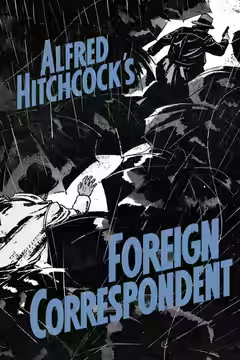
Foreign Correspondent

1940 · Directed by Alfred Hitchcock · 2h 00m

In a sentenceA crime reporter is sent to cover the end of the world and keeps losing his hat

ThrillerMysteryAction

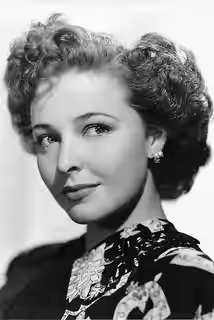
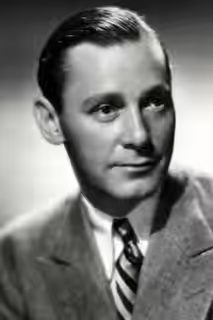
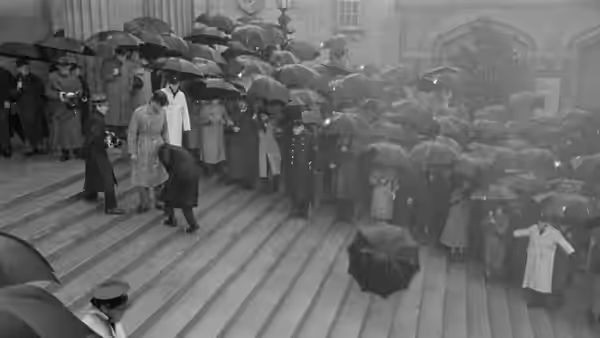
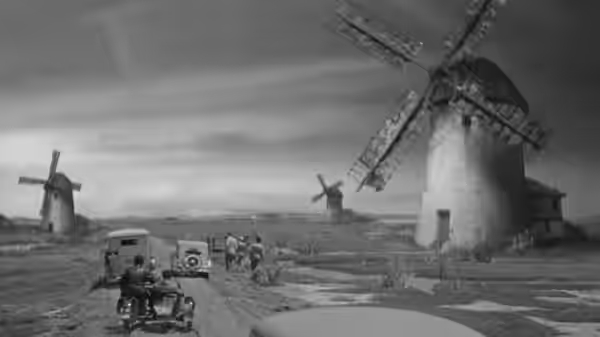
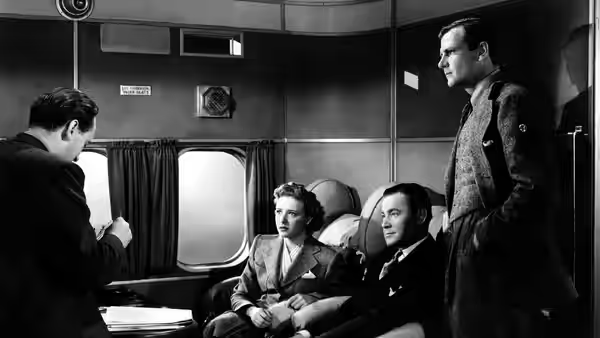
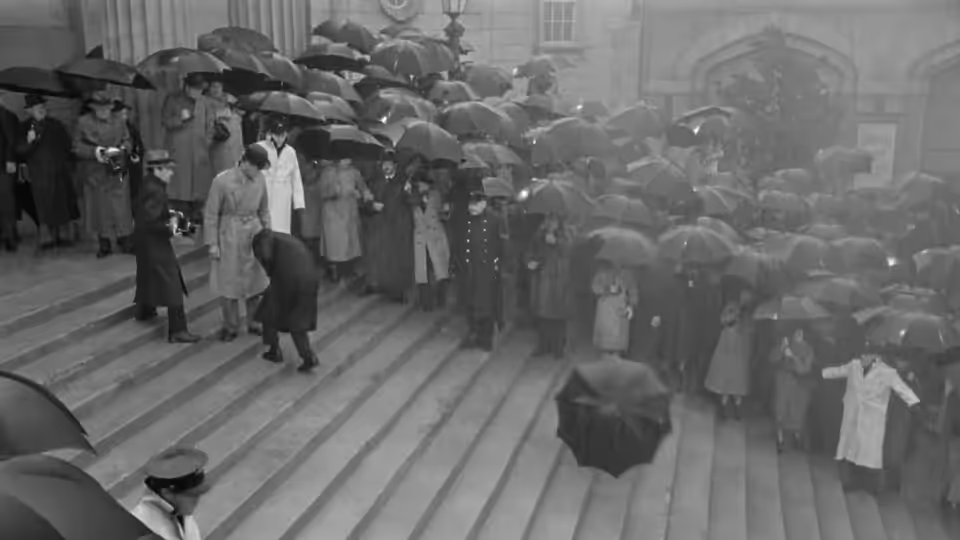
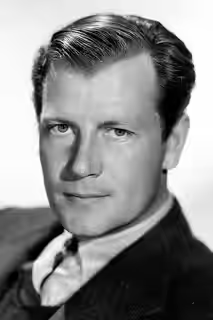
New York, the summer of 1939. John Jones (Joel McCrea) is a crime reporter who knows nothing about Europe, which is why his publisher, Powers (Harry Davenport), sends him there: the foreign desk keeps filing economics, and he wants a man who will ask plain questions about whether there is going to be a war. Under a grander byline, Jones is dispatched to London to interview the Dutch diplomat Van Meer (Albert Bassermann), and falls in with Stephen Fisher (Herbert Marshall), who runs a peace organisation, and Fisher’s daughter Carol (Laraine Day), who takes an instant dislike to him. The story moves to Amsterdam, where on a rain-soaked flight of steps, under a crowd of umbrellas, a shot is fired, and Jones gives chase into flat Dutch farmland towards a windmill whose sails are turning against the wind.

Fi1m review

Hitchcock’s second American film is a chase across a Europe about to go dark, fast and funny and with three set pieces that people still copy. The middle idles and the last speech has dated. Worth your evening regardless.

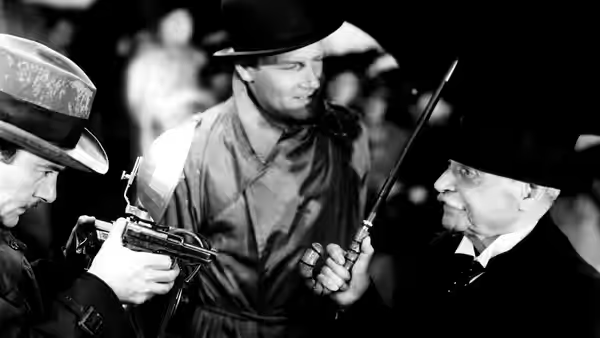
Alfred Hitchcock’s first Hollywood film was Rebecca, a slow gothic in a large house. Foreign Correspondent, made the same year, is the other Hitchcock, the one who likes an ordinary man in over his head and a joke in the middle of a murder. Joel McCrea’s John Jones is a New York crime reporter posted to Europe in the summer of 1939 because his publisher is sick of experts. It is a good, quick, funny 120 minutes with three sequences that have never gone out of fashion, a middle that idles, and a closing speech that belongs to 1940 alone.

The sequences first. A man is shot on a flight of steps in Amsterdam, in pouring rain, and Rudolph Maté photographs it from above, so we see a field of black umbrellas and the killer’s escape is a ripple through them. We had seen the shot in stills a hundred times and it still made us sit up. The sound does it: one flat crack under the hiss of the rain, then the umbrellas moving the wrong way. Then a chase across flat country to a windmill whose sails turn against the wind, and inside it a wordless stretch of Jones on the stairs while Maté looks down through the wooden gears. The creak of the wheel does the work a score usually would, and Alfred Newman has the sense to stay out. Near the end comes a set piece aboard an aeroplane; what happens in it we will not say.

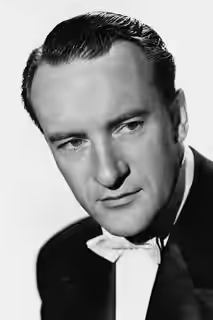
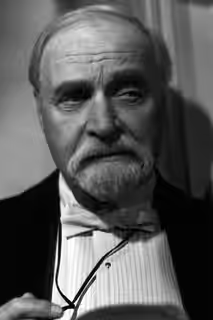
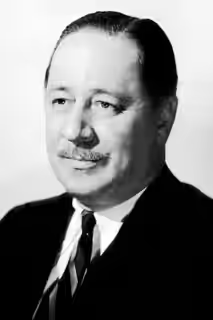
McCrea is not Cary Grant, which is why he was cast. He plays Jones as a man who is good at his job and ignorant of everything else, which is the joke and the point: he asks the plain questions the diplomats have stopped asking. George Sanders, as the British reporter Scott ffolliott, is dry and quick and takes every scene he is let into. Herbert Marshall gives Stephen Fisher, who runs a peace organisation, a soft, tired courtesy. Albert Bassermann plays Van Meer, the Dutch diplomat, with a gentleness that makes his later scenes hard to sit through. Robert Benchley, as the paper’s London man, nurses a hangover and has the best lines.

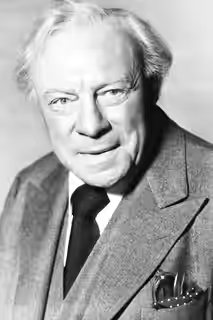
Edmund Gwenn turns up for ten minutes as Rowley, a cheerful Londoner hired to keep an eye on Jones. We laughed at him, at how chatty and pleased with himself he was, and a scene on top of a tower turned the laugh into something else, and we understood we had been set up. It is Hitchcock’s oldest trick. It still works.

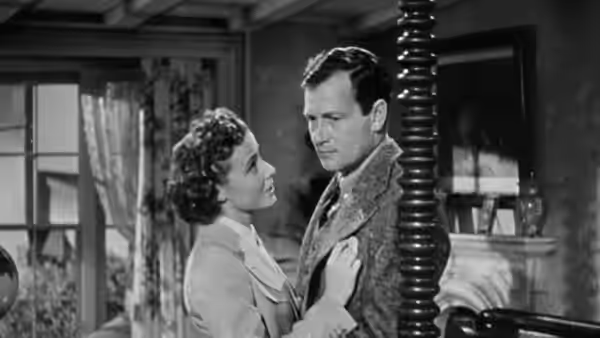
The weaknesses are in the writing. Charles Bennett, Joan Harrison and Richard Maibaum share the screenplay credit, and the romance between Jones and Laraine Day’s Carol Fisher reads as if none of them wanted it. He proposes marriage on a day’s acquaintance and the film treats this as a development rather than a symptom. Day is given nothing to do but be charmed, then hurt. The London stretch marks time in hotel corridors while the plot waits for Holland to matter again, and Dorothy Spencer’s cutting, sharp in the chases, goes slack there. The villains, Eduardo Ciannelli’s Krug among them, are never named as anything more specific than the enemy, which reads now as an odd politeness.

The last two minutes are a speech into a microphone, aimed at America, and critics have winced at it since. We did, a little, and then we looked at the date. The film reached British cinemas on 11 October 1940, when London was being bombed nightly, and it was made to persuade a neutral country that Europe was worth the trouble. It is not subtle about this and, that year, had no reason to be.

This sits below The 39 Steps and The Lady Vanishes, whose villains have faces. Anyone who knows North by Northwest will recognise the plan: a chase across a continent, danger in a flat open landscape where nothing should happen. That film is better. This one drew the map.

Watch it on a wet evening, for the umbrellas and the windmill; forgive it the proposal; and stay for the aeroplane.
Critical consensus AI synthesised

74
Positive
9
Mixed
1
Negative
0

Most critics enjoy Foreign Correspondent as a brisk espionage thriller and one of Hitchcock’s more assured early Hollywood films. The praise gathers around the set pieces: nearly every review names the Dutch windmill sequence, and the rain-soaked assassination under a sea of umbrellas and the effects-heavy plane crash also draw notice. Several see it as a rehearsal for the chase thrillers he made later, and the cast is consistently approved, with Joel McCrea’s mix of confidence and naivety and George Sanders, Edmund Gwenn and Herbert Marshall in support singled out.

The reservations cluster at the ending. The patriotic finale strikes more than one critic as florid, and Time Out finds it embarrassing today and misses the cruelty and pessimism of Hitchcock’s other work. The spread is narrow, running from warm to enthusiastic, with the Los Angeles Times the lone mixed voice, calling it good rather than great and complaining of too much talk about patriotism.

The AV Club
19 February 2014 · A- · Ben Kenigsberg
90

The critic finds the film spectacularly entertaining as a prime example of Hitchcock's breakneck travelogue thrillers and a dry run for later classics like North by Northwest. The rain-soaked assassination scene with the sea of umbrellas and other set pieces like the windmill and plane crash are highlighted as standout moments.

Read the full review →
The New Yorker
31 August 1940
90*

The incidents are extraordinarily exciting and up-to-the-minute, dramatizing current news events as a perfect thriller with Fifth Columnists, assassinations, kidnappings, and a tremendous finale aboard a plane on the day war is declared. Hitchcock's unfailing contribution is the smooth piecing together of these elements.

Read the full review →
Slant Magazine
20 February 2014 · Jordan Cronk
80*

The critic views the film as a key early Hollywood work that foreshadows Hitchcock's later style and scale through its ambitious production and memorable set pieces. The windmill chase, rooftop escape, and plane crash sequence are singled out as impressive examples of cinematic spectacle.

Read the full review →
The Guardian
27 August 2012
75*

The critic describes the film as a breathless yarn with serious intent that soars well beyond mediocrity but just below genius, and argues it deserves a place among Hitchcock's best. They single out its humour and brilliance in staging, along with its clear propagandistic purpose to inspire American audiences about events in Europe.

Read the full review →
Empire
28 April 2006 · Kim Newman
70*

The critic calls it highly-wrought entertainment in the vein of Hitchcock's other thrillers, with the hero getting into scrapes across London and Holland. They single out the windmill sequence, Edmund Gwenn's creepy cameo, and the effects-laden plane crash climax for praise.

Read the full review →
The New York Times
28 August 1940 · Bosley Crowther
70*

The critic finds the film packed with romantic action, melodramatic hullabaloo, comical diversion, and an illusion of momentous consequence. It is high-geared entertainment for those who can take sensationalism without skepticism, with uniformly good cast and excellent photographic sequences like the Dutch windmill.

Read the full review →

Cast

Awards

Academy Awards, 1941

Nominated
Best Art Direction, Black and White
Nominated
Best Cinematography, Black-and-White
Nominated
Best Picture
Nominated
Best Special Effects
Nominated
Best Supporting Actor
Nominated
Best Writing, Original Screenplay

If you liked this, try…

The Lady Vanishes poster88

The Lady Vanishes

1938 · Hitchcock’s British run at the same trick, with a train and a sharper pair of leads.

The Third Man poster92

The Third Man

1949 · Another innocent American in a European city where everyone knows more than he does.

Charade poster

Charade

1963 · Donen borrows the Hitchcock plan wholesale and adds Paris, Hepburn and better clothes.

Ministry of Fear poster

Ministry of Fear

1944 · Fritz Lang’s wartime London, a cake at a fête, and a hero nobody believes.

The Year of Living Dangerously poster

The Year of Living Dangerously

1982 · A foreign correspondent out of his depth, this time in Jakarta, with a better romance.