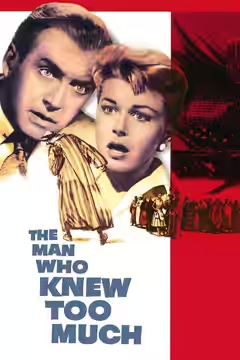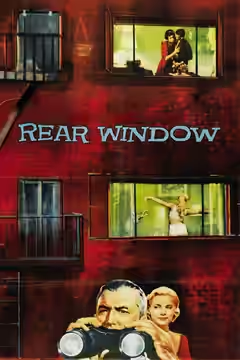
Alfred Hitchcock makes us enjoy watching strangers, then question why we cannot stop. Rear Window and Vertigo remain our strongest reasons to recommend him: patient thrillers that make curiosity and longing uncomfortable.
Fi1m perspective
James Stewart’s Jefferies looks across the courtyard in Rear Window (1954), and we begin checking the neighbours with him. Hitchcock gives us time to notice things before deciding what they mean. Stewart and Grace Kelly keep the film warm enough that this does not become a lecture on bad behaviour. Some neighbours are too neatly reduced to little stories, but the fixed view never becomes tiresome.
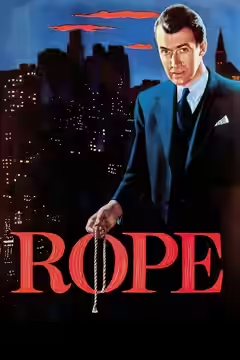
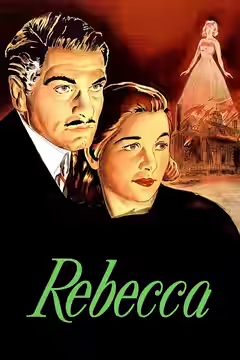
The Lodger (1927) established the wrongly suspected man as a recurring concern; Rebecca (1940) began his Hollywood work. Experimentation continued with Rope (1948), before the sustained run of the 1950s and early 1960s, including North by Northwest (1959) and Psycho (1960). Across that work, viewpoint and the timing of a cut matter more than anyone explaining the danger. Yet the two films we return to most readily concern people who choose to keep looking.
His regular collaborators included cinematographer Robert Burks and writer Alma Reville. Sound matters as much as framing in Rear Window: Franz Waxman’s music makes room for the natural sounds of the courtyard. We listen for clues rather than wait for the score to tell us when to worry. Those sounds help the separate households feel as though they share a real, occupied space.
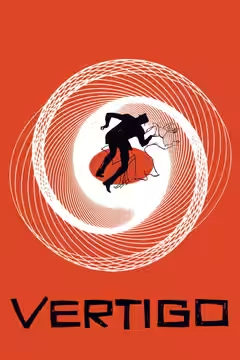
In Vertigo (1958), following someone becomes harder to excuse. Stewart’s detective, Scottie Ferguson, follows Kim Novak’s Madeleine Elster through San Francisco, and Hitchcock lets the fascination develop without much dialogue. We felt uneasy at how readily we accepted the pursuit, because Stewart makes Scottie’s longing recognisable before we have reason to trust it. Bernard Herrmann’s music gives the slow journeys emotional urgency without a conversation arriving to explain the feeling.
The far-fetched mystery in Vertigo is a real weakness, and some of its journeys drag. We would still resist any attempt to speed it up: the time spent watching is what makes the attraction persuasive. Start with Rear Window; leave Vertigo for an evening when there is no need to hurry.
Biography
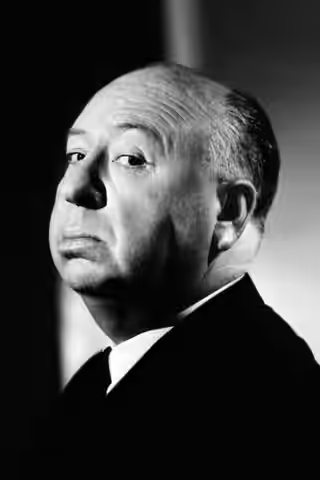
Alfred Hitchcock was an English film director, producer and screenwriter. Born in Leytonstone, London, he began his career in the film industry in 1919 as a title card designer and made his directorial debut with The Pleasure Garden (1925). His early British films, including The Lodger (1927) and Blackmail (1929), established his reputation in the thriller genre.
Hitchcock moved to Hollywood in 1939. He directed and produced a series of acclaimed films, including Rebecca (1940), Rear Window (1954), North by Northwest (1959), Psycho (1960) and The Birds (1963). He made uncredited cameo appearances in many of his films, including Vertigo (1958). His work received multiple Academy Award nominations.