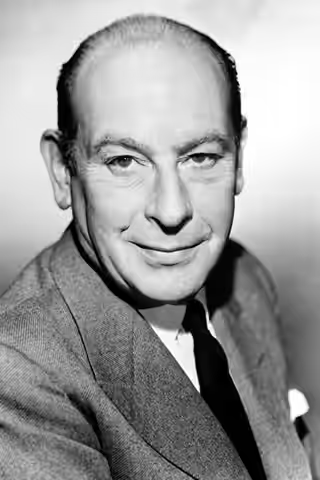
Hardwicke played bishops, villains, pharaohs and fathers with the same unhurried voice, and his trick was never to raise it. He was cast for authority so often that people forgot how gentle he could be; the bishop in Les Misérables is the proof.
Fi1m perspective
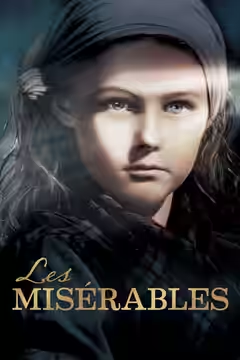
Ten minutes into Les Misérables (1935) a convict robs a bishop, is caught, and hears the bishop tell the police he gave the silver away. Cedric Hardwicke plays Bienvenue as a man settling a household matter before bed. He hands over the candlesticks and goes back upstairs. It is the most famous scene in the book and he plays it as if nobody had told him, and it moved us more than we expected to be moved by something we could have recited in advance. The reason is simple: he does not preach. The line is said in the voice he would use to ask for the lamp to be put out.
He had been on the stage since 1912, much of it in Shaw, and he came to British films in 1931 in his late thirties, with the manner fully formed. Things to Come (1936) gave him Theotocopulos, the artist who stands against progress, and it was not often afterwards that he was asked to be the emotional one. From the late 1930s he worked mostly in Hollywood, and Hollywood knew what it had: a resonant voice and a face that looked as though it disapproved of you. So he was Frollo in The Hunchback of Notre Dame (1939), Mr Kentley in Hitchcock's Rope (1948), Sethi in The Ten Commandments (1956), and dozens of other men of power in literary adaptations and biblical pictures, until The Pumpkin Eater (1964), which was his last.
The complaint against him, then and since, is that he was typecast as the intimidating man, and it is fair as far as it goes. But watch the bishop and then think of Frollo, and the same instrument is doing opposite work. He never underlines. Where another actor would lean on a threat or a blessing, Hardwicke says it once, at conversational pitch, and lets his face do nothing. That stillness reads as kindness in the bishop and as something colder in the villains, and the pictures around him rarely bothered to ask for anything else. The Winslow Boy (1948), as the father who will not let a small injustice lie, is the part most often named when people want to show he could be stubborn and warm at the same time.
He had few illusions about the trade. "I believe that God felt sorry for actors so he created Hollywood to give them a place in the sun and a swimming pool. The price they had to pay was to surrender their talent." He said it as a joke and stayed until the end. Whether he surrendered anything is for others to argue. Start with the bishop, then go looking for the villains, and notice that he plays them exactly the same way.
Biography
Sir Cedric Hardwicke was an English stage and film actor. Born Cedric Webster Hardwicke on 19 February 1893 in Lye, Worcestershire, he trained at the Royal Academy of Dramatic Art and made his London stage debut in 1912. His theatre work included leading roles in productions by William Shakespeare and George Bernard Shaw; he was knighted in 1934 for his contributions to the stage.
Hardwicke appeared in British films from the early 1930s and later worked extensively in Hollywood. His screen credits include Bishop Bienvenue in Les Misérables (1935), Theotocopulos in Things to Come (1936), Frollo in The Hunchback of Notre Dame (1939), Mr Henry Kentley in Rope (1948), and Sethi in The Ten Commandments (1956). He also provided narration for The War of the Worlds (1953) and appeared in episodes of Alfred Hitchcock Presents and The Twilight Zone. He died in New York on 6 August 1964.