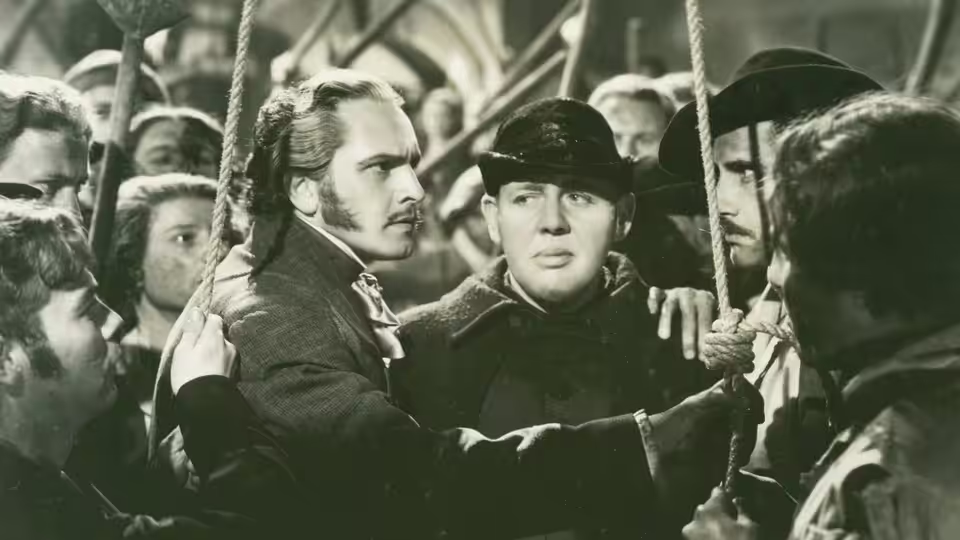
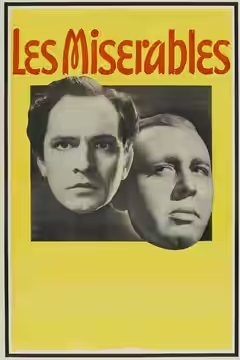
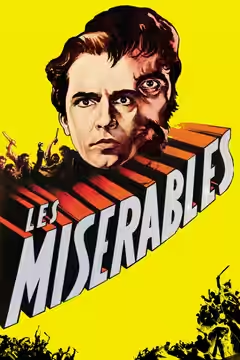
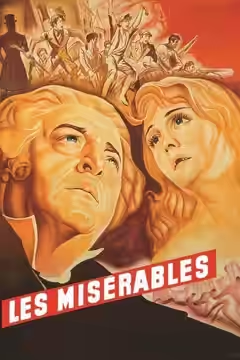
Richard Boleslawski gets Hugo’s brick of a novel down to 108 minutes without losing the story, and Charles Laughton’s Javert is a study of a man frightened of his own mercy. The young lovers are dull and the barricades are over in a hurry.
Victor Hugo’s novel is long enough to prop a door, and anyone who films it has to decide what to throw away. W.P. Lipscomb’s screenplay throws away most of it and keeps the spine: a man sent to the galleys for a loaf of bread, a bishop who forgives him, a policeman who will not. Richard Boleslawski’s film runs 108 minutes, moves quickly, and is at its best whenever Fredric March and Charles Laughton are in the same room. It is a good film with a great performance in it, and the performance is not the lead’s.
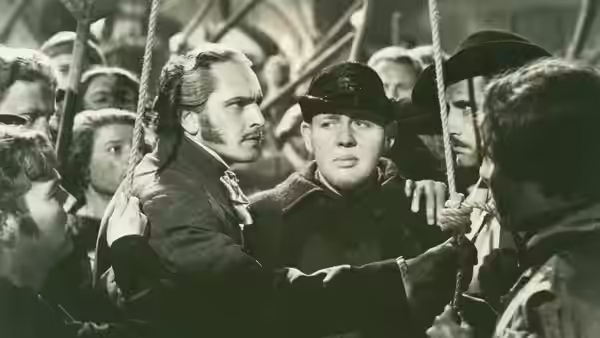
The galleys come first, and Gregg Toland shoots them as a black room full of backs. Men strain at the oars under a lash; the light falls on shoulders and sweat and hardly ever on faces, so that when March’s Valjean finally lifts his head he seems to be coming up from under water. Laughton’s Javert is a guard here before he is an inspector, and the film gives him a short speech about his own parents, criminals both, that explains the rest of his life. He has decided the law is the only wall between him and them. Laughton plays it not as cruelty but as fear: a heavy, damp, exact man holding on to the rulebook with both hands.
The bishop’s house is the scene everyone knows, and Cedric Hardwicke plays it as if he did not. His Bienvenue takes in the convict, is robbed, and tells the police he gave the silver away, all in the tone of a man dealing with a household matter before bed. He hands over the candlesticks and goes back upstairs. We were moved, more than we expected to be by a scene we could have recited in advance, because Hardwicke will not make a sermon of it. Those candlesticks are the one object in the film that means anything, and the film is wise enough to keep bringing them back.
March is a decent Valjean and sometimes a stiff one. Under the greying make-up as the mayor he does a good deal of gazing past the camera, and there are stretches where the man’s goodness looks like tiredness. He is better early, when Valjean is still half an animal, and in the quiet scenes where he sits opposite Javert and tries not to give himself away. Florence Eldridge’s Fantine is on screen briefly and does the work of a longer part; her fall from factory worker to woman on the street is handled without much fuss and lands the harder for it.
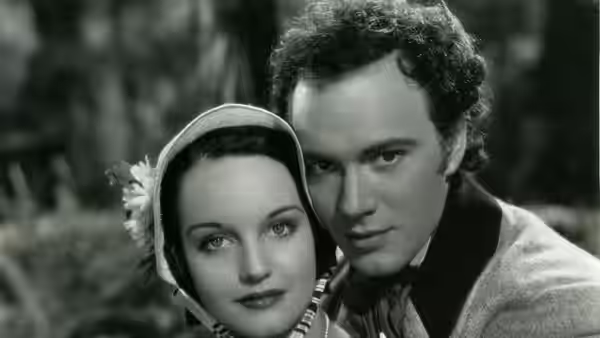
The trouble, as in most versions, is the young people. Rochelle Hudson’s grown Cosette and John Beal’s Marius meet in a garden and say the kind of things lovers say when a script needs them out of the way until the fighting starts. We waited through them, and we were aware of waiting. Frances Drake’s Eponine has more to do and does it with some spirit, but the film has no time to make her count. The student rising, when it comes, is staged well and finished fast. Barbara McLean cuts it as gunsmoke and falling bodies, and Toland’s sewers beneath the streets are wet, black and properly frightening, but the whole passage plays as a summary of a chapter rather than the chapter itself.
Alfred Newman’s score is thick and nearly constant, swelling at every doorway, and the film would be stronger with half of it. Omar Kiam’s costumes do the period plainly and well: convict rags, a mayor’s sober black coat, and Javert’s uniform buttoned to the throat in every weather, which tells you most of what you need to know about him.
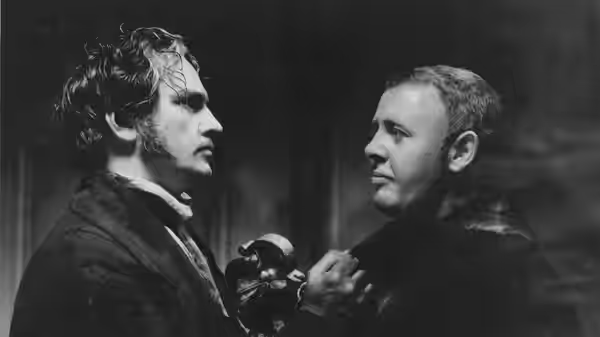
Every adaptation of this book is really a film about Javert, whether or not it admits it, and this one admits it. The final scenes between Laughton and March, which we will not describe, carry more weight than the barricades before them, and Laughton plays them with a stillness he has been saving for an hour and a half. See it for him, for Hardwicke’s ten minutes, and for Toland’s galleys. It is a brisk, handsome, slightly bloodless telling of a story that has survived far worse, and at 108 minutes it asks less of an evening than the book asks of a month.