A Stanislavski-trained actor's director who came to Hollywood and made brisk studio pictures in every genre the front office handed him. On the evidence of Les Misérables, his gift was for two actors facing each other, not for the crowd behind them.
Fi1m perspective
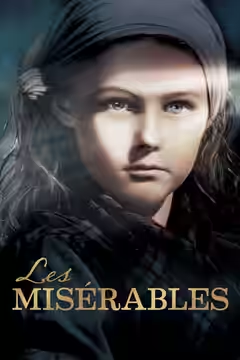
The best thing in Richard Boleslawski's Les Misérables (1935) is not the hero. It is Charles Laughton's Javert, a policeman played as a man frightened of his own mercy, and the film comes alive whenever he and Fredric March are in the same room. That tells you what kind of director Boleslawski was. He was interested in the second lead, the face at the edge of the frame, the person who has to react rather than speak.
The interest was trained into him. He came up as an actor at the Moscow Art Theatre under Stanislavski, directed films in Poland, and reached America in 1922, where he taught acting in New York and founded the American Laboratory Theatre before the studios took him on in 1929. His teaching outlived him as a book, Acting: the First Six Lessons. In Hollywood he was handed whatever was on the slate: Rasputin and the Empress (1932), with all three Barrymores in one picture; The Painted Veil (1934), a Garbo vehicle; Les Misérables; then, in the same year, 1936, the screwball comedy Theodora Goes Wild with Irene Dunne and The Garden of Allah, an early Technicolor picture for Marlene Dietrich and Charles Boyer. He died in January 1937.
That is a run of assignments rather than a career with a shape, and it is hard to find Boleslawski in the material. What we can find is his hand on the actors. Les Misérables is played as an ensemble, and W.P. Lipscomb's screenplay gives it a spine he keeps to for 108 minutes. The reputation says he also staged crowds and battles with unusual clarity, and we would like to believe it, but in the one film of his we have reviewed the barricades are over in a hurry, as if the studio wanted its running time and he obliged. The young lovers are dull, and he does nothing to disguise it.
We will say plainly that the scenes between Laughton and March moved us more than an adaptation this compressed has any right to. Two men who cannot leave each other alone, and a director content to watch them. That is Stanislavski's classroom on a studio floor, and it is what Boleslawski should be remembered for.
He mostly is not. His films get less attention than those of the directors around him, partly because there are too few of them and partly because he never made the one that says his name. Start with Les Misérables, watch Laughton, and then decide whether to go looking for the rest.
Biography
Richard Boleslawski was a Polish theatre and film director, actor and acting teacher. Born Bolesław Ryszard Srzednicki, he trained as an actor at the Moscow Art Theatre under Konstantin Stanislavski before directing in Poland and later emigrating to the United States.
In the 1920s he founded the American Laboratory Theatre in New York and introduced Stanislavski’s methods to American actors and directors. He directed several Hollywood films in the 1930s, including Rasputin and the Empress (1932), The Painted Veil (1934), Les Misérables (1935) and Theodora Goes Wild (1936).
Boleslawski also worked on Broadway and wrote the acting treatise Acting: The First Six Lessons (1933). He died in Los Angeles in 1937.