Film review

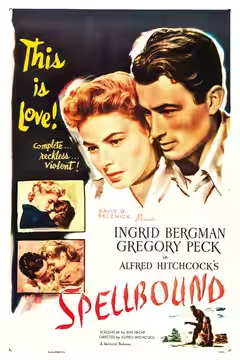
Spellbound

1945 · Directed by Alfred Hitchcock · 1h 51m

In a sentenceThe coldest psychiatrist in Vermont melts over lunch on his first day, and the hospital calls it a diagnosis

DramaCrimeMysteryRomance

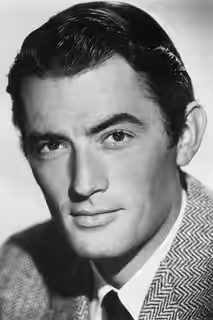
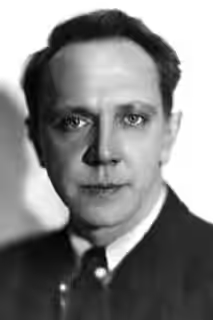
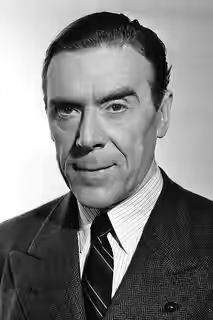
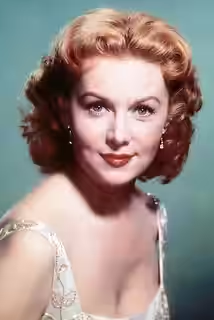
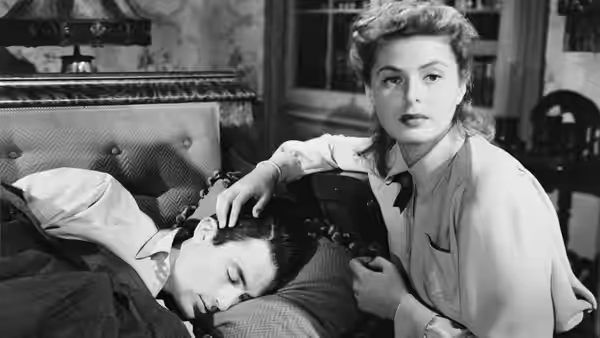
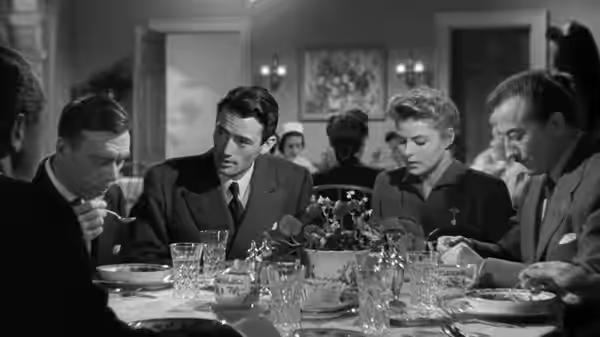
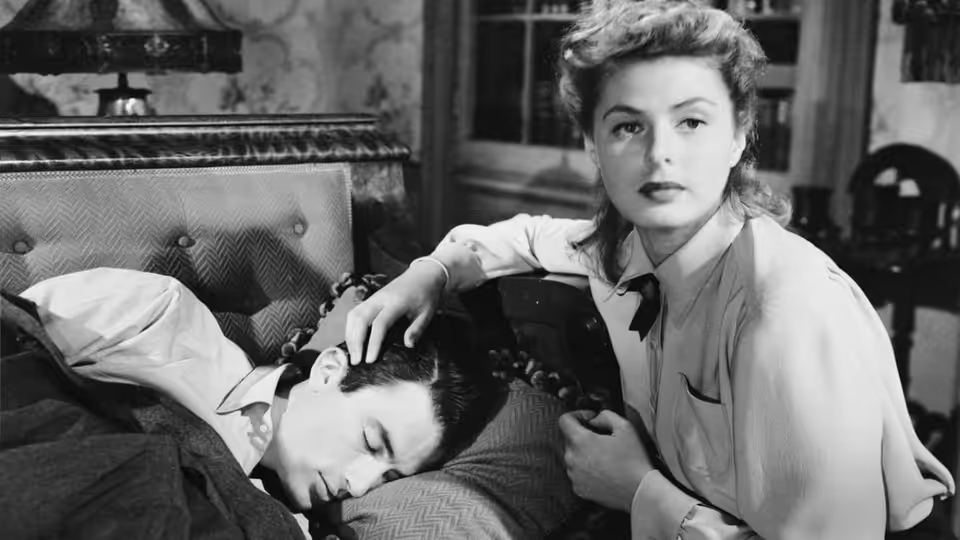
Green Manors, a mental hospital in Vermont, is losing its director, Dr Murchison (Leo G. Carroll). His replacement, the author Dr Anthony Edwardes, is expected any day. Dr Constance Petersen (Ingrid Bergman), a psychoanalyst whom her colleague Dr Fleurot (John Emery) accuses of having no feelings, treats patients like Mary Carmichael (Rhonda Fleming). Then the new man (Gregory Peck) arrives, and Constance has fallen for him by the end of their first lunch. He is strange: the lines a fork draws on a tablecloth make him flinch, and the stripes on a dressing gown bring on a fit. He is not Dr Edwardes. He does not know who he is, the real Edwardes is missing, and Constance decides to treat him rather than turn him in.

Fi1m review

Hitchcock’s psychoanalytic thriller is handsome, sincere and faintly absurd, its science no deeper than a Sunday supplement. It survives because Ingrid Bergman plays every scene as if the love story were the real one, and because Hitchcock can still make a doorway frightening.

Spellbound opens with a card telling us that psychoanalysis is how modern science treats the troubles of the mind. What follows is a romance in a white coat. Ben Hecht and Angus MacPhail have taken a novel by John Palmer and Hilary St George Saunders and made it a story about a woman who cures a patient by falling in love with him, and Alfred Hitchcock has directed it as a thriller. The science is nonsense. The film is good anyway, for most of its 111 minutes, because of Ingrid Bergman and because Hitchcock can still make a doorway frightening.

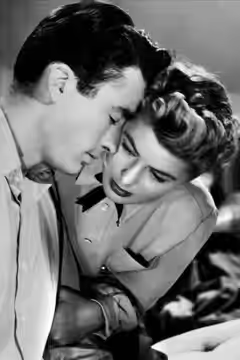
Green Manors is losing its director, Dr Murchison (Leo G. Carroll), and gaining the famous Dr Edwardes, who turns out to be Gregory Peck, looking like an advertisement for a good night’s sleep. Dr Constance Petersen (Bergman), whom her colleagues tease for having a mind and no heart, takes one look at him across the lunch table and the film stops pretending otherwise. That night she goes to his room to talk about a book, and as they kiss George Barnes lays a row of doors over their faces, each swinging open in turn. We rolled our eyes for a second, then stopped, because it is what falling in love feels like and nobody had thought to draw it before.

Peck’s trouble is lines. A fork dragged across a tablecloth, the stripes of a dressing gown, the tiles of a bathroom at night: each one sends him rigid, and Miklós Rózsa’s theremin wails as though the furniture were haunted. Barnes lights Bergman soft and Peck hard, so she glows and he sweats, and when he is handed a glass of milk Barnes shoots from inside it, the white rising to fill the screen. It is a cheap trick and a good one. Hal C. Kern cuts the fits short, rightly, because the film knows they are slightly ridiculous.

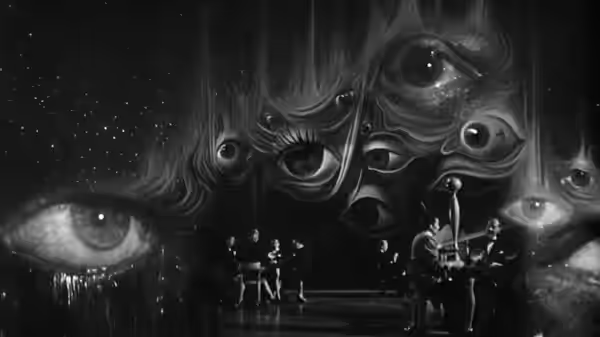
The dream is the famous part and deserves to be, briefly. Salvador Dalí designed it: eyes painted on curtains that a man cuts with enormous scissors, a card game with blank cards, a faceless figure on a sloping roof holding a small bent wheel. Peck narrates it from an armchair while Michael Chekhov, as the analyst Brulov, unpicks it like a crossword. The pictures are strange and the explanation is not, and every symbol means one thing.

Chekhov is the best thing after Bergman. His Brulov shuffles about in a dressing gown, complains about being woken, pours warm milk and says aloud what we were thinking: a psychiatrist who runs off with a possible murderer needs a psychiatrist. Carroll is dry and watchful. Peck is handsome and inert; asked to play a man with no memory, he plays a man with no thoughts, and his panics look like someone about to sneeze. Most critics complain that he and Bergman have no chemistry. We would put it differently: she does all the wanting, and the film is about that, so it works.

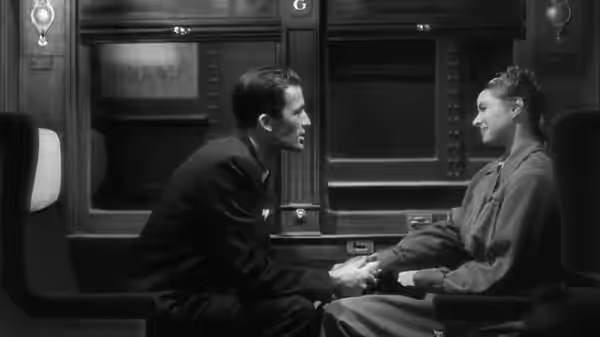
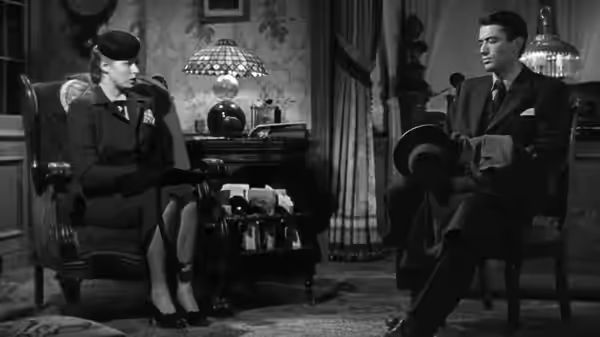
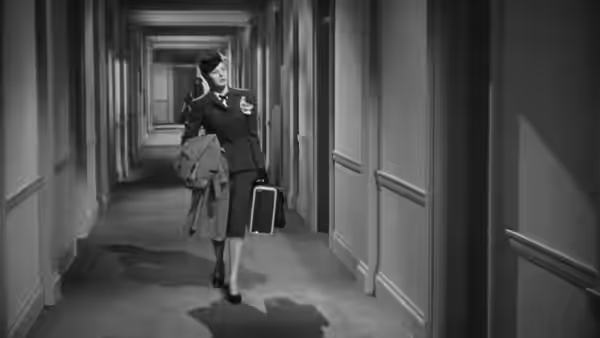
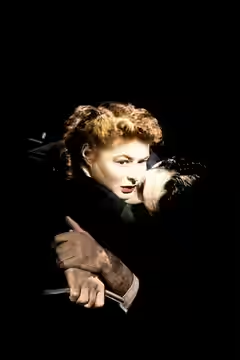
In a New York hotel lobby, Bergman finds the man who has fled her and sits beside him without a word of reproach, and we were moved, more than the script had earned, because she plays the scene with her eyes and lets the dialogue take care of itself. Later, on a train, she invents a marriage for a stranger and is so bad at lying that we laughed aloud and liked her more. Howard Greer dresses her in plain tailored suits, so at her most reckless she looks like the sanest person on screen.

The last stretch has a chase, skiing in front of a painted mountain and a lot of diagnosis at speed. We will not say how it ends, except that the final shot is a proper Hitchcock shot. The film is thinner and sillier than Rebecca (1940), his previous picture for David O. Selznick, and looks like a rehearsal for Notorious (1946), made with Bergman the following year, which does this properly.

See it for her, for Chekhov, for the doors and the milk. Do not see it to learn anything about psychoanalysis, and do not sit next to anyone who has.
Critical consensus AI synthesised

63
Positive
4
Mixed
3
Negative
1

Most critics come down on the film’s side, though few do so without qualification. The praise gathers around Hitchcock’s direction, which is called stylish and suspenseful across the board, and around Ingrid Bergman, whose performance is singled out more often than Gregory Peck’s. The Salvador Dalí dream sequence is mentioned in most reviews, and the production values of a top-budget Selznick picture are noted approvingly.

The reservations cluster on the story, and even the dream sequence is called predictable or disruptive by some. Several reviews find the Freudian plotting thin or silly, the mystery unconvincing and the ending dippy or slack, and more than one mentions friction between producer and director. Empire questions whether Bergman convinces as a psychiatrist and finds little chemistry between the leads. The spread is wide, from a B+ to Collider’s verdict that it is a misfire, if a fascinating one; that is the only outright dismissal.

The New York Times
11 November 1945 · Bosley Crowther
70*

Hitchcock has created his most mature melodrama yet, blending suspense with genuine emotional depth in the story of a woman psychiatrist's devotion to an amnesiac patient. The film stands out for its sensitive portrayal of human affection alongside the director's signature touches of peril and psychological intrigue.

Read the full review →
Time Out
22 September 2014 · HM
70*

The film is a straightforward tale of a psychoanalyst falling for her amnesiac boss who may be a killer, with Hitchcock adding suspenseful twists like parallel lines in Peck's mind. The imagery can be overblown and the Dalí dream sequences predictable, but moments towards the end show the images and ideas working well together.

Read the full review →
Variety
31 December 1944
70*

Selznick and Hitchcock deliver a top-budget psychological mystery with strong production values, suspenseful direction, and a standout surreal dream sequence designed by Salvador Dali. The film maintains pace despite some scientific dialogue, highlighted by fine performances from Bergman and Peck.

Read the full review →
Empire
3 February 2006 · David Parkinson
60*

The review highlights the film's pioneering use of Freudian psychoanalysis and Expressionist visuals, including a notable Salvador Dalí dream sequence, while noting producer interference and censorship issues. It criticizes the lack of chemistry between Ingrid Bergman and Gregory Peck and questions Bergman's suitability as a psychiatrist.

Read the full review →
The New Yorker
27 October 1945 · John McCarten
50*

The review covers Hitchcock's use of Freudian psychiatry in the murder mystery plot. It notes the film's blend of analysis and suspense alongside other current releases.

Read the full review →
The Playlist
31 October 2012 · B+ · The Playlist Staff
83

Praises the strong work in visuals and Bergman's performance but notes the convoluted plot and dippy conclusion.

Read the full review →

Cast

Awards

Academy Awards, 1946

Nominated
Best Cinematography, Black-and-White
Nominated
Best Director
Nominated
Best Picture
Nominated
Best Special Effects
Nominated
Best Supporting Actor
Won
Best Original Dramatic or Comedy Score

If you liked this, try…

Notorious poster92

Notorious

1946 · Hitchcock and Bergman a year later, with the love story doing the thriller’s work properly.

Secret Beyond the Door poster

Secret Beyond the Door

1947 · Fritz Lang’s Freudian gothic: a bride, a locked room and psychiatry as the plot’s engine.

Mirage poster

Mirage

1965 · Gregory Peck loses his memory again, in Manhattan, with a sharper script.

Whirlpool poster

Whirlpool

1949 · Preminger’s hypnosis noir, in which the analyst is the villain rather than the cure.

Memento poster88

Memento

2000 · Amnesia as structure rather than symptom; the tattoos do what the theremin did.