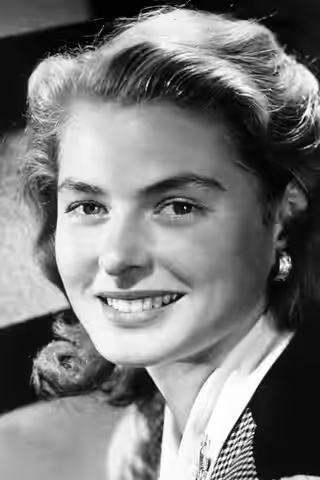
Ingrid Bergman makes a troubled face worth watching long after the dialogue stops. We value the uncertainty beneath her apparent sincerity, and films that give her room to be difficult to read.
Fi1m perspective
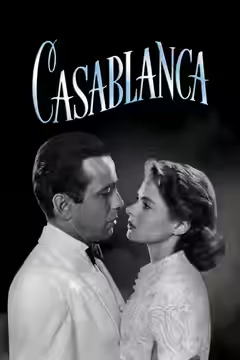
Watch Ingrid Bergman after Humphrey Bogart has finished speaking in Casablanca (1943). As Ilsa Lund, she listens with enough uncertainty to make us reconsider what we thought the conversation had settled. We were moved by Ilsa's uncertainty, because Bergman makes her distress matter as much as Rick Blaine's. It is excellent romantic acting because the woman has feelings that deserve attention even when they are inconvenient for the man opposite her.
That effect belongs partly to her collaborators, and Casablanca gives her the right ones. Arthur Edeson's cinematography keeps the uncertainty visible beneath the glamour, giving us a reason to look beyond the beautiful face. Owen Marks's editing moves between romantic distress and wartime danger without making either seem an interruption. The plotting can be decidedly convenient, but Curtiz keeps the story clear without making the characters explain every feeling. Bergman benefits from that patience: we can attend to what she holds back without losing track of what is happening.
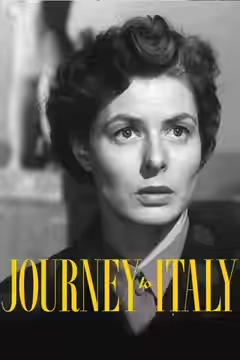
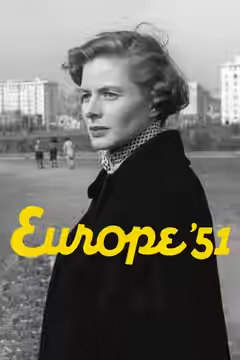
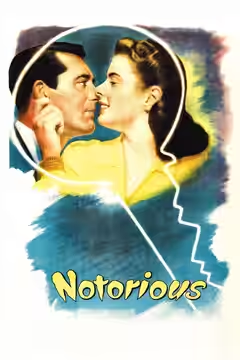
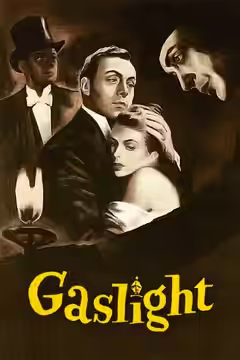
Hollywood stardom from 1939 put that apparently unforced presence to work in more than romance. The psychological distress of Gaslight (1944) and the moral uncertainty of Alfred Hitchcock's Notorious (1946) both suit an actor whose face can suggest intelligence as well as vulnerability. Stromboli (1950), directed by Roberto Rossellini, marks the turn towards European work and a starker setting for her acting. Not everyone found the combination convincing: some contemporary critics thought the Rossellini films too stark, or the styles poorly matched.
The Hollywood comeback of Anastasia (1956) was followed by selective later work, including Ingmar Bergman's Autumn Sonata (1978). As Charlotte, she brings her dramatic force to a mother-daughter conflict. That is worth seeking out if the early Hollywood image of idealised sincerity has made her seem too reassuring. We would still start with Casablanca, and resist the temptation to watch only the person speaking.
Biography
Ingrid Bergman was a Swedish actress. She studied for a year at the Royal Dramatic Theatre School in Stockholm and began her career in Swedish and German films before making her Hollywood debut in the 1939 English-language remake of Intermezzo.
She played Ilsa Lund in Casablanca (1942). Other notable roles include Alicia Huberman in Notorious (1946), Paula Alquist in Gaslight (1944), and Greta Ohlson in Murder on the Orient Express (1974). She also appeared in Spellbound (1945), Stromboli (1950), Journey to Italy (1954), Cactus Flower (1969) and Autumn Sonata (1978).
Bergman won three Academy Awards for acting, as well as two Primetime Emmy Awards, a Tony Award, four Golden Globe Awards and a BAFTA Award.