A stage actor of the first rank who reached Hollywood late and left only a handful of supporting parts. One of them, the grumbling analyst in Spellbound, is worth anyone's evening; the rest of his influence lives in the rehearsal room.
Fi1m perspective
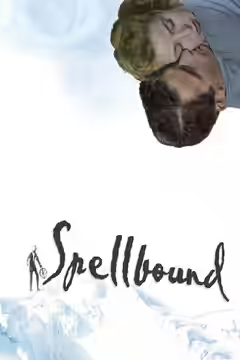
The man who has been woken in the middle of the night is not pleased about it. He shuffles downstairs in a dressing gown, pours warm milk, complains, and then tells Ingrid Bergman's psychiatrist what the audience has been muttering for half an hour: a woman who runs off with a possible murderer needs a psychiatrist herself. That is Michael Chekhov as Dr Alexander Brulov in Hitchcock's Spellbound (1945), and it is very nearly all the cinema ever caught of him. He has a few scenes and he is the best thing in the film after Bergman.
He was, first and last, a theatre man. He trained in Stanislavski's First Studio at the Moscow Art Theatre from about 1912, was running the theatre's second company by 1922, and left Russia in 1928. Most of the next fifteen years went on teaching and directing rather than performing, in Germany, Latvia, Lithuania and, from 1936 to 1939, at a studio at Dartington Hall in England, before he moved to America and opened schools there. Hollywood came late: a first appearance in Song of Russia (1944), then Brulov, then a scattering of character parts through the early fifties. He published To the Actor in 1953 and died two years later.
What he taught is easier to describe than to spot. Chekhov asked an actor to find a character's want as a physical gesture, a moulding or floating or radiating movement, and then to swallow it so that only the residue shows. Watch Brulov with that in mind and the shuffle stops being a bit of business. Every part of the man is turned towards the kettle and the bed; the mind is wide awake and the body is announcing that it retired an hour ago. We relaxed the moment he came down the stairs, and we were sorry each time the film cut back from him to Gregory Peck, who plays a man with no memory as a man with no thoughts. Chekhov, whose method was built on the unconscious rather than on dredging up an actor's own memories, sells the film's dream-talk about as far as it can be sold, which is not far, but nobody else in the picture gets it that far.
It is a thin filmography and there is no point pretending otherwise. There is no run of parts to trace, no phase in which the pictures caught up with the stage, and his reputation rests, rightly, on the classroom and the book rather than on anything a camera recorded. See Spellbound, watch what he does with a glass of milk, and then, if you want to know why so many actors still speak his name, read him rather than watch him.
Biography
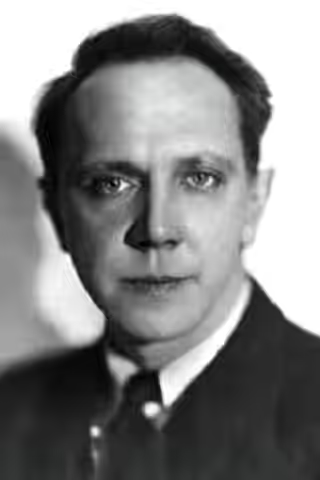
Michael Chekhov was a Russian-American actor, director, author and theatre practitioner. Born in Saint Petersburg in the Russian Empire, he was a nephew of the playwright Anton Chekhov and a student of Konstantin Stanislavski, who described him as his most brilliant pupil.
Although primarily a stage actor, Chekhov appeared in a small number of films. He is best known for his performance as Dr Alexander Brulov in Alfred Hitchcock's Spellbound (1945), for which he received an Academy Award nomination for Best Supporting Actor.