Irving Rapper came out of the theatre and directed as if he were still in one: he stood back and let good actors be plain. On a slight script that looks like polish; on Fredric March's Methodist minister it looks like judgement.
Fi1m perspective
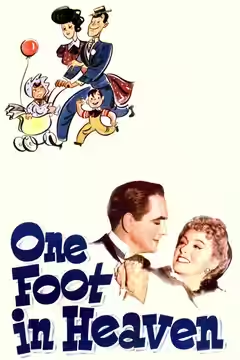
Fredric March spends One Foot in Heaven (1941) moving from one draughty Iowa parsonage to the next, and over some thirty years the stakes never rise above a roof, a salary and a congregation's good opinion. Irving Rapper directed it and produced it, and the producing is the telling part. As producer he chose material in which nothing much is at stake, and as director he declined to inflate it. March never asks to be admired, the film never asks to be wept over, and the last forty minutes quietly pay for the slow first hour.
That restraint came from the stage. Rapper acted, stage-managed and directed on Broadway in the 1920s and early 1930s, then joined Warner Bros. in the mid-1930s as a dialogue coach and assistant director, working on The Story of Louis Pasteur (1936) and with directors including William Dieterle and Anatole Litvak. He was not promoted to director until 1941, with Shining Victory, so by the time he directed he had spent five years on other people's sets. What followed is the run his reputation rests on: Now, Voyager (1942), The Corn Is Green (1945) and Deception (1946), all with Bette Davis, and The Glass Menagerie (1950), the first time a Tennessee Williams play reached the screen. After he left the studio the films came less often and were noticed less.
His strength and his limit are the same thing. He specialised in plays and novels brought to the screen, and he trusted the actors to carry them rather than the camera; the complaint that follows him is that the scripts were sometimes slight and his direction merely made them shine. He knew what he wanted from a performer. "She doesn’t give a damn what she looks like, only how well she performs. She has an inner electricity," he said of Davis, and the four films they made together are where most people meet him. We have only one of his films under review, and it is the modest one, so we will not pretend to weigh the Davis pictures here.
What we can say is that One Foot in Heaven worked on us against our expectations. We sat down braced for piety and found ourselves, somewhere in the final stretch, minding a great deal about that roof and that salary and what the congregation thought, because Rapper had let March make the man ordinary and then left him alone. It is a small film, and it is slow, and we would not send a stranger to it. But if you want to know what a director who came up through the theatre thought a film was for, start there, and then go and find the cigarette scene in Now, Voyager.
Biography
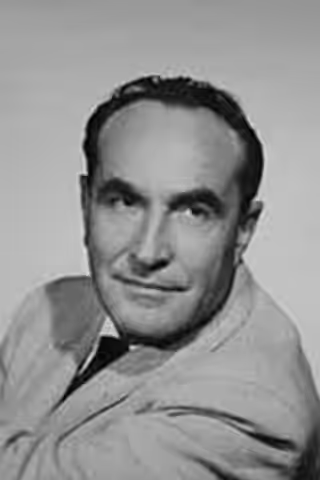
Irving Rapper was a British-born American film director. Born in London in 1898, he emigrated to the United States and studied at New York University while working as an actor and stage director on Broadway. He joined Warner Bros. in Hollywood in 1936 as an assistant director and dialogue coach.
Rapper made his feature directorial debut with Shining Victory (1941). He directed and produced One Foot in Heaven (1941), which received an Academy Award nomination for Best Picture. Among his other films were several starring Bette Davis: Now, Voyager (1942), The Corn Is Green (1945), Deception (1946) and Another Man's Poison (1951). He also directed The Brave One (1956).