Sidney Franklin’s film of the stage play keeps Elizabeth Barrett in her upstairs room and moves like a play. Norma Shearer is a convincing invalid and Fredric March an exhausting suitor, but Charles Laughton’s soft-spoken tyrant of a father makes it worth your evening.
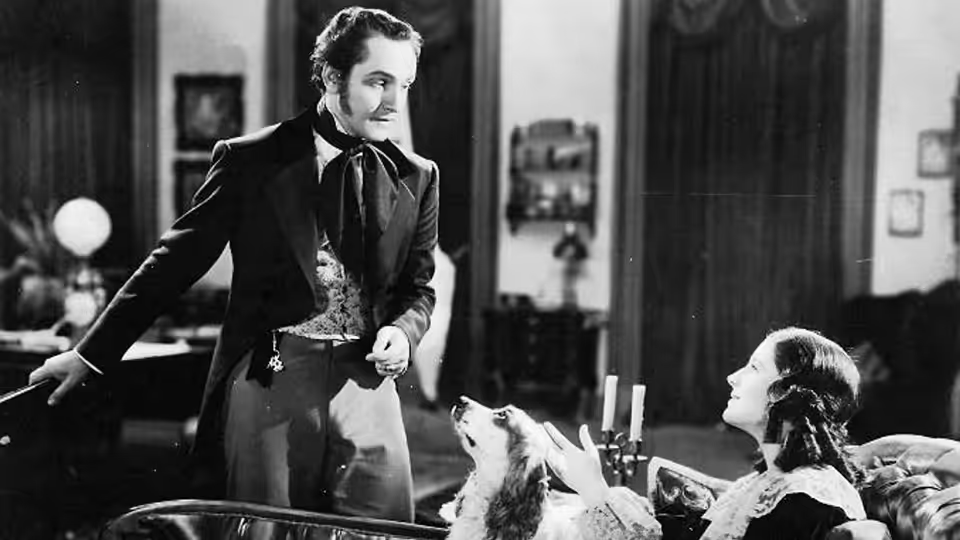
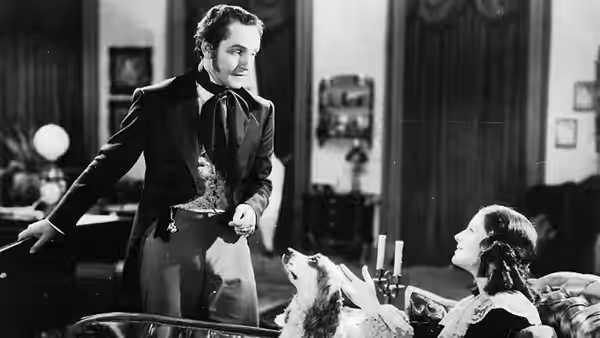
The play is Rudolf Besier’s, and it was a success on the stage before Sidney Franklin filmed it, which explains a good deal about how the film behaves. Almost everything happens in one upstairs room at 50 Wimpole Street, where Elizabeth Barrett (Norma Shearer) lies on a sofa with a spaniel called Flush and receives visitors. Three screenwriters, Ernest Vajda, Claudine West and Donald Ogden Stewart, have kept the play’s shape: people come in, say what they mean, and go out again. Irving Thalberg produced it, it is handsomely made, and it is a filmed play that moves like one. It is worth your evening, and the reason is Charles Laughton.
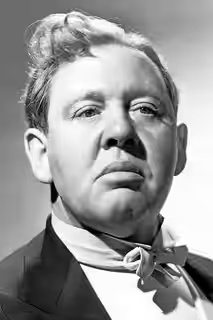
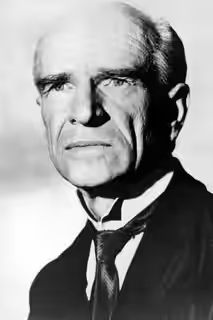
Laughton plays Edward Moulton-Barrett, the father who has forbidden every one of his children to marry and has arranged the household so that nobody can. He almost never raises his voice. In the scene we have not been able to shake, he arrives at Elizabeth’s bedside with the tankard of porter the doctor has prescribed, and when she says she cannot face it he does not argue. He waits, and he prays over her, and he tells her she will drink it because he asks. We were frightened of him, more than we expected to be by a man in a frock coat in a costume drama, and it was the patience that did it. Everybody else in the film sits; Laughton stands, in the doorway or over the sofa, and William H. Daniels keeps him at the edge of the frame so that Elizabeth’s bedroom seems smaller once he is in it.
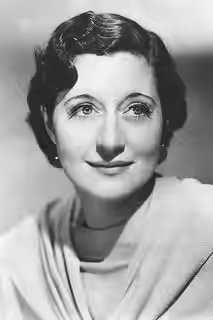
Shearer has the harder job and does about half of it. She is convincing as an invalid, pale and slow, propped on cushions, and Adrian has dressed her in dark, heavy stuff that makes her look like part of the furniture. What she cannot quite manage is the wit. Elizabeth Barrett was a formidable mind, and Shearer plays her cleverness as a series of bright, brave little laughs that belong to the stage rather than to a woman who has spent years alone with her books. In the quiet scenes with her sisters, and in the porter scene, she is at her best. When she has to be a poet she is an actress.
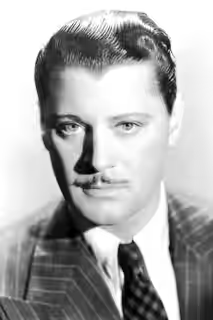
Fredric March comes through the door as Robert Browning with his arms open and his voice up, and he stays that way. The idea is sound: he is meant to be fresh air in a shut room. But he plays the whole courtship at the volume of a proposal, and the love scenes become two people declaring things at each other while Herbert Stothart’s strings agree with them. We believed that Browning loved her. We did not, for a while, believe that she would let him keep talking.
The subplot is where the film breathes. Maureen O’Sullivan’s Henrietta is being courted, in secret and in the hall, by Captain Surtees Cook (Ralph Forbes), and their scenes have the nervous quickness the main romance lacks. Katharine Alexander is a steady Arabel, and Vernon Downing’s Octavius gives the film its clearest picture of what growing up in that house does to a boy. Una O’Connor, as the maid Wilson, and the dog supply what comedy there is, and it is welcome. Leo G. Carroll and Ferdinand Munier, as the two doctors, have the job of explaining to Elizabeth what she may and may not do, and they do it with the same soft authority as her father, which we took to be the point.
Margaret Booth cuts on the lines, holding a face while it takes in what has just been said, and this gives the long dialogue scenes a rhythm they would not otherwise have. Still, there is a stretch in the middle where we found ourselves counting the entrances and exits, and the count was high. The second half tightens a good deal and turns towards what the film is really about, which in 1934 it could only imply. We will not describe it, except to say that Laughton understood it perfectly and plays it in his eyes.
At 109 minutes it does not overstay. Watch it for the father. Whenever he leaves the bedroom the film waits for him to come back, and so did we.