A studio craftsman who spent decades turning plays and novels into handsome, well-behaved MGM pictures, and who twice remade his own films. The polish is real and so is the feeling; what is hard to find is a signature.
Fi1m perspective
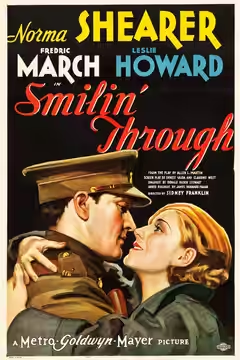
The best stretch of Smilin' Through (1932) is the long flashback to how Moonyeen died, which we will not describe. Franklin stages it as one sustained sequence and lets his editor, Margaret Booth, hold the shots far longer than she does in the modern scenes, while Adrian puts Norma Shearer in white and yards of veil and the Victorian party guests move around her in crinolines. It is patient and tasteful and it works. That is Franklin: he trusts the material, dresses it well and stays out of its way.
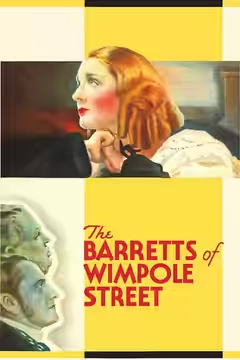
He had been in films since about 1912, first as a writer and assistant cameraman, then from 1915 co-directing shorts and features with his brother Chester, children's films for Triangle and fairy-tale adaptations for Fox. After some years working independently he joined MGM in 1926 and found his trade, which was turning plays and novels into pictures. Smilin' Through was a sound remake of his own 1922 silent. The Barretts of Wimpole Street (1934) came from Rudolf Besier's play, with Shearer again. The Good Earth (1937) came from Pearl S. Buck's novel. After that he mostly produced, directing only once more, a scene-for-scene CinemaScope remake of Barretts in 1957, before retiring from the studio the following year.
What he does well is actors, and women in particular. Shearer made three films with him, and in Smilin' Through he gets more from her in the smaller of her two parts, the slower and softer Moonyeen, than in the brisk modern niece. Leslie Howard's grieving baronet is the reason to watch the film, and Fredric March, doubled as well, is better as the man with drink and wounded pride than as the young lover we are meant to like. We sat down to Smilin' Through expecting a museum piece and were caught out; the play knows exactly where the tears are kept and Franklin, with Howard's help, goes for them without a flicker of embarrassment, and it worked on us.
What he does not do is leave a mark. Irving Thalberg and Albert Lewin produced Smilin' Through, Claudine West and Ernest Vajda kept the play intact and added little, and what Franklin added was a look. That is the usual charge against him, that the films carry the studio's polish rather than any vision of his own, and on the evidence we have it is fair. It is not a hanging offence. A director who can put a play on screen without apologising for it or wrecking it is rarer than it sounds, and MGM kept him for good reason.
A man who remade two of his own films, once when sound arrived and once when the screen got wider, plainly believed the play was what mattered and he was the frame round it. If that is what you want, he is safe hands. Start with Smilin' Through, in a forgiving mood, and stay for Howard.
Biography
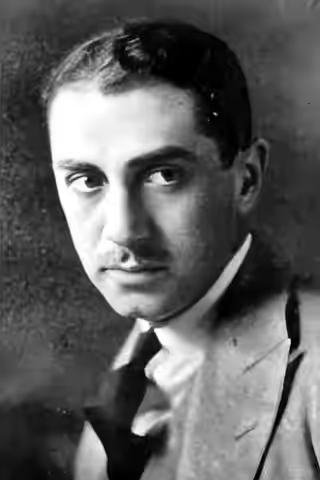
Sidney Franklin was an American film director and producer. He began his career in the silent era, co-directing several short films and features with his brother Chester Franklin, before working independently and joining MGM in 1926.
Franklin specialised in adaptations of literary works and stage plays. His credits include Smilin' Through (1932) and The Barretts of Wimpole Street (1934), both starring Norma Shearer. He also directed The Good Earth (1937), for which he received an Academy Award nomination for Best Director.
He later worked primarily as a producer at MGM before returning to direct a 1957 remake of The Barretts of Wimpole Street.