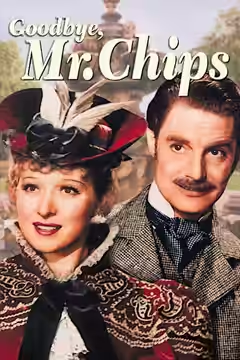
Greer Garson played good women so steadily that the goodness came to look like a limit. It was not, quite: watch the sense and the dryness she gets into Goodbye, Mr. Chips and ask who chose the parts that followed.
Fi1m perspective
A young woman on a bicycle in the Tyrol mist, and a nervous schoolmaster scrambling up to rescue her. She turns out to know exactly where she is. That scene, in Goodbye, Mr. Chips (1939), is Greer Garson's first on film, and it tells you most of what she did for the next two decades: she is the sensible one, she is gracious about it, and she lets the man believe he has helped. When Kathy arrives at Brookfield the staff brace for a dragon and get a woman who opens the rooms to the boys for tea. We had thought ourselves too dry for it. We were not; the film sags through its Vienna waltz, and the moment she walks into that school it stands up straight, and so did we.
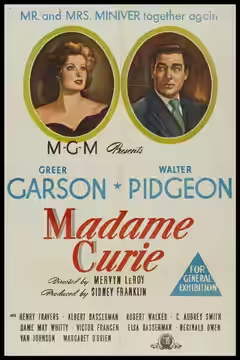
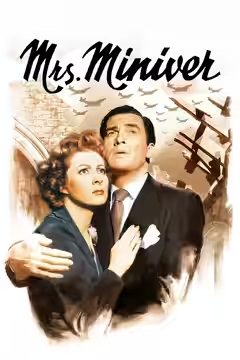
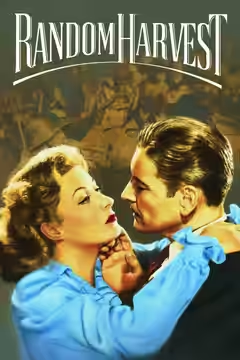
MGM did what studios did. Louis B. Mayer saw her on stage in Old Music (1937) and signed her, and after the Hilton film she was Elizabeth Bennet in Pride and Prejudice (1940) opposite Laurence Olivier. Then came the run that fixed her: Mrs. Miniver (1942), Random Harvest (1942), Madame Curie (1943), women of loyalty and good manners holding a household or a husband together while history knocked. Walter Pidgeon was the husband, or something like it, eight times. Mervyn LeRoy directed her twice. The contract ended in 1954 and the films thinned out; Sunrise at Campobello (1960), with Garson as Eleanor Roosevelt, is the late one people remember, and after that there was television and the stage she had come from.
What she had was a voice, deep and clear and trained at Birmingham Repertory Theatre, and a stillness that reads as strength without anyone having to say so. What she lacked, or was not allowed, was a flaw. The complaint that followed her through the 1940s was that her women were too good to be true, and Mrs. Miniver is the usual exhibit. When the studio tried her in comedy, in Julia Misbehaves (1948), some found the effort showed. In Chips we said the briskness stops Kathy being a wish, and then that she is still a wish. That is the Garson problem in a sentence. She could make a saint plausible. She was rarely asked to make anyone else.
She knew it. "If you're going to be typed, there are worse moulds in which you can be cast," she said, and she was right, and the line has a dryness her scripts seldom gave her. Start with Chips, where the mould has not set and you can see the intelligence before the nobility was painted over it. Go on to Mrs. Miniver knowing what you are getting. The good women are worth an evening. It is the woman underneath them we would have liked to see more of.
Biography
Greer Garson, born Eileen Evelyn Greer Garson, was a British and American actress. She was born on 29 September 1904 in London, England, and died on 6 April 1996 in Dallas, Texas. She began her career on the stage in England before signing with MGM and moving to Hollywood.
Garson made her film debut as Katherine 'Kathy' in Goodbye, Mr. Chips (1939), for which she received an Academy Award nomination. She went on to star in Pride and Prejudice (1940), Mrs. Miniver (1942), for which she won the Academy Award for Best Actress, Random Harvest (1942), Madame Curie (1943) and Julius Caesar (1953). She received a total of seven Academy Award nominations. Later credits include the voice of the narrator in The Little Drummer Boy (1968) and appearances in The Love Boat (1977).