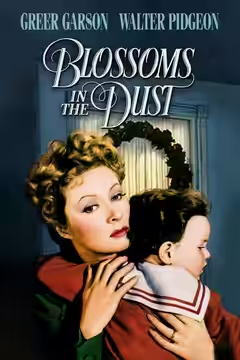
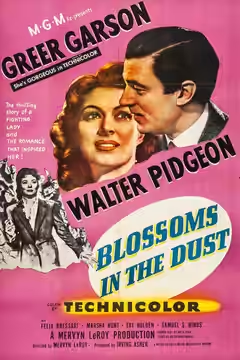
Mervyn LeRoy’s Technicolor life of Edna Gladney gives Greer Garson a warm, quick heroine and Walter Pidgeon the right man to stand beside her, then pours sugar over both. Handsome, sincere and easy to sit through; harder to believe.
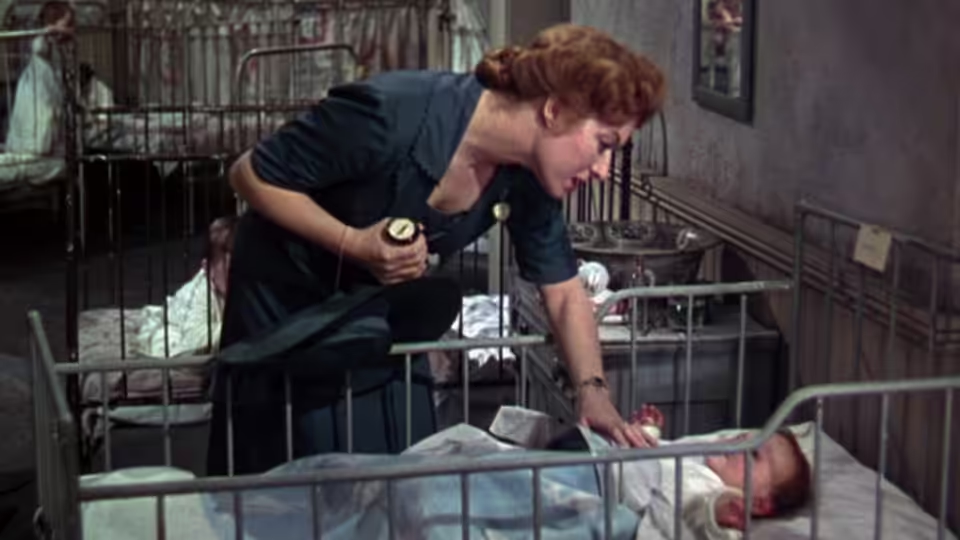
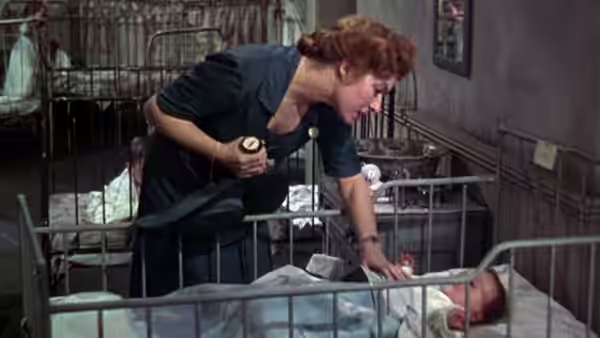
Mervyn LeRoy directs a 99-minute life of Edna Gladney, the Texas woman who took in other people’s unwanted children and then took on the state over what its paperwork called them. Anita Loos, Dorothy Yost, Hugo Butler and Ralph Wheelwright share the writing credit, and they shape it the way the big studios shaped all their lives of the good: a courtship, a marriage, a loss, a cause. It is done in Technicolor, with care and money, and it is exactly as sentimental as that list suggests. We came away liking Garson a great deal, admiring the hats and wishing somebody had turned the orchestra down.
Garson is the reason to sit through it. She plays Edna as a woman who knows she is charming and enjoys it, and she is at her best when she is annoyed, which Pidgeon’s Sam takes care to make her often. He turns up uninvited, tells her what she is going to do, and waits. Pidgeon plays him as a man who has already seen how the story ends and is content to let her catch up. This was the first time the two were put together on screen, and you can see why the studio kept doing it: she talks, he listens, and the listening is not passive.
Felix Bressart, as the family doctor Max Breslar, is the only person in the film allowed a joke, and he makes about three of them go a long way. Marsha Hunt has a short, sharp part as Charlotte and does the most honest acting in the picture in about ten minutes. Kathleen Howard, as the mother who objects to her, is given one scene of pure small-town cruelty and plays it without softening a syllable.
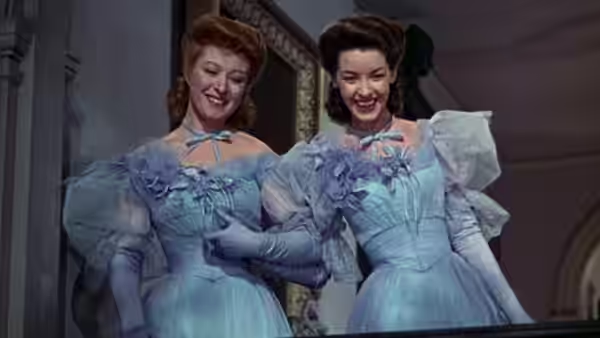
Karl Freund, who photographed Metropolis for Fritz Lang, shares the camera credit with W. Howard Greene, and the colour they arrive at is cream, rose and pale green, with Garson’s hair the shade the format seems to have been built to record. Adrian dresses the Wisconsin scenes in puffed sleeves and hats the width of a card table, and lets the Texas years go plainer as they pass. It is the film’s clearest way of showing time moving, and it is a better one than the script’s.
Late on, Garson is given a speech about a single word printed on a birth certificate. We will not say where she gives it or what comes of it. We will say that it got us. She drops the arch manner entirely and talks as if she has waited ninety minutes to say this, which she has, and for a moment the film is about something real. Then Herbert Stothart’s strings came in underneath her, and we felt cross about it, because she did not need the help and the film would not let her prove it.
The children are the larger problem. There are a great many of them and every one is clean, cheerful and pretty, and nobody is ever ill. Edna’s house fills by the dozen and we never once feel the cost of feeding one. George Boemler cuts the years in fades, and each fade seems to deliver another wagonload of well-behaved infants. When the story reaches for loss, and it does, Stothart is there first, telling us what to feel before the actors have finished, which is the surest way to stop us feeling anything.
LeRoy made Little Caesar and I Am a Fugitive from a Chain Gang at Warner Bros a decade before this, and those films had dirt under their nails. At MGM he made Waterloo Bridge the year before, which is every bit as sentimental but lets its heroine be wrong. Edna Gladney is not wrong for a moment, and a saint is a hard thing to make a drama out of.
The few reviews we have read split cleanly, one warm and two cool, and we sit between them. It is worth an evening if Garson and Pidgeon are your idea of good company, and they are good company. Keep a handkerchief within reach and your expectations a little lower than the hats.