Film review

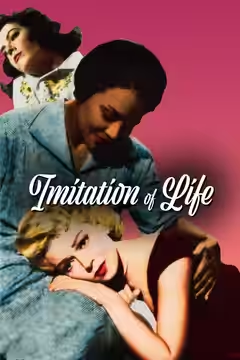
Imitation of Life

1959 · Directed by Douglas Sirk · 2h 05m · MPA NR

In a sentenceLana Turner gets the gowns and the staircase; Juanita Moore, in an apron, quietly walks off with the film

DramaRomance

Coney Island, the summer of 1947. Lora Meredith (Lana Turner), a widow who has come to New York to be an actress, loses her six-year-old daughter Susie (Terry Burnham) on the crowded beach. She finds her under the boardwalk with Annie Johnson (Juanita Moore), a black widow whose own daughter Sarah Jane (Karin Dicker), aged eight, is light-skinned enough to be taken for white. A photographer, Steve Archer (John Gavin), snaps the four of them together. By evening Annie and Sarah Jane have moved into Lora’s cold-water flat, Annie keeping house in exchange for a bed. Lora chases auditions and modelling jobs and meets the agent Allen Loomis (Robert Alda), while Sarah Jane starts at school and tells nobody there who her mother is.

Fi1m review

Douglas Sirk’s last Hollywood film is a glossy Broadway weepie with a much harder film about a black housekeeper and her light-skinned daughter running underneath it. Lana Turner’s half is thin; Juanita Moore and Susan Kohner’s half is the reason it has lasted.

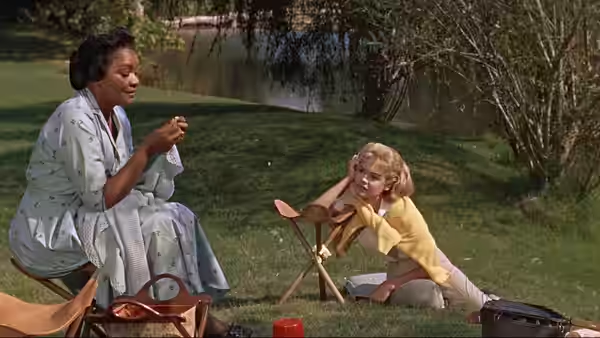
Coney Island, the summer of 1947. Lora Meredith (Lana Turner), a widow who has come to New York to act, has lost her small daughter on the beach. She finds Susie (Terry Burnham) under the boardwalk in the care of Annie Johnson (Juanita Moore), another widow, whose own girl Sarah Jane (Karin Dicker) is playing beside her. A photographer, Steve Archer (John Gavin), takes their picture. By nightfall Annie and Sarah Jane have moved into Lora’s cold-water flat, Annie keeping house for a bed and no wages. Douglas Sirk’s last Hollywood film, a remake of the 1934 picture from Fannie Hurst’s novel, starts from that accident and follows the household for ten years.

We think it is a fine film and an odd one. It is two pictures in one frame. Lora’s is the glossy one: the agent Allen Loomis (Robert Alda) who expects payment in more than commission, the playwright David Edwards (Dan O’Herlihy) who gives her a part, the staircase, the gowns, the telegrams. Annie’s happens in kitchens and doorways at the edge of Lora’s scenes, and it is the one that matters. Sirk knows which of the two we have paid to watch, and keeps drifting the camera to the other.

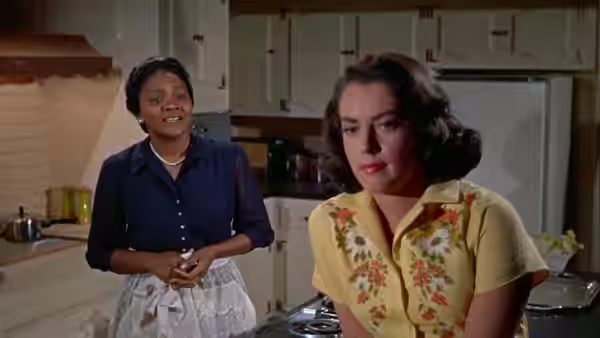
Sarah Jane is light-skinned enough to pass for white, and at eight she has already decided to. Karin Dicker plays her as a child who has worked out how the world is arranged. She refuses the black doll Susie offers her. She tells the class her mother is somebody else. Then Annie turns up at school on a wet afternoon with a raincoat and galoshes, and the teacher says there must be some mistake, there is no coloured child here. It moved us more than we expected, and not because of the girl running out into the rain. It was Moore in the doorway with the little coat over her arm, understanding in about two seconds what her daughter has been doing and deciding, for now, to say nothing.

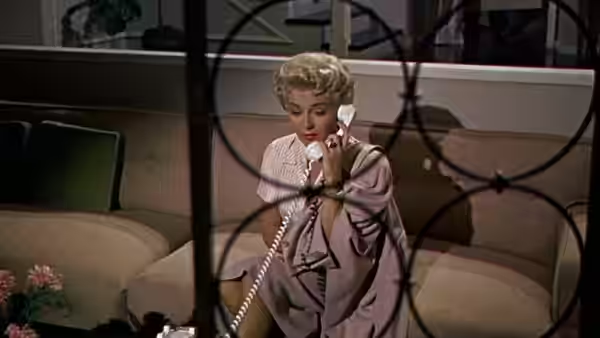
Russell Metty photographs it in colours no real room has ever had. Lora’s flat is the yellow of a paperback; her later house has a white staircase wide enough for a musical and mirrors in which people talk to reflections rather than to each other. Frank Skinner’s score, with Henry Mancini also credited, swells on cue every time, and Milton Carruth cuts to the tear before it falls. Sirk had made All That Heaven Allows and Written on the Wind in the same manner, and the title tells you what the manner is for: everything Lora acquires is shown to us as a shop window. You may find that cold. We found it cold and then, about an hour in, found it working.

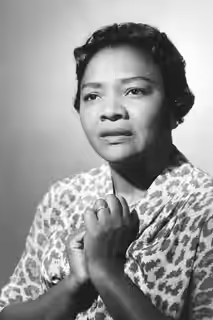
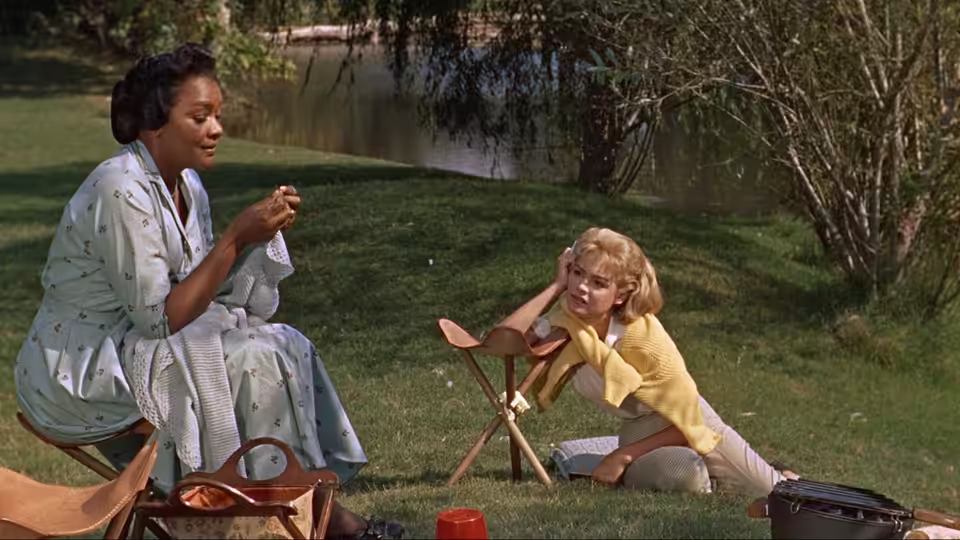
Juanita Moore is the reason to see it. She plays Annie almost without raising her voice, as a woman who knows more than anyone in the house and has learned not to show it. Susan Kohner takes over Sarah Jane at eighteen and gives her a hard, bright, frightened surface; her scenes with Moore are the best in the film and we will not say where they lead.

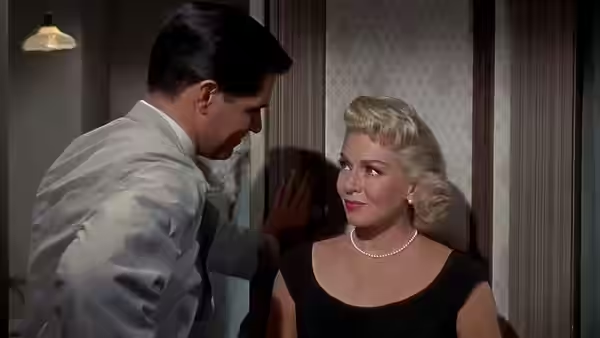
The rest is weaker, and much of it is Lana Turner. She is playing a woman who cannot stop performing, and in her scenes with John Gavin’s Steve it is hard to tell the character’s acting from the actress’s. Gavin is handsome and immovable and asked to be nothing else. Sandra Dee’s Susie at sixteen is handed a storyline in the last third whose purpose we could see and did not believe for a minute. One reviewer in 1959 dismissed the whole thing as a tear-jerker, and on the evidence of Lora’s half we would not argue very hard. Most critics since have come round to it, and so have we.

The last quarter of an hour is famous and we will not describe it. It is staged on a scale the rest of the film has been saving up for, and we cried in a way we slightly resented and then stopped resenting. At 125 minutes the film is patient about getting there. Watch it with someone who thinks old Hollywood melodramas are safe, and see how long they last.

Critical consensus AI synthesised

78
Positive
7
Mixed
0
Negative
1

Most critics take Imitation of Life for a melodrama that knows exactly what it is doing. The praise clusters on Sirk’s direction: the Technicolor surfaces, the open manipulation, and the way the weepie machinery is turned against the racism and commercialism it appears to serve. Juanita Moore and Susan Kohner, as the mother and the light-skinned daughter who rejects her, draw the warmest notices, and their subplot is repeatedly named the strongest thing in the film. Nearly everyone mentions the funeral.

The spread is narrow at the top and then drops sharply. Seven of eight reviews are positive; the one dissenter is The New York Times, writing on release, which finds a shameless tear-jerker with banal dialogue and overacting. Later critics tend to read that excess as deliberate, and Collider notes the film was dismissed as soap before being recognised for its boldness on race, class and gender. Variety, also at the time, is warmer but measured: a solid remake, with Lana Turner outstanding.

Empire
1 February 2007 · ★★★★★ · Ian Freer
100

The critic calls it a consummate display of populist weepie-making that edges out the 1934 version thanks to Sirk's ersatz style and masterful manipulation. Standout praise goes to the performances of Moore and Kohner, especially their hell-for-leather confrontation scene.

Read the full review →
Slant Magazine
3 July 2003 · Ed Gonzalez
90*

Sirk's film is a sardonic melodrama that exposes the deranged surfaces and racial realities of American society through its story of ambition, passing, and maternal sacrifice. The critic praises its rigorous mise-en-scène, Brechtian distancing, and sensitive handling of the light-skinned daughter's rejection of her mother as a subversive critique of white America's relationship to people of color.

Read the full review →
The New Yorker
26 March 2015 · Richard Brody
90*

Sirk unleashes a melodramatic torrent of rage at the corrupt core of American life including racism, commercialism, and puritanism. The grand finale funeral is a trumpet blast against social façades.

Read the full review →
Time Out
31 March 2015 · GA
85*

Sirk's final Hollywood film is a coldly brilliant weepie that undercuts romantic sentimentality with racial tension and the breakdown of family bonds. The critic highlights a key moment where emotional payoff is undercut by the daughter's rejection of her mother and the unforgettable funeral scene that reveals underlying hopelessness.

Read the full review →
Little White Lies
4 December 2016 · Sophie Monks Kaufman
80*

Sirk's 1959 melodrama is a perfect vehicle for encoding awareness of racial injustice in America through emotional arcs and Technicolor surfaces. The piece singles out Juanita Moore's performance as Annie for embodying the tragedy of a Black woman navigating subservience and limited aspirations in a racist society.

Read the full review →
Variety
31 December 1958 · Variety Staff
70*

The film is a solid remake with Lana Turner outstanding as the ambitious actress. The subplot of the light-skinned daughter passing as white, played memorably by Susan Kohner and Juanita Moore, emerges as the strongest element.

Read the full review →

Cast

Awards

Academy Awards, 1960

Nominated
Best Supporting Actress

If you liked this, try…

Far from Heaven poster87

Far from Heaven

2002 · Todd Haynes rebuilds Sirk’s colours and manners and lets the cracks show on purpose

All That Heaven Allows poster

All That Heaven Allows

1955 · Sirk again, a widow and a gardener, and a television set as the villain

Passing poster

Passing

2021 · Rebecca Hall’s black-and-white Harlem story about two women and one lie, told quietly

Ali: Fear Eats the Soul poster

Ali: Fear Eats the Soul

1974 · Fassbinder takes Sirk’s cleaning woman and shows what Munich thinks of her

Mildred Pierce poster

Mildred Pierce

1945 · Joan Crawford works herself up from waitress to ruin for an ungrateful daughter