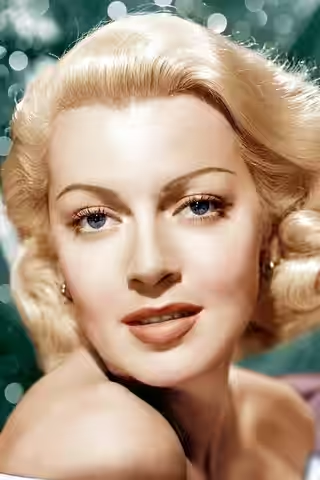
Lana Turner played women who were being looked at and knew it, and for twenty years the studio system asked little more of her. It works best when the part is a performer too; when it is not, there is not much underneath.
Fi1m perspective
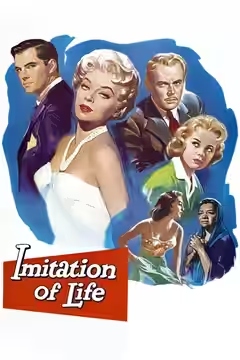
Coney Island, the summer of 1947. Lora Meredith has lost her small daughter on the beach, a photographer takes her picture, and by nightfall she has acquired a housekeeper she cannot pay. Lana Turner plays Lora in Imitation of Life (1959) as a woman who cannot stop performing, and in her scenes with John Gavin's Steve we found it hard to tell the character's acting from the actress's. That is Turner in a sentence. When the part is a performer, it is a virtue. When it is not, the film has to manage without her.
She was found, not trained. A talent scout spotted her in Hollywood in 1936, at fifteen or sixteen; Mervyn LeRoy signed her, gave her a debut in They Won't Forget (1937) as Mary Clay that made her the Sweater Girl, and took her to MGM in 1938, where she stayed under contract until 1956. The ingénue parts of the late 1930s became leading roles in the 1940s, four of them opposite Clark Gable. The turn came with The Postman Always Rings Twice (1946), where she played Cora Smith, a scheming wife, and critics who had noticed only the sweater started noticing the actress. She said that year that she was tired of walking across the screen and looking pretty, and that she did not intend to slip back.
She mostly did not slip back. The Bad and the Beautiful (1952) gave her Georgia Lorrison, a sustained dramatic part in a film about Hollywood; Peyton Place (1957) put her at the centre of a large ensemble as Constance MacKenzie. Imitation of Life, produced by Ross Hunter and directed by Douglas Sirk, was the comeback and one of her most successful late films. After it the parts thinned, and there were occasional films and television, including Falcon Crest in 1982 and 1983.
The case against her is old and has not changed: wooden, limited, cast for her looks rather than her technique, with A Life of Her Own (1950) the film usually cited. The case for her is that in noir and melodrama, playing the good girl gone bad, the ambitious woman who is also frightened, the looks were the technique. Audiences watched her whoever else was in the frame. That is not nothing, and it is not the same as acting.
We know this because of Imitation of Life. It is the film of hers we rate highest, and the reason is not Turner. Watching Lora's half we felt the film idling, and we caught ourselves waiting for Juanita Moore to come back on screen, because Moore does so little and means so much of it, and next to her Turner is visibly working. Most critics have come round to the film, and so have we, on the strength of the housekeeper's story rather than the star's. Start there. Then watch it again for Moore.
Biography
Lana Turner was an American actor. Discovered by MGM at the age of sixteen, she first appeared in They Won't Forget (1937). She played featured roles in films including Love Finds Andy Hardy (1938) before establishing herself as a leading actor in the early 1940s with Johnny Eager (1941), Ziegfeld Girl (1941) and Somewhere I'll Find You (1942).
Turner appeared in Dr. Jekyll and Mr. Hyde (1941) and The Postman Always Rings Twice (1946). Her later films included The Bad and the Beautiful (1952), Peyton Place (1957) and Imitation of Life (1959), in which she played Lora Meredith. She received an Academy Award nomination for Best Actress for Peyton Place. In the 1980s she had a recurring role in the television series Falcon Crest.
Turner made her final television appearance in 1991. She died in 1995.