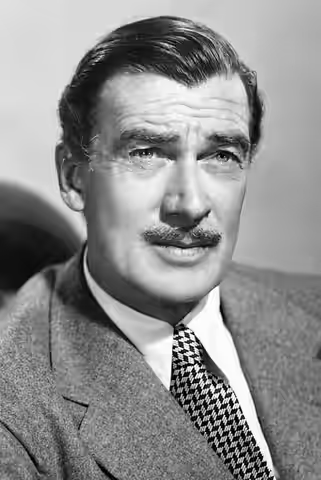
Walter Pidgeon made a career of standing next to people more interesting than himself and not minding. Tall, level-voiced and decent, he was the husband and the mentor of MGM's prestige dramas, and the films trusted him a shade more than we do.
Fi1m perspective
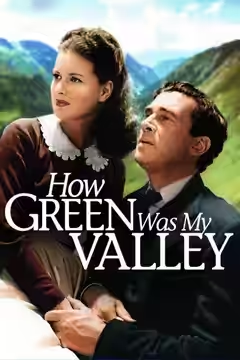
Walter Pidgeon's habit was to stand still and let the other person have the scene. In How Green Was My Valley (1941) his preacher, Gruffydd, is upright and kind and talks a good deal, and he never once raises his voice to do it; the valley comes to him, and the film is built so that it does. That stillness, and the low even voice that goes with it, is the whole instrument. He trained as a singer, and it shows in how he never seems to run short of breath.
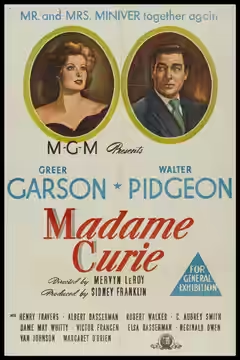
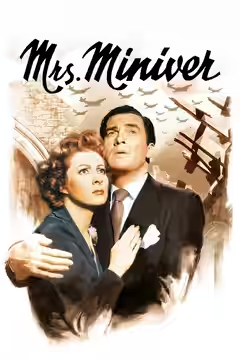
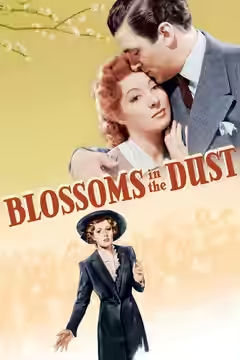
He had been around a while before anyone noticed. There were Broadway musicals and silent films in the mid-1920s, then supporting dramatic parts at MGM from 1937, and then 1941, when How Green Was My Valley and Blossoms in the Dust made him a leading man in the same year. From there the studio paired him with Greer Garson eight times, in Mrs. Miniver (1942), Madame Curie (1943) and on into the early 1950s, mostly as the husband who stands slightly behind and approves. Mervyn LeRoy and Robert Z. Leonard each directed him three times. Later he did character work: the producer Harry Pebbel in The Bad and the Beautiful (1952), the reclusive scientist Morbius in Forbidden Planet (1956), the Senate Majority Leader in Advise & Consent (1962). He retired in 1977.
What he was good at is easy to name. He made intelligence look restful. Put him opposite a woman with a great deal to do and he stood back and reacted, and the scene was better for it. Put him in a laboratory or a legislature and you believed he had read the papers. He was reliable in the exact sense: you knew what you were getting, and it was never less than what was promised.
That is also the limit. In Ford's film we found Gruffydd a good man and rather a lot to sit through; he talks and the village listens, and well before the end we were looking past him to Maureen O'Hara, who is where the film's feeling actually lives. The film loved him more than we did. Critics have noted over the years that his co-stars tended to take the scenes, and that the studio kept him in the gentleman's suit long after he might have tried something else. Forbidden Planet is the one later part that suggests something harder was available, and we would like to have seen more of it.
He was cheerful about the arrangement. "Greer and I have worked well from the first. I've done eight pictures with that gal, and we never had a bad word between us." That is the man, and it is also the actor: no bad words, no rough edges, a partner who never once pulled focus. Start with the Ford, and watch where the camera goes when he stops talking.
Biography
Walter Pidgeon was a Canadian actor. He trained in voice at the New England Conservatory of Music in Boston and began his career in stage musicals before moving to Hollywood in the 1920s, where he appeared in silent films. He later worked under contract at MGM in supporting roles and gained prominence in the early 1940s.
He is known for performances in How Green Was My Valley (1941) as Mr. Gruffydd, Blossoms in the Dust (1941) as Sam Gladney, Mrs. Miniver (1942) as Clem Miniver, Forbidden Planet (1956) as Dr. Edward Morbius, and Funny Girl (1968) as Florenz Ziegfeld. Pidgeon received two Academy Award nominations for acting. He retired in 1977 and died in 1984.