Film review

Funny Girl

1968 · Directed by William Wyler · 2h 35m · MPA G

In a sentenceBarbra Streisand auditions for the rest of her career for two and a half hours while Omar Sharif holds her coat

ComedyDramaRomance

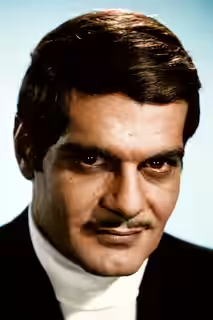
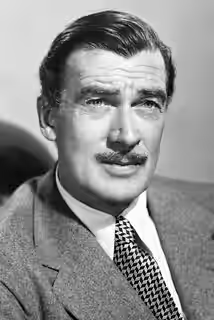
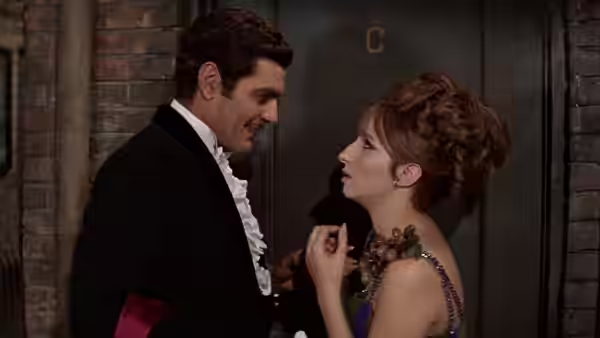
New York, in the years before the First World War. Fanny Brice (Barbra Streisand), a skinny, big-voiced girl from Henry Street on the Lower East Side, wants to be on the stage and is told by everyone, including her mother Rose Brice (Kay Medford) and the women who drink in Rose’s saloon, that she does not have the face for it. She talks her way into the chorus at Keeney’s music hall, cannot roller-skate, and turns the disaster into her act. In the audience is Nick Arnstein (Omar Sharif), a gambler in a good coat, who sends flowers and disappears. When Florenz Ziegfeld (Walter Pidgeon) hires her for the Follies, Fanny rewrites his bridal number to suit herself, and Nick comes back.

Fi1m review

Barbra Streisand’s first film is the reason to watch it, and she is reason enough: loud, funny, unembarrassed, and then suddenly not. William Wyler builds a long, handsome musical around her that goes slack once the songs give way to the marriage.

William Wyler had made Ben-Hur and The Best Years of Our Lives and had never directed a musical when he took on Funny Girl, and he approached it the way he approached everything: carefully, expensively and at length. The film tells the story of Fanny Brice, the Ziegfeld comedienne, as the rise of a plain girl with a great voice and the marriage that came with it, and its real purpose is to put Barbra Streisand, repeating her stage part, in front of a camera for the first time. On that purpose it succeeds completely. As a film it is delightful for ninety minutes and patient for the rest, and the rest is considerable.

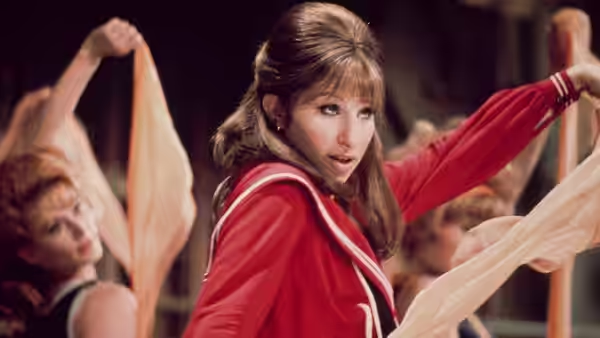
Streisand is the whole event. She plays Fanny as a girl who decided she was a star some years before anyone agreed, and she is funny in the old vaudeville way, with the body first: in the roller-skate number at Keeney’s she cannot skate, takes half the chorus down with her, and turns the wreckage into an encore. We laughed out loud, which we do not often do at a musical of this vintage. She reads Isobel Lennart’s lines as though she had thought of them a second before, and when she stops being funny, halfway through ‘People’ on a stoop at night, the change is so complete that the film goes quiet with her.

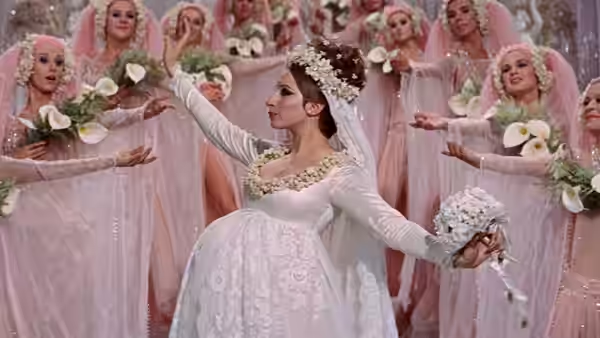
Wyler and Harry Stradling shoot the stage numbers straight on and wide, as if from a good seat in the stalls, and let Gene Callahan’s Follies sets fill the frame with staircases and ostrich feathers. Irene Sharaff dresses the Ziegfeld girls in white and Fanny in whatever will make the joke land, most memorably the wedding gown she pads out to ruin Ziegfeld’s bridal tableau. Jule Styne’s songs were written to be sung to the back of a theatre and Streisand sings them there. The peak is ‘Don’t Rain on My Parade’, which starts on a railway platform, moves through a train and ends with Fanny on the bow of a tugboat in New York harbour, the camera lifting away as she holds the last note. We sat up. It is the one moment the picture is as big as the woman in it.

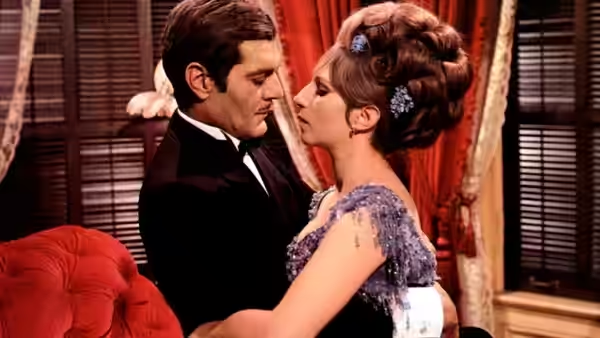
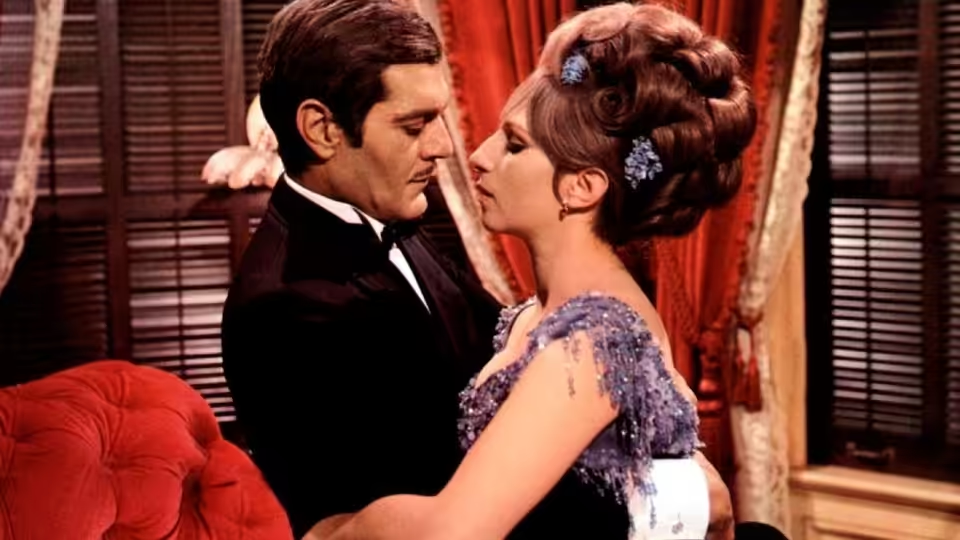
After the interval it becomes another film, slower and sadder and less sure of itself. The second half belongs to the marriage, and Omar Sharif plays Nick Arnstein as a good coat with a moustache: courteous, handsome, and giving Streisand nothing to push against, so that whatever passes between them we take on her word rather than see for ourselves. Lennart’s screenplay keeps the story on rails and stops to say each thing twice, and Maury Winetrobe and William Sands cut at a stately pace that lets scenes end a beat after they are over. There is a stretch in the middle, all telephones and apartments, in which we noticed how long the film was and then could not stop noticing.

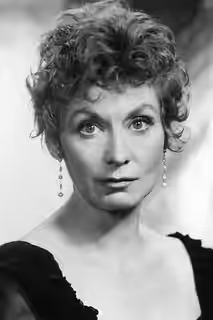
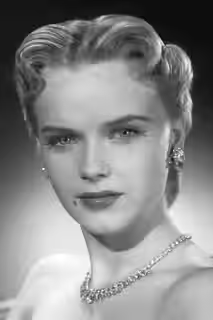
The supporting cast is better than most critics allowed at the time. Kay Medford’s Rose Brice, running her saloon on Henry Street, is a dry pleasure, a mother who believes in her daughter and would sooner die than say so, and Mae Questel’s Mrs. Strakosh gets more from one disapproving noise than others get from a page. Walter Pidgeon’s Ziegfeld is a monument in a waistcoat, which is what the part asks for. Anne Francis has little to do as the showgirl Georgia James and does it kindly, and Lee Allen’s Eddie Ryan is there to be loyal to Fanny and is.

Wyler’s best films gave actors room and then watched them think, and he does the same here; it works whenever the actor is Streisand and stalls whenever she leaves the frame. As a musical it belongs with the big roadshow pictures of its decade, long and plush and built around an interval, and it has their habit of underlining. Watch it at home, where you can stop for tea in the middle and come back for the closing number, which she sings alone in a black dress and which is worth the wait. It runs 155 minutes and carries a U.
Critical consensus AI synthesised

69
Positive
8
Mixed
2
Negative
2

Most critics come down in favour, and the praise lands almost entirely on Barbra Streisand. Her screen debut as Fanny Brice is the one thing every review agrees on, from the warmest to the coldest; even critics who dislike the film call her the reason to watch it. Several credit William Wyler with building the show around her and holding it together, and the musical numbers, Don’t Rain On My Parade in particular, are singled out for their staging and camerawork.

The spread is wide. Reservations fall on the film rather than its star: overlong, overproduced, a familiar story, a supporting cast that cannot keep up with her. The New York Times and The New Yorker, reviewing on release, are the sharpest dissenters, both admiring Streisand while rejecting the picture around her. The Guardian, decades later, finds her comic scenes embarrassing, a complaint no one else makes. The most recent reviews are the kindest, reading the film as a vehicle that has lasted because of who is driving it.

Empire
1 January 2000 · David Parkinson
90*

The critic notes that Barbra Streisand's film debut as Fanny Brice earned her an Oscar and mirrored the character's rise, with Wyler's direction and strong supporting elements helping the biopic succeed as a top box-office hit of the 1960s. Streisand excels in both comedy and drama, particularly in her musical numbers.

Read the full review →
Los Angeles Times
31 August 2001 · Kevin Thomas
90*

Hails the restored film as a true classic and superb example of Hollywood craftsmanship, praising Streisand's electrifying debut, Wyler's direction, the songs, and the restoration quality.

Read the full review →
Slant Magazine
27 November 2024 · Derek Smith
85*

The critic lauds Streisand's awe-inspiring performance of vulnerability and humor that made her a star, noting how the film's enduring appeal stems from her magnetic presence rather than the musical genre's excesses. They highlight the elegant style and emotional power in numbers like the final “My Man” sequence.

Read the full review →
The Telegraph
19 January 1969 · Margaret Hinxman
85*

Streisand is superbly right as Fanny and the life force of the film. Director William Wyler drapes the opulent show around her, making the story work despite its clichés.

Read the full review →
Radio Times
★★★★ · Adrian Turner
80

Streisand delivers a bravura performance replicating her Broadway triumph as Fanny Brice, earning a joint Oscar. It is a marvellous musical comedy tracing her rise and troubled marriage, Wyler's first musical and penultimate picture.

Read the full review →
The AV Club
6 November 2024 · Jacob Oller
80*

The critic praises William Wyler's direction as perfectly complementing Barbra Streisand's charismatic performance in her screen debut, highlighting the film's balance of traditional musical elements with youthful irony and self-deprecating humor. They single out the inventive camerawork in musical numbers like “Don’t Rain On My Parade” for praise.

Read the full review →

Cast

Awards

Academy Awards, 1969

Nominated
Best Cinematography
Nominated
Best Film Editing
Nominated
Best Original Musical Score
Nominated
Best Picture
Nominated
Best Sound
Nominated
Best Supporting Actress
Won
Best Actress

If you liked this, try…

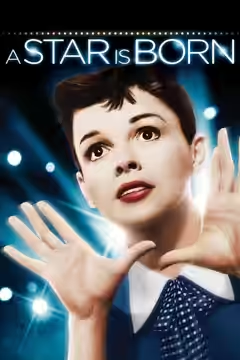
A Star Is Born poster

A Star Is Born

1954 · Judy Garland does the same job of being the whole film, with darker results

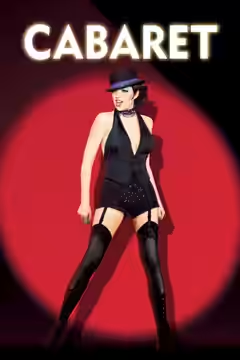
Cabaret poster

Cabaret

1972 · The musical grown up four years later: shorter, meaner, and every number earned

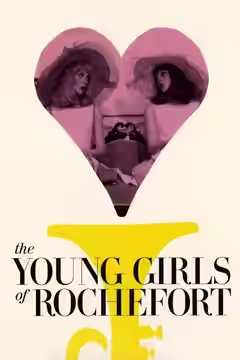
The Young Girls of Rochefort poster

The Young Girls of Rochefort

1967 · A French musical from the same moment that is light where this is heavy

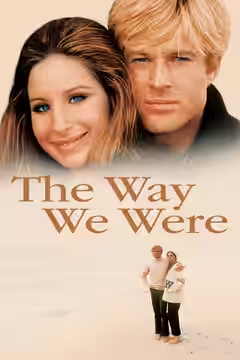
The Way We Were poster

The Way We Were

1973 · Streisand in another mismatched romance, this time without songs to hide behind

Gypsy poster

Gypsy

1962 · Another Jule Styne score about a woman who wants the stage more than anything