Film review

Cabaret

1972 · Directed by Bob Fosse · 2h 04m · MPA PG

In a sentenceCome for the garters and the bowler hats; the armbands arrive when you have stopped looking

MusicRomanceDrama

Berlin, 1931. Brian Roberts (Michael York), an English academic, steps off a train and takes a room in Fräulein Schneider’s (Elisabeth Neumann-Viertel) boarding house, meaning to live by giving English lessons. Down the hall is Sally Bowles (Liza Minnelli), an American who sings at the Kit Kat Klub, wears green nail varnish and decides at once that they are going to be friends. Onstage at the club, the white-faced Master of Ceremonies (Joel Grey) welcomes the customers and promises that their troubles will stay outside. Brian’s pupils include Fritz Wendel (Fritz Wepper), who wants to marry money, and Natalia Landauer (Marisa Berenson), who has it. Outside, men in brown shirts collect for the party, and a Nazi thrown out of the club does not forget it.

Plays from YouTube when you press play; nothing loads from them until then.

Fi1m review

Bob Fosse’s film of the stage musical keeps the songs on a tiny club stage and lets Berlin turn brown outside the door. Minnelli and Grey are extraordinary; the scenes between the numbers are not, and we do not much mind.

Bob Fosse’s Cabaret takes the Broadway musical and does something the Hollywood musical had almost never done: nobody sings unless they are paid to. Every number but one is performed on the stage of the Kit Kat Klub, a Berlin dive in 1931, and the story of Sally Bowles and the Englishman down the hall is told in ordinary rooms without music. Fosse was a choreographer before he was a director, and he knows what a body on a stage means. It is the rare musical that gets darker each time we see it, and we recommend it with one reservation about what happens when the singing stops.

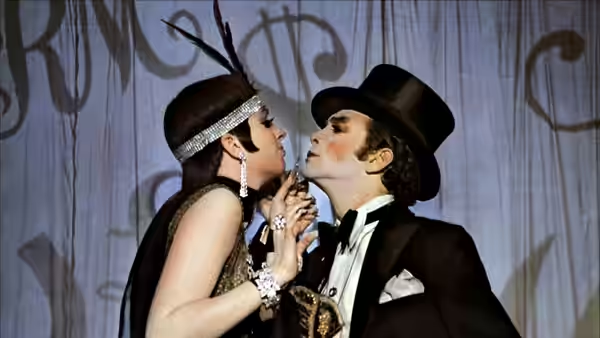
Joel Grey’s Master of Ceremonies opens the film in a warped mirror, white-faced and rouged, and welcomes us in three languages. Geoffrey Unsworth lights the club from the footlights up, so every face on stage has a shine of grease and shadows in the wrong places. Herbert Strabel’s set is small and mean: a low stage, tables close enough to touch the dancers. Fosse’s dancers work with knees turned in and fingers splayed, hats over one eye, and Grey conducts them like a man who finds everything funny and nothing surprising. His grin is the most frightening thing in the film and he barely raises his voice.

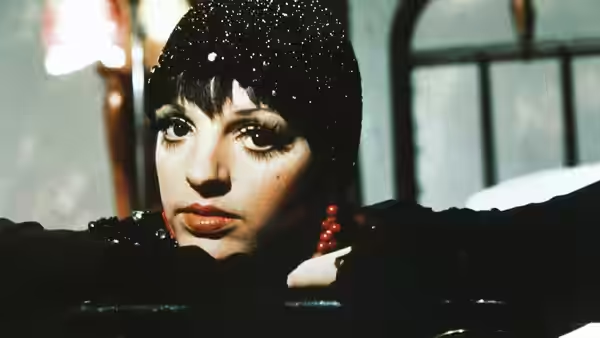
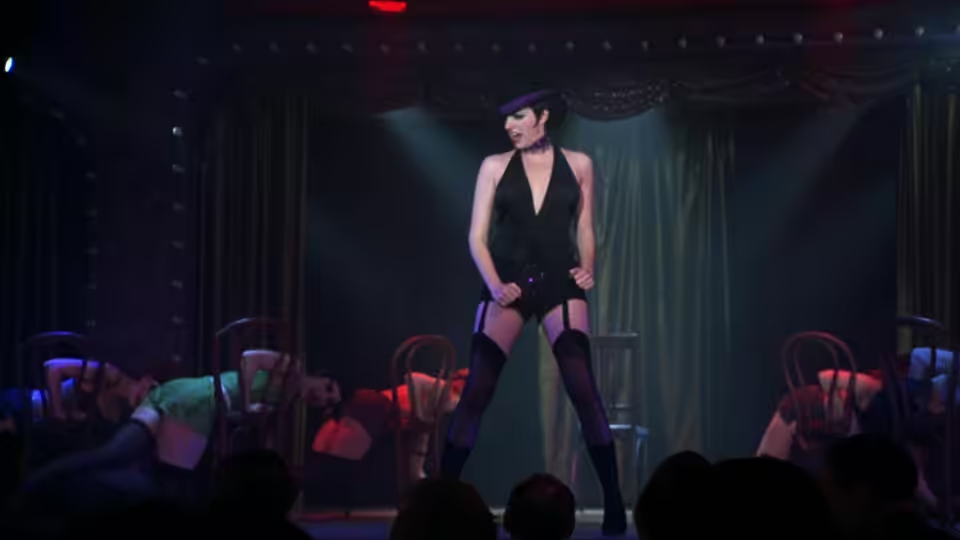
Liza Minnelli’s Sally does ‘Mein Herr’ in a bowler hat and black stockings on a bentwood chair, and Charlotte Flemming dresses her in the same few black things throughout, so that off stage in a shabby fur she still looks half in costume. Minnelli plays her as a woman who wants to be looked at so badly she has stopped seeing anything else: loud, pushy, a little exhausting, which is right. Then she sings ‘Maybe This Time’ under one light while David Bretherton cuts to her and Brian in the boarding house, and it moved us more than we expected. Her face at the end of the last note has given up before the applause starts.

The street arrives in pieces. Men in brown shirts collect money at the club door. Bretherton cuts a slap-dance routine against a beating in an alley, one blow on stage for each blow off it, and here we side with the film’s few detractors: the point lands on the first cut and the sequence keeps making it. The one song outside the club is another matter. Brian and his rich new friend Maximilian von Heune (Helmut Griem) stop at a country beer garden, a blond boy stands and sings ‘Tomorrow Belongs to Me’ in a clear tenor, and Unsworth’s camera moves down from his face and shows us what he is wearing. Then the garden gets to its feet, a table at a time. We were horrified, and what horrified us was that we had been enjoying the tune. Fosse does not cut to a clenched fist. One old man stays seated, and that is all.

The boarding house is where the film is weakest, and it is where most of the plot lives. Jay Presson Allen’s screenplay, taken from the stage show and from Christopher Isherwood’s Berlin stories, gives Brian little to want, and Michael York plays him at a slight remove, so that we sometimes wonder why he is there. Fritz Wendel (Fritz Wepper), a gigolo taking English lessons to improve his prospects, and Natalia Landauer (Marisa Berenson), the heiress he sets his cap at, carry a subplot the film keeps forgetting and then remembering. Berenson has poise and one good scene of alarmed innocence, and not much else to play. Griem’s Maximilian arrives in a long car with a great deal of money, and the middle of the film follows him; we will leave it there.

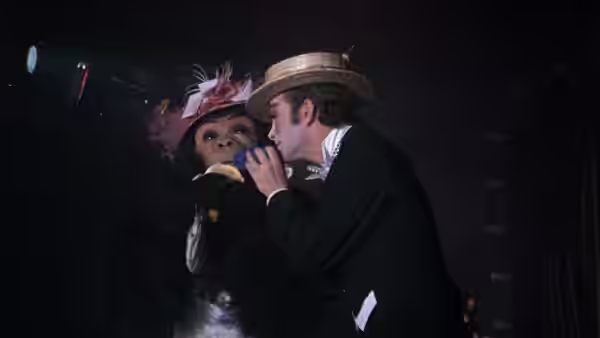
The songs, by John Kander with Fred Ebb, are why the trick holds. They are good enough to enjoy as songs and nasty enough to enjoy with a bad conscience. ‘Money, Money’ is a music-hall turn about poverty performed for people about to lose everything, and the number in which the Master of Ceremonies dances with a gorilla in a frock has a last line we will not quote. A studio musical of the period would have taken Sally into the street and made the traffic dance. Fosse keeps her on a stage the size of a kitchen table and shows us who is clapping.

At 124 minutes and with a 15 certificate, it is not for a family Sunday, whatever the tagline says about life. The Master of Ceremonies asks us to leave our troubles outside. For about twenty minutes we did.

Critical consensus AI synthesised

85
Positive
10
Mixed
1
Negative
0

Most critics agree that Cabaret is one of the few musicals that is also serious political film-making, following the rise of the Nazis in Weimar Berlin without softening it. The praise gathers around Bob Fosse’s decision to keep the numbers on the club stage and cut them against the life outside, and around the two central performances: Liza Minnelli’s Sally Bowles and Joel Grey’s Master of Ceremonies are named again and again. Several reviews credit the film with breaking the glossy Hollywood musical for good, and the design, lighting and colour are compared to Expressionist painting.

The spread is narrow, with ten of eleven reviews positive. The reservations sit almost entirely on the editing. Time Out calls the film a maddening mixture and finds the cross-cutting crude, pushing it into overstatement. The New York Times, writing on release, admires it a great deal but calls it imperfect and picks at details in Minnelli’s performance. Nobody disputes the numbers themselves.

Radio Times
★★★★★ · Tony Sloman
100

This is hailed as a tremendously effective and affecting adult musical that pulls no punches in depicting the rise of Hitler and antisemitism in Weimar Berlin. Minnelli’s magnificent Sally Bowles and Grey’s decadent MC, plus Fosse’s compelling cinematic moments, are highlighted as turning it into a lasting screen classic.

Read the full review →
The Times
6 May 2022 · ★★★★★ · Kevin Maher
100

Cabaret is often overlooked as one of the great pieces of political film-making, castigating political complacency with knockout show tunes while tracking the rise of Nazism with sickening dread. It features a chilling camera movement and has informed pop iconography from Madonna to Beyoncé.

Read the full review →
Little White Lies
13 February 2022 · Jarek Kupść
90*

The critic praises Fosse’s 1972 film for breaking with glossy Hollywood musical traditions to chronicle a society sliding into totalitarianism. Minnelli and Grey’s performances, along with the dynamic, innovative staging of the Kander & Ebb numbers, are singled out as the film’s energetic yet despairing heartbeat.

Read the full review →
Slant Magazine
8 February 2013 · Eric Henderson
90*

The critic praises how the film perceptively unmasks the horrors of escapism and societal denial through its musical numbers and performances. The Blu-ray restoration is singled out for respectfully preserving the original's gritty cinematography and atmosphere.

Read the full review →
The Guardian
21 June 2002 · Peter Bradshaw
90*

This viscerally powerful, deliriously inspired musical stands the test of time. Bob Fosse's classic 1972 movie gave us one of Hollywood's great female leads in Liza Minnelli's Sally Bowles, with show-stopping dance sequences, genius cinematography and pure gold songs.

Read the full review →
The New Yorker
12 February 1972 · Pauline Kael
90*

Cabaret is a great movie musical made miraculously without compromises, the first really innovative one in many years. It escapes grandiosity through a prismatic approach with superb design, lighting and color that evoke Expressionist art, remaining detached and objective while demonstrating faith in the audience.

Read the full review →

Cast

Awards

Academy Awards, 1973

Nominated
Best Picture
Nominated
Best Writing, Adapted Screenplay
Won
Best Actress
Won
Best Cinematography
Won
Best Director
Won
Best Film Editing
Won
Best Original Song Score
Won
Best Production Design
Won
Best Sound
Won
Best Supporting Actor

Silver nugget for the best foreign film, 1972

Won
Silver nugget for the best foreign film

If you liked this, try…

All That Jazz poster

All That Jazz

1979 · Fosse turns the same knees-in choreography on his own life; harder to watch, hard to stop.

The Blue Angel poster

The Blue Angel

1930 · Dietrich in the actual Weimar cabaret, before anyone knew how the decade would end.

Mephisto poster

Mephisto

1981 · István Szabó’s actor makes his peace with the new regime one curtain call at a time.

Babylon Berlin poster82

Babylon Berlin

2017 · The same city two years earlier, with murders, and a nightclub number to match.

Christopher and His Kind poster

Christopher and His Kind

2011 · Matt Smith as Isherwood in the Berlin that produced Sally Bowles; smaller, franker.