A classically trained Englishman at his best in motion, with a sword or a temper, and at his least when asked to hold a film's centre politely. His Tybalt is all heat; his Brian in Cabaret is a well-mannered blank.
Fi1m perspective
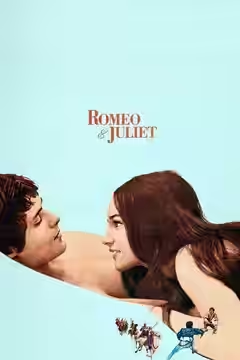
Watch the duel in the square in Zeffirelli's Romeo and Juliet (1968). Michael York's Tybalt arrives all hair and heat, a boy who fights because it is the one thing he does well, and the fight starts as two men showing off and ends with both of them meaning it. That is York as we like him: moving, hot-blooded, slightly too pleased with himself. It was the part that made his name, and it told the truth about him early.
He had come from the stage, the National Youth Theatre and then Olivier's National Theatre Company, and Zeffirelli had already given him his film debut as Lucentio in The Taming of the Shrew (1967). The 1970s made him a lead: Brian Roberts in Cabaret (1972), D'Artagnan for Richard Lester in The Three Musketeers (1973) and its sequels, Logan 5 in Logan's Run (1976). Then the leads thinned out, and the rest of the career is supporting parts, television, voice work and, from 1997, Basil Exposition in the Austin Powers films, a part whose name tells you what he is there to do. Zeffirelli and Lester each directed him three times.
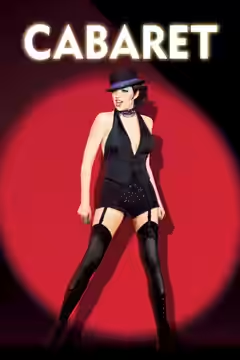
Cabaret is the film he will be remembered for, and it is the one where we are least sure he is doing anything. Fosse keeps the songs on the club stage and the plot in the boarding house, and Jay Presson Allen's screenplay gives Brian little to want. York plays him at a slight remove, so that we sometimes wonder why he is in Berlin at all. York has himself described the part as a vague centre with extroverts revolving round it, and that is a fair account of the design and of the problem. Watching him in the boarding-house scenes, we grew impatient for Minnelli and Grey to come back, and felt a little unfair about it, because he is doing exactly what the script asks. It just does not ask much.
He knew the danger. "I like a sort of swashbuckling role like the one in the musketeers films, because I think there's a danger if you're seen as just one type of British actor," he said in the 1970s. The type was the clean-cut, well-spoken gentleman, and it is what he was handed for two decades in period pieces and adventures; the complaint that it narrowed him is fair. His early parts were less tidy than that, in Cabaret and in Something for Everyone, and we wish more directors had noticed. The gentleman was a costume he wore well, not the whole man.
See him with a sword or a grievance. Asked to stand politely in the middle of a film, he does it beautifully, and the film walks past him.
Biography
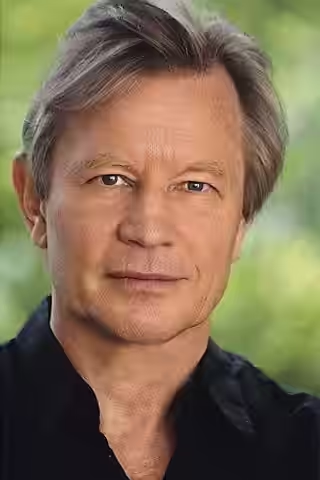
Michael York, OBE (born Michael Hugh Johnson) is an English actor. He trained at the University of Oxford, where he graduated with a degree in English in 1964, and performed with the National Youth Theatre and the Oxford University Dramatic Society. Early stage work included the Dundee Repertory Theatre and Laurence Olivier's National Theatre Company.
York made his film debut as Lucentio in Franco Zeffirelli's The Taming of the Shrew (1967) and had a breakthrough as Tybalt in Zeffirelli's Romeo and Juliet (1968). He played leading roles in 1970s films including Cabaret (1972), The Three Musketeers (1973) and its sequels, Murder on the Orient Express (1974) and Logan's Run (1976). In later career he portrayed Basil Exposition in the Austin Powers films (1997–2002).
York received the OBE in the 1997 Birthday Honours and a star on the Hollywood Walk of Fame in 2002. He is married to photographer Patricia McCallum.