Babylon 5 is worth the patience it demands of science-fiction viewers. Its long story gives personal grudges room to become absorbing drama, though a stiff opening and overemphatic dialogue make the first stretch harder work than it should be.
Peace is a fine stated purpose for a space station, though it leaves a television writer needing people who will make it difficult. Creator J. Michael Straczynski finds enough of them to sustain Babylon 5 across five seasons. We recommend it to anyone who enjoys science fiction with room for grudges, changing loyalties and decisions that continue to matter. There is a rough beginning to get through, however, and the series sometimes confuses giving a character something important to say with giving them a convincing way to say it.
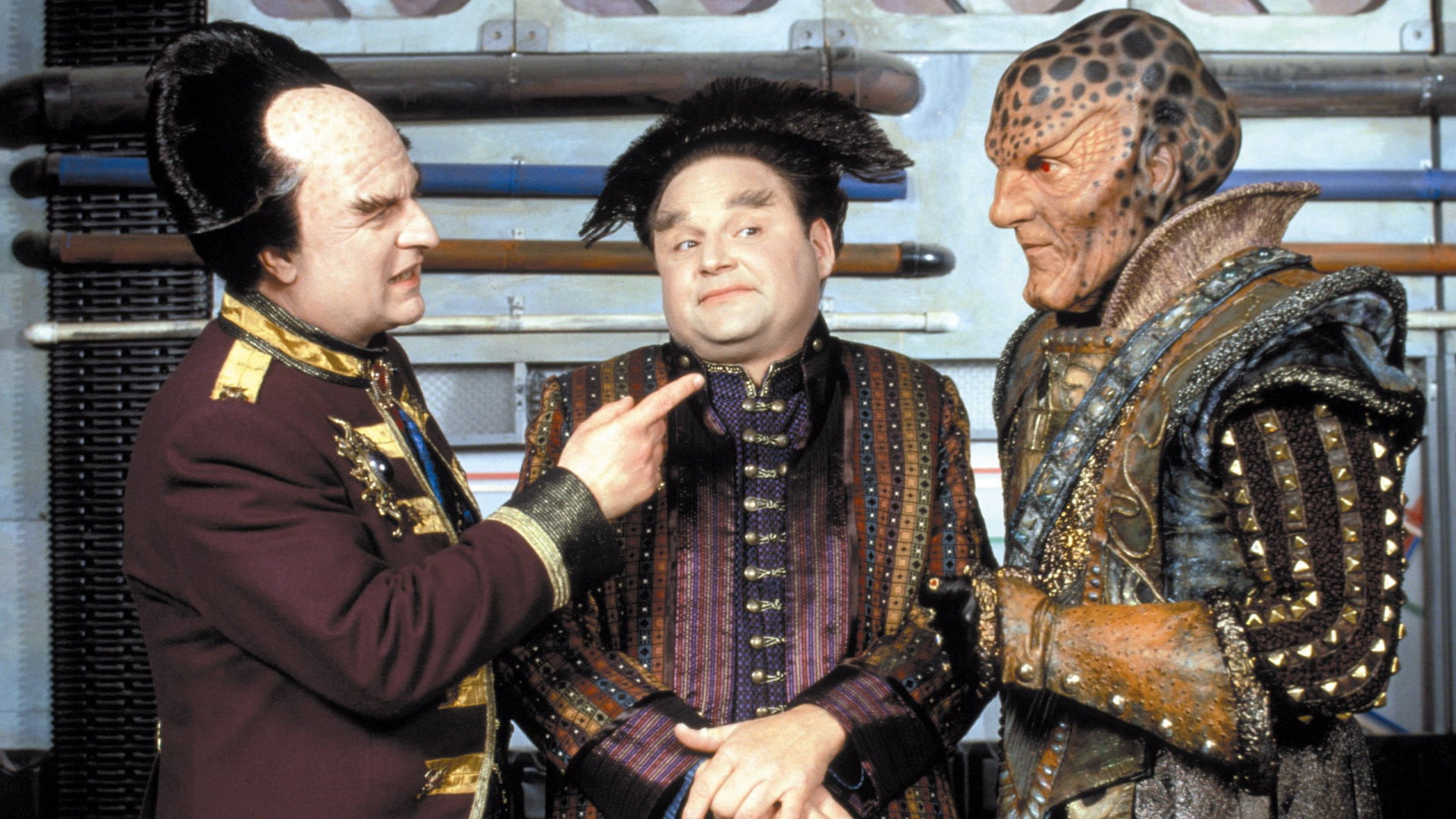
The strongest reason to stay is the antagonism between Londo Mollari and G’Kar. Peter Jurasik and Andreas Katsulas give these characters enough pride and sensitivity to make their exchanges hurt, even when the dialogue is pushing hard. We were moved more than we expected by their quarrels, because both actors make wounded pride recognisable beneath the alien appearance. Their performances encourage us to notice how personally each takes a disagreement, and the continuing story rewards that attention.
The long story earns its length by allowing characters to change without making their earlier behaviour irrelevant. In its middle stretch, the series has accumulated enough history for a confrontation to carry more than the immediate disagreement. This is where it becomes absorbing, and where the early patience is repaid. The later unevenness is a real reservation: maintaining a long story is also a matter of pace, and some stretches feel extended after their strongest material has passed.
Before that, there is a fair amount of awkward television. J. Michael Straczynski’s writing can lean heavily on statements of purpose, and the performances are not uniformly able to make those statements sound like conversation. Characters too often appear to be waiting for their next substantial speech. The ideas are worth hearing, but there are early exchanges in which we can feel the effort of getting them said.
John Iacovelli’s production design supplies a workable home for the drama, though the early surroundings do not always convince. We find the cinematography of Fred V. Murphy and John C. Flinn III least persuasive in those early conversations, where it does too little to make laboured dialogue interesting to watch. The CGI also demands tolerance. It becomes less distracting once people and their grievances are the reason to watch, but the opening gives the hardware more attention than it deserves.
The editing team, including Suzanne Sternlight and Skip Robinson, has the difficult job of making this much talk move. Early on, scenes can feel longer than the ideas inside them warrant, though the middle stretch gains considerable momentum as the continuing stories gather force. Christopher Franke’s music lends conviction to the larger drama. It can also make an already emphatic passage feel over-insisted upon; a little less instruction about what matters would help.
As science-fiction television, Babylon 5 is most persuasive when disagreements have consequences that cannot be tidied away at the end of an episode. The satisfaction comes from remembering how these people used to think and recognising what has changed them. That takes time, and the weaker stretches still count against it. Give it time if the genre appeals, but there is no obligation to pretend the awkward episodes are good.