Film review

All That Jazz

1979 · Directed by Bob Fosse · 2h 03m · MPA R

In a sentenceA choreographer flirts with the Angel of Death for two hours and she seems to be enjoying it

Drama

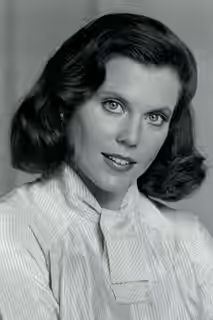
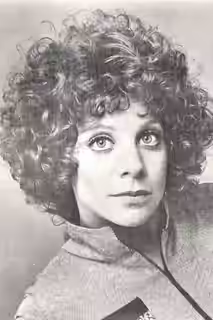
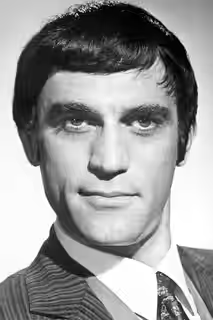
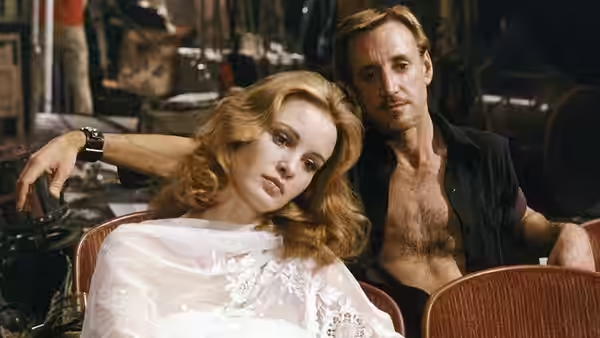
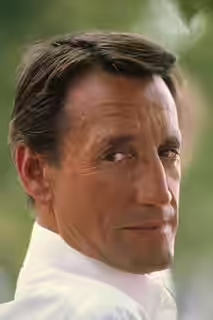
New York, the late 1970s. Joe Gideon (Roy Scheider) is a director and choreographer with two jobs and no sleep: by day he is casting and rehearsing a new Broadway musical, and by night he is in a cutting room failing to finish a film about a stand-up comedian, Davis Newman (Cliff Gorman). Every morning he takes Dexedrine, eye drops and Alka-Seltzer with Vivaldi playing, looks in the mirror and says, “It’s showtime, folks.” His girlfriend Kate Jagger (Ann Reinking), his ex-wife Audrey Paris (Leland Palmer) and his daughter Michelle (Erzsebet Foldi) all know he is sleeping with dancers from the chorus. Between scenes he sits in a white dressing room and talks about his life with a woman in a veil called Angelique (Jessica Lange), and she seems to be waiting for something.

Plays from YouTube when you press play; nothing loads from them until then.

Fi1m review

Bob Fosse’s film about a director dancing himself into the grave is vain, brilliant and often hard to like, and it is one of the few films about show business that knows exactly what the business costs. Roy Scheider carries it on a cigarette and a cough.

Bob Fosse made Cabaret in 1972 and Lenny in 1974, and then he made a film about a man called Joe Gideon who has just made a film about a comedian and is now staging a Broadway musical while his heart gives out. He has changed the names and almost nothing else. All That Jazz is a confession dressed as a musical, and it is one of the best things Fosse did. It is also exhausting, self-regarding and about twenty minutes too pleased with itself, and we would still recommend it.

The opening tells you what kind of film you are in. Hundreds of dancers audition in a theatre to “On Broadway”, and Alan Heim cuts them down to a dozen in a few minutes, so that we watch a room of hope become a room of rejection without a line of dialogue. Heim then builds the film around a refrain: Gideon’s morning routine, the pills, the drops, the shower, the mirror, “It’s showtime, folks”, repeated until it stops being a joke. Giuseppe Rotunno lights the rehearsal halls in plain grey daylight and the dressing room where Gideon talks to Angelique in a soft white haze, so that we always know which world we are in. Nobody has to explain who the woman in the veil is.

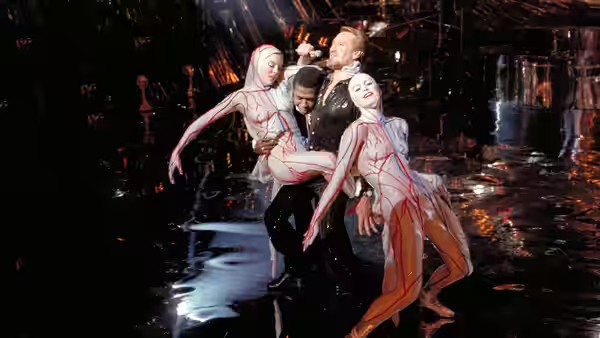
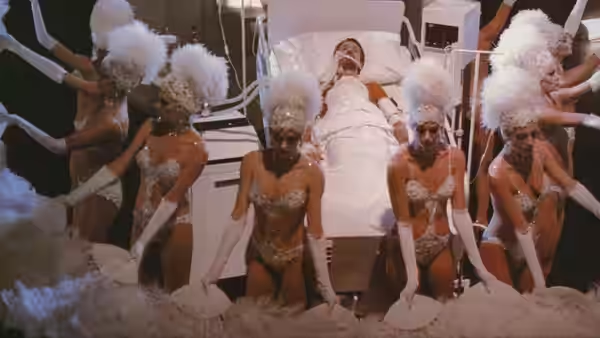
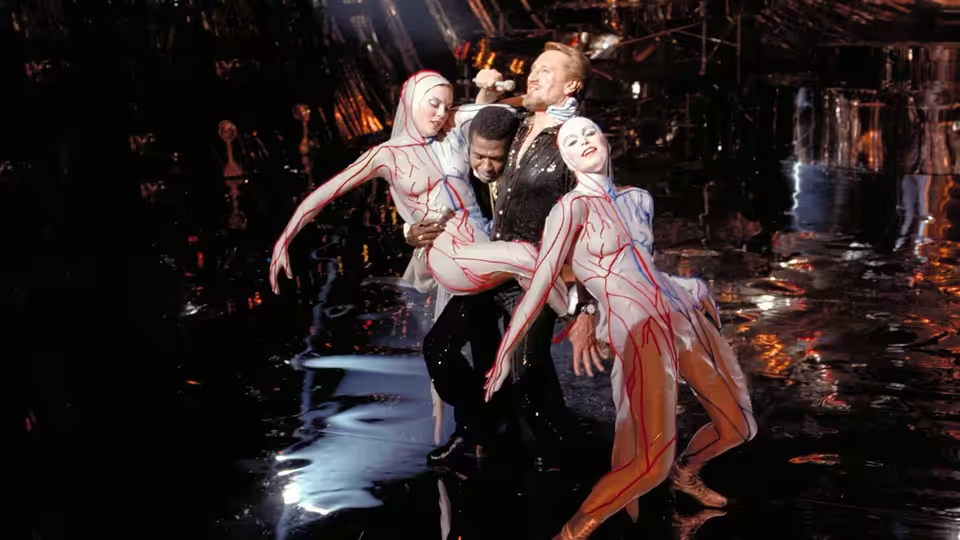
The centrepiece of the first half is a backers’ showing of a number called “Take Off With Us”. It begins as a cheery airline jingle, and then Gideon rebuilds it as a sweaty, near-naked orgy in half-light, with Ralph Burns’s arrangement slowing to a pulse and Albert Wolsky’s costumes reduced to almost nothing. We squirmed, frankly; it goes on, and it means to. Then Fosse cuts to the producers watching it, and their faces are so stricken that we laughed out loud and felt better. That is the film in one scene: it shows you the thing, and then it shows you what the thing costs the people who paid for it.

Scheider is the reason it holds. He plays Gideon with a goatee, a cigarette that is never out and a cough he keeps pretending not to hear, and he never once asks us to like the man. He is charming to dancers because it is quicker than being honest with them, and he knows it. Lange plays Angelique as a woman who has heard all his excuses before and is fond of him anyway. Reinking’s Kate and Palmer’s Audrey get the film’s best small moments, two women who have both been let down by him and have compared notes.

The scene that got at us is a quiet one. Kate and the young Michelle rehearse a dance for Gideon in his flat to “Everything Old Is New Again”, with no set, no lighting effects and no audience but him, and Foldi and Reinking are so clearly delighted to be dancing that we found ourselves moved before we had worked out why. It is the only number in the film that nobody is selling anything with. Gideon watches it and, for once, says the right thing.

The faults are real. Gorman’s Davis Newman does a routine about the five stages of dying, and the film plays it back so many times, in so many cuts, that it stops being clever and starts being homework. The second half moves into a hospital and slows badly; the fantasy sequences get bigger and the film gets smaller. And Fosse cannot help forgiving himself. Every woman Gideon has wronged turns up to say she loved him anyway, which may be true and is certainly convenient. Philip Rosenberg and Tony Walton’s sets are handsome throughout, but the late ones exist mainly to give the director a large room to be sorry in.

Critics have never agreed about this film, and the split is honest: what one viewer sees as candour another sees as a man filming his own eulogy. We lean towards candour, because Fosse puts the vanity on screen and lets us watch it kill him. Cabaret was about other people; this is about the one person he never managed to direct.

See it in a cinema if one will have it, because the audition needs a big room. It runs 123 minutes, carries a 15, and the music will stay in the head for a week whether wanted or not.
Critical consensus AI synthesised

71
Positive
7
Mixed
0
Negative
2

Most critics admire All That Jazz, and the praise settles on Bob Fosse himself: his direction, his choreography, and the nerve of making a musical about his own excess and his own death. The production numbers are singled out again and again, as is the editing, which several reviews credit with the film’s manic energy. Its candour about show business sleaze and a man’s preoccupation with dying is taken as a virtue rather than a confession too far, and Roy Scheider’s performance is noted with approval.

The reservations cluster on the ego. Even the admirers concede that Fosse’s self-regard is enormous and that parts of the film make one wince. The two dissenters go further: Variety calls it self-important and finds no explanation of what drives the man beyond vanity, while Time Out judges the whole thing self-indulgent, the dance numbers built in the cutting room and the surreal passages flat. The spread is wide, from outright dismissal to unreserved acclaim.

Slant Magazine
25 August 2014
90*

The Criterion edition confirms the film as a brilliant musical X-ray of showbiz excess and self-destruction. The transfer preserves the seamy, gritty, furious poetry of Fosse's direction and choreography.

Read the full review →
The New York Times
20 December 1979 · Vincent Canby
90*

The film is an uproarious display of brilliance, nerve, dance, maudlin confessions, inside jokes and ego, essentially a funny movie that operates on too many levels at once but gives the customers their money's worth. Some of it makes you wince, but a lot of it is great fun, with big beautiful steamy Fosse production numbers and the figure of a man who deserves the attention he affords himself.

Read the full review →
Empire
1 January 2000 · Kim Newman
85*

The critic calls it a fascinating, imaginative and intimate biographical musical drama, a startlingly candid testament from Bob Fosse featuring sensational dancing and eye-popping production numbers. It is praised as an unmistakable classic that stands alongside Cabaret as one of the best musicals of its era.

Read the full review →
Film Comment
· Michael Koresky
85*

The critic describes the film as a tricky masterpiece and a wrenching autobiographical work, noting its uncommonly heterosexual perspective on a philandering showman in a gay-dominated milieu while praising its matter-of-fact treatment of identity and personal neuroses.

Read the full review →
Los Angeles Times
1 April 2007
70*

Fosse warped the movie musical to his purposes in a way that could never quite be repeated; it is a bravura feat of narcissism and an obsessive biopic that exerts a morbid fascination rather than seeking audience approval, reaching a black-comic peak in the final musical number.

Read the full review →
Variety
31 December 1978 · Variety Staff
30*

It is a self-important, egomaniacal, wonderfully choreographed, often compelling film portraying the energetic life and preoccupation with death of a director-choreographer who suffers a heart attack; Roy Scheider gives a superb performance, but the major flaw is its lack of real explanation of what beyond ego motivates the character.

Read the full review →

Cast

Awards

Academy Awards, 1980

Nominated
Best Actor
Nominated
Best Cinematography
Nominated
Best Director
Nominated
Best Picture
Nominated
Best Writing, Original Screenplay
Won
Best Costume Design
Won
Best Film Editing
Won
Best Original Song Score
Won
Best Production Design

Cannes Film Festival, 1980

Won
Palme d'Or

If you liked this, try…