Fosse's dancers stand with knees turned in and hats over one eye, and he films them from where the paying customer sits. On the strength of Cabaret he is the rare director of musicals who distrusted applause, and we rate him highly.
Fi1m perspective
A Fosse dancer stands with knees turned in, fingers splayed, shoulders rolled forward and a bowler tipped over one eye. It is a posture borrowed from vaudeville and burlesque, and it looks less like a person dancing than a person being made to. In Cabaret (1972) Joel Grey conducts a chorus of them like a man who finds everything funny and nothing surprising, and Fosse keeps the camera down among the tables so that we watch as the clientele does. That is the method in one shot: the number is on a stage, and we are shown who is clapping.
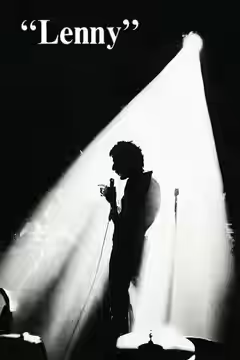
He came to the camera late. Fosse was a child performer in Chicago's vaudeville and burlesque houses, a professional dancer at thirteen and then, from The Pajama Game (1954), a Broadway choreographer for fifteen years before he directed a film. Sweet Charity (1969), from his own stage show, came first. Then Cabaret, and then a turn away from song altogether: Lenny (1974), a biography of Lenny Bruce told in fragments and interviews; All That Jazz (1979), a semi-autobiographical film about a director who cannot stop working; and Star 80 (1983), a stark drama about the murder of Dorothy Stratten, his last. We have reviewed only Cabaret, and it carries the weight here.
It can. Fosse's decision that nobody sings unless they are paid to was something the film musical had almost never tried, and it is what makes the film. Geoffrey Unsworth lights the Kit Kat Klub from the footlights, so every face shines with grease, and the songs by John Kander and Fred Ebb are good enough to enjoy and nasty enough to enjoy with a bad conscience. The one number outside the club, a blond boy singing 'Tomorrow Belongs to Me' in a beer garden while the tables get to their feet one at a time, horrified us, and what horrified us was that we had been enjoying the tune. Fosse does not cut to a clenched fist. One old man stays seated.
The charge against him, then and since, is that the work is calculated: polished until feeling cannot get in. There is something in it. The sequence in Cabaret that cuts a slap-dance against a beating in an alley makes its point on the first cut and keeps making it, and a director less pleased with his own precision would have let it go. He knew the complaint. "I've really tried to vary my choices to try to get rid of whatever it is that people call my style," he said in 1978, and the dramas that followed Cabaret are that attempt.
He kept the same dancers around him for years: Gwen Verdon, his muse and assistant choreographer, Ann Reinking, Kathryn Doby, all of whom knew what the turned-in knee was for. Start with Cabaret, and watch the beer garden twice. The second time you know what is coming, and it is worse.
Biography
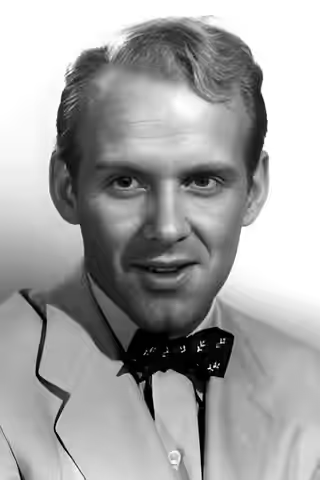
Bob Fosse was an American director, choreographer and screenwriter. Born in Chicago, he began his career as a dancer and performer before moving into choreography on Broadway productions including The Pajama Game (1954) and Damn Yankees (1955).
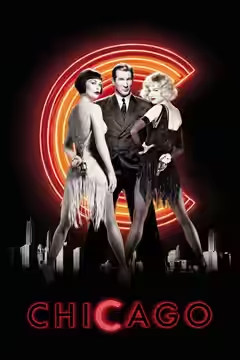
He directed the films Sweet Charity (1969), Cabaret (1972), Lenny (1974), All That Jazz (1979) and Star 80 (1983). Fosse also directed and choreographed stage musicals such as Pippin (1972) and Chicago (1975). He died in Washington, DC, in 1987.