Minnelli plays women who want to be looked at, and lets us see what is under the bright surface. On the small club stage of Cabaret it is extraordinary; her later films mostly asked for the energy and not the rest.
Fi1m perspective
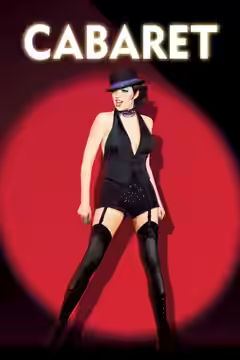
Sally Bowles sits astride a bentwood chair in a bowler hat and black stockings and sings 'Mein Herr' at a roomful of people who have paid to look at her, and Liza Minnelli does not so much perform the number as insist on it. The movement is angular and unpredictable, the whole body arguing for attention. Off stage, in a shabby fur, she still looks half in costume, which is Charlotte Flemming's doing and also the point. Sally wants to be seen so badly she has stopped seeing anything else, and Minnelli plays her as loud, pushy and a little exhausting, because that is what such a woman is.
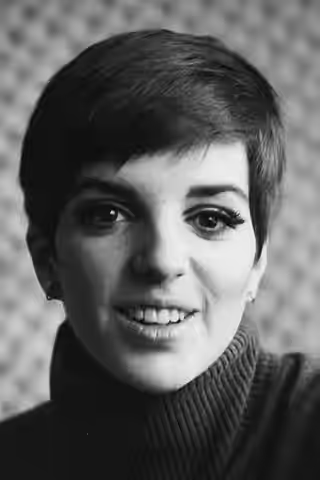
The wanting is the through-line. Pookie Adams in The Sterile Cuckoo (1969), her first large film part, is a needy, eccentric girl; Sally in Cabaret (1972) is the same appetite with better songs; Francine Evans in New York, New York (1977) and Linda Marolla in Arthur (1981) both decide to be cheerful and then dare the world to argue. She has said she considers herself an actress first, a dancer second and a singer third, and the films bear that out more than the legend does. What she acts, every time, is the gap between the bright face and whatever is behind it. The television special Liza with a Z (1972), made with Bob Fosse the same year as Cabaret, is where the look was fixed: the pixie cut, the eyelashes, the slouchy clothes cut to move in.
Fosse is the director who got the best of it. He keeps the numbers on a tiny club stage and will not let the film open out, so her size has walls to hit, and David Bretherton cuts 'Maybe This Time' against Sally and Brian in the boarding house so that a song becomes a scene. It moved us more than we expected. Her face at the end of the last note has given up before the applause starts, and that small collapse tells you more about Sally than any of the dialogue does. John Kander and Fred Ebb wrote her the songs, on stage and on screen, for a big alto that fills a room without help.
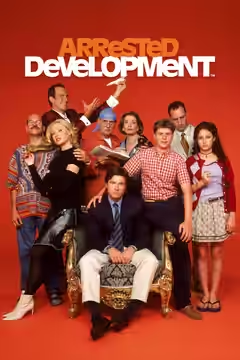
The usual charge against her films is that she is manic and everything is built towards the finale, and New York, New York is where it is most often laid. Scorsese directed her twice, and both times the films wanted her voltage. Few directors seem to have wanted her quiet, and it is fair to wonder whether the sequins got in the way. Later work is guest turns, Arrested Development among them, and a great deal of concert stage. Start with Cabaret, and watch the chair number twice, once for the legs and once for the eyes, which are doing something quite different.
Biography
Liza Minnelli is an American actress and singer. She was born on 12 March 1946 in Los Angeles, California, the daughter of actress and singer Judy Garland and film director Vincente Minnelli.
She began her stage career with an Off-Broadway appearance in the 1963 revival of Best Foot Forward and won the Tony Award for Best Actress in a Musical for her performance in Flora the Red Menace (1965). Minnelli received the Academy Award for Best Actress for her portrayal of Sally Bowles in Cabaret (1972).
Her other film roles include The Sterile Cuckoo (1969), New York, New York (1977) and Arthur (1981).