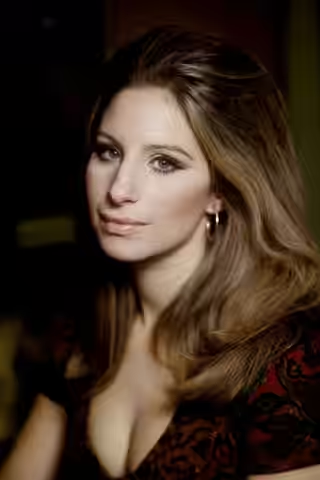
Streisand plays women who decided they were stars some years before anyone agreed, and sings as though it were another way of acting. In Funny Girl she is loud, funny and then suddenly not; in the films she later directed, the hand on the tiller shows.
Fi1m perspective
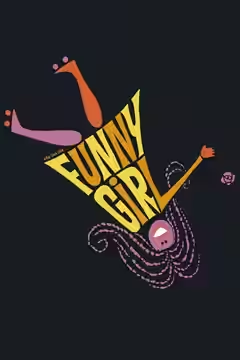
At Keeney's, in Funny Girl (1968), Fanny Brice is put on roller skates for a chorus number and cannot skate. She takes half the line down with her and turns the wreckage into an encore. We laughed out loud, which we do not often do at a musical of that age, and it told us most of what there is to know about Barbra Streisand: the joke starts in the body, and the character has decided she is a star some years before anyone else has. Then, halfway through 'People' on a stoop at night, she stops being funny, and the film goes quiet with her.
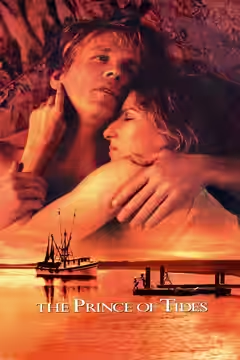
She had played Fanny on Broadway since 1964, and William Wyler's film existed to put her in front of a camera. The musicals and comedies of the 1970s used what he found: What's Up, Doc? (1972) ran her through a screwball plot opposite Ryan O'Neal, and The Way We Were (1973), for Sydney Pollack, set her against Robert Redford in a romantic drama whose title song became a hit in its own right. The turn came with Yentl (1983), which she wrote, produced, directed and starred in, the first major studio film on which a woman had done all four. The Prince of Tides (1991), with Nick Nolte, and The Mirror Has Two Faces (1996) followed the same plan. Since then she has taken supporting comic parts, in Meet the Fockers (2004), Little Fockers (2010) and The Guilt Trip (2012).
The singing is the acting, not a break from it. Jule Styne wrote the Funny Girl songs to reach the back of a theatre and Streisand sings them there, but the words stay clear and the volume rises and falls with the sense, so that 'Don't Rain on My Parade' is a woman talking herself off a railway platform, through a train and onto the bow of a tugboat. Wyler and Harry Stradling shot the numbers wide and straight on, as if from a good seat in the stalls, and let her fill the frame. We sat up. The women she plays are of a piece: strong-willed, often Jewish, not conventionally pretty, and winning on wit and talent because nothing else was on offer.
What she needs is something to push against. In Funny Girl Omar Sharif gave her none, so the marriage that fills the second half is a thing we take on her word. The films she directed herself have been faulted for a soft centre, The Prince of Tides most of all, and collaborators have found her exacting on set. She has noticed what that gets called: "Why am I called an egotist? Is it because I dare to do more than one job? Why do you think men are not called egotists?"
She has a point. Start with Funny Girl, and give it the first ninety minutes at least. Everything that came after, the director's chair included, is already there in the girl who pads out a wedding gown to wreck Ziegfeld's bridal tableau, and would rather run the show than be in it.
Biography
Barbra Streisand is an American actor. She made her screen debut reprising her Broadway role as Fanny Brice in the musical Funny Girl (1968), directed by William Wyler, and won the Academy Award for Best Actress.
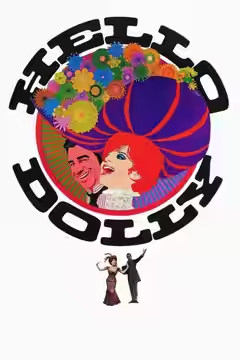
Her other film credits include Hello, Dolly! (1969), What's Up, Doc? (1972), The Way We Were (1973), A Star Is Born (1976) and The Mirror Has Two Faces (1996), which she also directed. She later appeared in Meet the Fockers (2004) and The Guilt Trip (2012).