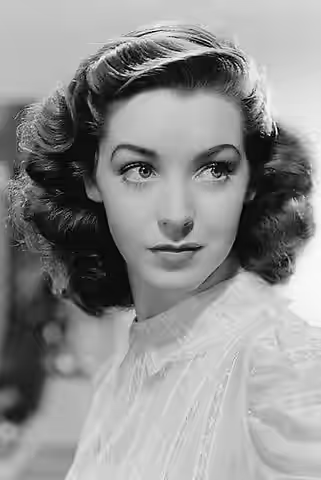
Marsha Hunt was a supporting player by trade and, on the evidence, by conviction: she turns up for ten minutes, does the most truthful acting in the picture and leaves before the film can sentimentalise her. The films around her rarely deserved it.
Fi1m perspective
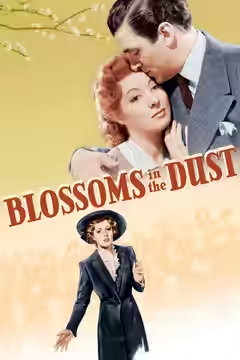
Early in Blossoms in the Dust (1941), a film we found handsome and hard to believe, a young woman called Charlotte is told by someone else's mother exactly what the town thinks of her. Kathleen Howard delivers the cruelty without softening a syllable. Hunt takes it without asking us to feel sorry for her, and that is her method. Everyone else in the picture is playing for our sympathy; she is playing the scene. It is the most honest acting in the film and it is over inside ten minutes.
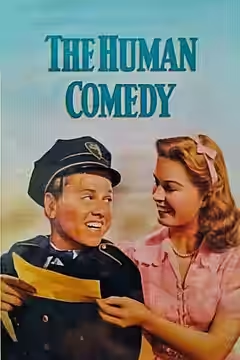
That was the shape of the job. Hunt went into films at Paramount in 1935, moved to an MGM contract in 1939 and by 1949 had made more than fifty of them, as ingénues, society girls, wives and character parts, frequently playing older than she was. Mary Bennet in Pride and Prejudice (1940) is the early one people remember. The Human Comedy (1943) gave her Diana Steed, courted by James Craig's telegraph manager, and our complaint there was with the writing, not with her: the courtship adds nothing but running time to a film already too sure of its own decency. That is the supporting player's lot. You are exactly as good as the scene they have given you, and MGM in the war years gave her a great many scenes that were there to make the picture longer.
She seems to have known it and not minded. "I didn't care about billing. I didn't care about being the lead, fame or anything like that. I didn't want to be a star: I wanted to be the best actress I could possibly become," she said in 2015. The films we have reviewed bear that out. Nothing in them is pitched at the back row. In Blossoms we had stopped believing the picture by the time she arrived and, for her few scenes, believed it again, because she is the one person on screen behaving as if the situation were real rather than uplifting.
The noir Raw Deal (1948) is the one retrospectives cite from the end of the studio run. Then, after 1950, the film work all but stopped, for reasons that had nothing to do with her acting. There was stage and television, and a return to features as Joe's mother in Johnny Got His Gun (1971), written by Dalton Trumbo. Her last film was in 2014. We cannot vouch for those we have not seen. What we can say is that in two middling MGM pictures she is the part that has not dated, and if you want to see what she did, start with Blossoms in the Dust and watch her rather than the film. She will not be on screen long. She never was.
Biography
Marsha Hunt (born Marcia Virginia Hunt) was an American actress whose career spanned nearly eighty years. She appeared in dozens of films from the mid-1930s onwards and later worked extensively in television and on stage.
She made her screen debut after signing with Paramount Pictures in 1935 and went on to roles at MGM, including Mary Bennet in Pride and Prejudice (1940) and Charlotte in Blossoms in the Dust (1941). Other notable films include Raw Deal (1948) and Johnny Got His Gun (1971). Hunt was blacklisted in the 1950s after protesting the House Un-American Activities Committee as a member of the Committee for the First Amendment.
From the 1950s she found regular work in television series such as The Twilight Zone, Alfred Hitchcock Presents, Gunsmoke, Murder, She Wrote and Star Trek: The Next Generation. She also performed in theatre productions in New York and on tour.