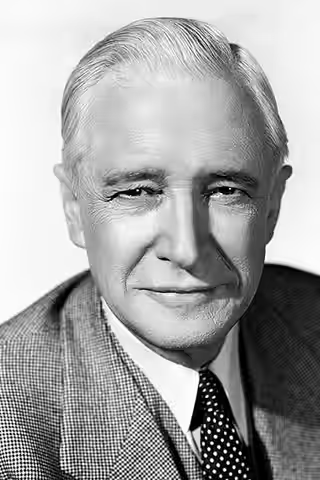
Samuel S. Hinds spent thirty years as a lawyer and the next sixteen playing the judges, doctors and fathers a lawyer would have known. He was never the point of a film and rarely its problem, and a Hollywood ensemble was steadier for having him in it.
Fi1m perspective
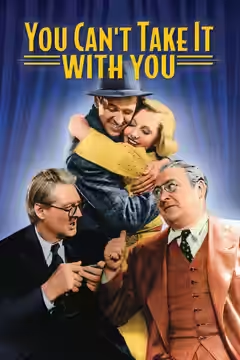
In You Can't Take It with You (1938) Samuel S. Hinds is down in the cellar making fireworks with an iceman who came to deliver and never left. Upstairs a daughter dances in a tutu, a son-in-law plays the xylophone and a mother types plays because a typewriter once arrived by mistake. Hinds, as Paul Sycamore, is the father of this house and makes no attempt to run it. He is content to be one more thing happening in the background of Joseph Walker's deep frames, and we warmed to him before he had said much of anything, which is roughly the effect he had on films for sixteen years.
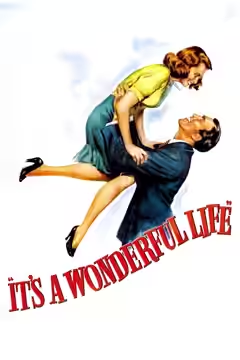
He came to it late. Hinds practised law for more than three decades, lost his money in the crash of 1929 and turned professional actor in his mid-fifties by way of the Pasadena Community Playhouse, where he had long been an amateur. The film work was steady from If I Had a Million (1932) and did not stop until his death in 1948, by which time he had appeared in something over two hundred pictures. Nearly all of them were supporting parts: Mr March in Little Women (1933), Judge Slade in Destry Rides Again (1939), Charles Pringle in Scarlet Street (1945), and, for Frank Capra a second time, Pa Bailey in It's a Wonderful Life (1946). The 1940s were mostly spent at Universal, in Abbott and Costello comedies and half a dozen Dr Kildare films opposite Lew Ayres.
What he offered was a tall, well-tailored calm. Directors cast him as men people defer to, and he never had to raise his voice to earn the deference; the casting did half the work and his bearing did the rest. He said of the change of trade that he had nothing to lose, for he had lost everything, and there is something of that in the performances, a man with no need to impress anyone standing quietly at the edge of the scene.
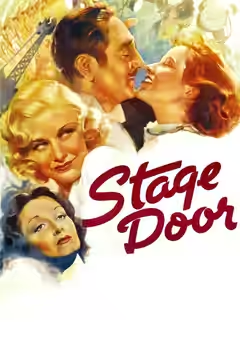
The limit is the same as the virtue. In Stage Door (1937), a film we admire a great deal, he plays Henry Sims and we cannot honestly say we noticed him; La Cava's picture belongs to the women in the boarding house, and Hinds does what the part asks and nothing the part does not. That is the whole career in miniature. He was reliable, he was clear, and he was seldom asked for more, so we cannot say whether more was there.
Start with the Capra house, where the noise is the point and he is happily part of it. Then, if you are curious, watch for him in the Universal programme pictures of the following decade, where a man who had spent his working life in front of the bench spent his retirement sitting on it.
Biography
Samuel S. Hinds was an American actor. He appeared in more than 200 films between 1926 and 1948, often in supporting roles as kindly authority figures such as lawyers, doctors, judges and fathers.
Born in Brooklyn, New York, Hinds trained as a lawyer, graduating from Phillips Academy, Andover, and Harvard Law School. He practised law for over thirty years before the 1929 financial crisis prompted him to turn to acting. He joined the Pasadena Community Playhouse and began his screen career at the age of 54.
Hinds is known for his performances in Frank Capra films including You Can't Take It with You (1938) and It's a Wonderful Life (1946). He also appeared in Stage Door (1937), Destry Rides Again (1939), Scarlet Street (1945) and several Abbott and Costello comedies. He died in Pasadena, California, on 13 October 1948.