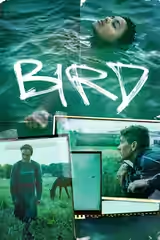
Most critics warm to Bird, and the spread is fairly narrow: ten positive, three mixed, none hostile. The praise settles almost unanimously on Nykiya Adams, a newcomer, whose performance as Bailey is described again and again as the thing that holds the film together, with Barry Keoghan’s volatile father Bug and Franz Rogowski’s gentle stranger close behind. Many reviews also single out the soundtrack and an unexpectedly hopeful final stretch.
The reservations gather around Arnold’s move from kitchen-sink realism into fable: several critics find the magical elements jarring or say they do not cohere, and a few note a drift into sentimentality. Slant goes furthest, finding the narrative slack and the artful touches a drag on authenticity, while Collider and Variety suspect the film will chiefly please those already fond of Arnold. At the other end, NME is the most enthusiastic and awards full marks. The arguments are about the fairy tale, not the girl at the centre of it.
E
Empire
5 November 2024 · Sophie Butcher
85*
This is a classic Andrea Arnold picture about hope, with striking new talent in Nykiya Adams as Bailey and moving insight into life on the margins. The critic highlights the tender friendship between Bailey and the enigmatic Bird, Keoghan's comedic yet heartfelt performance as Bug, and the uplifting final sequence.
Social and magical realism merge in Andrea Arnold’s scintillating Thames Estuary fable about the friendship between a latchkey kid and a smiling wanderer searching for home. Bailey’s feelings of rejection have led her to reject the world back in turn, but the arrival of Bird starts to change her perspective through a patchwork of moments.
With a high-velocity energy rarely found in social-realist dramas, Andrea Arnold’s coming-of-age film races between gritty realism and magical fabulism while barely pausing for breath. Arnold effectively explores the point at which human nature and animal instinct meet, balancing the mood with care without shying away from the grimmer aspects of Bailey’s life.
The critic praises Arnold's feral, fantastical drama as her closest film to a feelgood flick, celebrating unconventional characters and finding beauty in marginalised lives. The remarkable newcomer Nykiya Adams as Bailey is singled out for her bristling, pugnacious performance.
Arnold combines kitchen-sink realism with magical realism in a working-class fairy tale that finds freedom and joy despite cycles of poverty. The critic praises the lively chemistry between Barry Keoghan and Franz Rogowski, and the gentle presence of newcomer Nykiya Adams as Bailey, leading to an affirming, buoyant conclusion.
The critic sees it as a flawed modern fairy tale where Arnold dabbles in surrealism that feels overwrought as a metaphor for survival, favoring caricature over nuance though praising the soundtrack and the lead performance.
The film is an endearing but ungainly mix of gritty drama and fairy tale that is compelling yet sketch-like, with strong performances especially from the young lead though tonal shifts around the character Bird prove tricky.
The critic finds the film a gritty yet sentimental coming-of-age fable where artful indulgences detract from authenticity, with strong direction of actors but narrative lacking urgency and coherence.
The critic calls it a far more accomplished return to the themes of Fish Tank, with Barry Keoghan delivering a tour de force as the volatile father Bug. She singles out the film's focus on nature and freedom amid social realism, loving the touch of magical realism despite potential criticism.
The review calls it a bold modern fable with a kinder, sadder creature than Hitchcock's birds, highlighting the youthful sense of possibility shared by the tough 12-year-old protagonist and the cryptic stranger.
The critic notes Arnold goes surreal in her strangest movie yet with Barry Keoghan and Franz Rogowski shining to varying results in the story of a girl's friendship with a kindly vagabond.
The review highlights a hopeful streak in this raw fable about a young girl's search for stability amid hardship, praising the poetic visuals, strong performances by the leads, and Arnold's blend of social realism with fantasy elements.
Andrea Arnold blends gritty and magical realism in her Kent-set Competition title starring Barry Keoghan. Arnold weaves a subtle mix between gritty realism and the magical kind, rolling up several of the themes that have caught Arnold’s attention over the years.
Newcomer Nykiya Adams triumphs in this otherworldly kitchen sink story of a young girl who forms a bond with a peculiar stranger. Arnold grapples with the very real dilemma of how to keep one’s senses, and spirit, alive, against uncertainty and pain.
The critic finds the film an uplifting, entrancing magical-realist fable that transforms from gritty social realism, praising the director's knack with actors especially the young lead and the optimistic ending while noting some sentimentality.
The critic finds the film warm and sincere, praising its focus on love, safety, and the realization that parents are doing their best. It singles out the heartfelt performances and emotional authenticity in depicting chaotic family life.
The critic applauds Arnold's ambitious blend of social and magical realism as strange, beguiling and quietly moving, noting the big swing in the final sequence with special effects.
The critic sees it as a gritty yet fantastical coming-of-age tale that mixes emotional poverty with fairy-tale elements but questions its authenticity and broad appeal, noting it may mainly satisfy Arnold's fans.
The critic hails it as a divisive but life-enhancing masterpiece blending social realism with magical realism. The stellar soundtrack and scenes of unexpected grace and optimism are singled out for praise.
The film threads the line between real and surreal in a tender coming-of-age fable, with standout gentle empathy from Rogowski and a career-making turn from newcomer Adams. Arnold captures a tangible sense of place and the beauty in formative relationships.
The critic calls it one of the year's best British movies, praising Arnold's generous, non-judgmental take on working-class life blended with surreal elements. Nykiya Adams' debut performance is singled out as superb.
The review notes that the film feels too familiar overall despite welcome additions like magical realism, and is unlikely to win over non-fans of Arnold's style. It singles out Barry Keoghan's charismatic performance as Bug and the standout introduction of the titular Bird character for shining moments.
The critic finds it a textured and lived-in coming-of-age fairytale that is brilliant when it flows. The more fantastical elements are singled out as sometimes jarring or not landing in execution.
The critic finds Arnold's film a redemption tale amid bleakness, with a sunlit ray of hope at the end thanks to fantastical elements. Rogowski's captivating performance as Bird and strong turns from the young cast are singled out for praise.
Arnold returns to social-realist territory with a dysfunctional family tale lifted by fantasy and magical realism elements that provide an uplifting outcome. The non-professional young lead gives a knockout performance that draws viewers into her marginal existence.
Arnold leans into magical realism in this coming-of-age story about a young girl navigating family upheaval and a mysterious stranger, but the approach does not always cohere. The young lead delivers an enormously engaging performance that anchors the film.
The critic praises Arnold's shift into a more fantastical fairy tale that blends raw brutality with transcendence through magical realism. They single out the central performances, especially Franz Rogowski as Bird and newcomer Nykiya Adams, for capturing compassion and a child's imagination amid harsh circumstances.
The critic calls the drama arresting and surreal, noting it takes a big swing into magical realism that largely works. Nykiya Adams' astounding debut performance is highlighted as the standout element that makes the film soar.
Ordered by the weight we give each publication, then by score. Scores are normalised to 100; * means inferred from an unrated review. Summaries are ours, not quotations; follow the links for the reviews themselves. How we rate