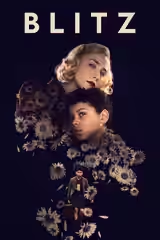
Most critics like Blitz, though the spread is wide. Praise clusters on the craft, the production design and the set-pieces recreating bomb-struck London, and on the two central performances, with newcomer Elliott Heffernan singled out as often as Saoirse Ronan. Many also credit McQueen with correcting the cosy myth of Blitz spirit, showing racism, class division and looting alongside the shelters and sing-songs.
The reservations are consistent: the picaresque, episode-by-episode structure leaves characters thin, and several reviews find the wartime clichés McQueen is meant to be dismantling turning up in his own film. The Financial Times awards full marks and calls George’s odyssey the best of it, while Variety finds the whole thing skilful but almost shockingly conventional, and Vulture rates it McQueen’s weakest. Notably, the warmest notices come from the British press; the sharpest doubts arrived from festival screenings, where the trade and independent outlets were far cooler.
F
Financial Times
31 October 2024 · ★★★★★ · Danny Leigh
100
McQueen tells the story of bomb-struck London through the eyes of a family and especially a child. The film is a bravura wartime epic, greatest in the odyssey of young George, with British filmmaking of which to be proud.
McQueen’s wartime drama is a monumental achievement and expressionist masterpiece that feels new and revelatory. It singles out the director’s focus on ordinary lives, diverse London, and the power of community amid intolerance and war.
McQueen’s sensational wartime adventure ranks among the very best, thrilling, moving and morally provoking. It is a big-picture British film of scale and depth that reimagines London during the Blitz.
The critic praises the film’s use of classical storytelling to present a radical view of the war, highlighting its focus on internal societal conflicts alongside external threats. It singles out the portrayal of racism and chaos within London for praise.
This is Steve McQueen’s most accessible film to date, mixing epic sweep with textured detail while remaining gripping and emotionally powerful. It singles out the raw, fresh take on familiar wartime situations and strong central performances, especially from the young lead.
The critic praises the film's honest portrayal of Blitz-era London through a biracial child's eyes and McQueen's assured direction. They single out the captivating lead performance by newcomer Elliott Heffernan and the dynamic Hans Zimmer score for praise, while noting occasional heavy-handedness.
The critic describes the film as muscular and sincere in its reckoning with historical incident and home-front life. It singles out the top-notch craft, including cinematography and production design, for praise while noting its inclusive view of Britain’s racist past.
The critic commends the film's fiery challenge to romanticised 'Blitz spirit' myths by exposing social and racial divisions in wartime London. They single out its technical spectacle, avoidance of clichés, and strong central performances for praise.
The film is a pitched battle between war-movie conventions and stranger chaos; McQueen's eye for detail creates a frequently beautiful, challenging picture despite a frame too tight for all its ambitions.
McQueen delivers a straightforward, handsomely managed period drama about a boy and his mother during the London Blitz. The film is praised for its sturdy, unfussy construction and honest simplicity, likened to an Anderson shelter.
The critic finds the film unfocused and overly commercial, with uneven characterisation and a picaresque structure that dilutes its impact. They single out its impressive technical achievements and diverse depiction of 1940s London for praise, while deeming it less potent than McQueen's earlier work.
9 October 2024 · festival review · Owen Gleiberman
60*
The critic calls the film skillful and touching yet almost shockingly conventional and middle-of-the-road. It singles out the detailed recreation of Blitz-era London for praise while complaining that it lacks moral complexity or dramatic depth.
9 October 2024 · festival review · Leslie Felperin
55*
The critic finds the film admirably crafted in its details and craft but overly clichéd and lacking subtlety, with over-familiar tropes dulling its impact.
The critic describes the film as lavishly produced but disjointed and schematic, with a muted central child performance and unsubtle handling of racism. They single out its impressive set-pieces and production design for praise while noting it lacks cohesion and emotional depth.
The film is not McQueen’s finest but streets ahead of typical wartime schmaltz, anchored by a strikingly assured child performance. It singles out the detailed period evocation and corrective view of London’s diverse Blitz experience through the boy’s eyes.
31 October 2024 · Critic’s Pick · Alissa Wilkinson
The critic finds the film appears conventional on the surface but targets triumphalist WWII narratives. It singles out McQueen’s sharp depiction of racism and class divides among Londoners during the Blitz for praise.
McQueen’s propulsive yarn is a breathtaking love letter to London on the brink, with strong performances. The city itself emerges as the most heroic character in this instantly great London movie.
McQueen crafts a dazzling, humane portrait of resilience in war-torn London, praised for its visuals, performances (esp. newcomer and Ronan), and inclusive Dickensian tale, with warmth and optimism shining through.
The critic calls the film a masterpiece and one of the most enormous cinematic experiences in recent memory, blending epic scale with intimate drama and modern insight. It singles out the child's perspective for revealing the era's complexities and racism in fresh ways.
The critic praises McQueen for focusing on civilians, working-class people, and minorities during the Blitz rather than soldiers or leaders. Immersive set pieces and strong performances across the ensemble make it a soulful, affecting human story.
The critic finds McQueen's film a gripping and moving human story of a young boy navigating the Blitz, with strong performances especially from newcomer Elliott Heffernan and Saoirse Ronan. It is praised for its timely relevance, superb technical craft, and focus on the human price of war.
McQueen delivers a powerful, ground-level portrait of wartime London through vignettes of a young boy's perilous journey home and his mother's search, blending chaos with grace notes and strong performances from the leads. The episodic structure holds it back from being his best work, but it remains engaging and unique.
The review finds the film drearily conventional and overly reliant on familiar WWII tropes despite some artistic flourishes and strong music sequences. It singles out the lack of originality in its depiction of civilian turmoil and mounting tragedies.
Visually stunning with authentic Blitz depiction and strong performances, but narrative is thin, characters underdeveloped, emotional impact inconsistent, missing the mark despite ambition.
McQueen offers a withering vision of London during the Blitz that challenges the myth of stoicism and solidarity, highlighting heroes alongside violent police, racists, and criminals. However, the film only delivers this spiky perspective in bursts while also indulging in war-movie clichés, as if torn between surreal horror and conventional melodrama.
McQueen's film mixes compelling and clichéd elements in a WWII drama that feels like an anthology, excelling in portraying humanity under extremes but ultimately falling short as an anthology structure leads to underdeveloped characters and a Sunday-teatime drama feel.
The critic sees the film as McQueen pushing toward wider acceptance with a picaresque story that revises historical narratives from a child's and minority perspective but finds it compromised by overdone intensity and mechanical elements. It singles out the tension between avant-garde instincts and crowd-pleasing sentiment.
Ordered by the weight we give each publication, then by score. Scores are normalised to 100; * means inferred from an unrated review. Summaries are ours, not quotations; follow the links for the reviews themselves. How we rate