Critics’ reviews

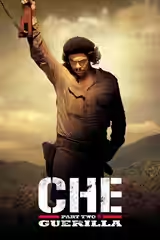
Che: Part Two (2008)

15 reviews from 15 publications. Critics’ score 74: 4 positive, 3 mixed, 0 negative.

Back to our review of Che: Part Two

74
Positive
4
Mixed
3
Negative
0

Most critics agree on what Che: Part Two is doing and split on whether it is worth the effort. The praise clusters around Benicio del Toro, whose quiet, unshowy performance is singled out again and again, and around Soderbergh’s refusal of biopic habits: no psychology, no speeches, just the daily grind of a failing campaign reconstructed with unusual care. The reservations cluster just as tightly. A large share of the reviews find the film emotionally flat, the marches tedious and the skirmishes hard to tell apart, and several say the fastidiousness leeches the drama out of the story. The spread is moderate rather than wide; nobody dismisses it, but a good number stop short of recommending it. Variety, writing from the festival, is the harshest, arguing neither half stands alone and the whole offers more aggravation than reward. The Guardian and The Skinny take the opposite view, finding Part Two the more coherent and affecting of the pair.

The AV Club
12 December 2008 · A- · Keith Phipps
90

Soderbergh emphasizes observation over ideology with an eye toward the mundane details of life on the front lines of a revolution, building to a thrilling climax in the first half and a kind of grace in the second. The film renders Guevara as an undemonstratively magnetic figure driven by his convictions.

Read the full review →
Empire
29 January 2009 · Andrew Male
80*

The critic views the film as a grim, melancholic depiction of Guevara's failed Bolivian campaign, marked by hunger and defeat. They single out Benicio Del Toro's quiet and magisterial performance for praise, especially in a tense persuasion scene.

Read the full review →
Time Out
17 February 2009 · ★★★★ · David Jenkins
80

Part Two stands alone effectively as Soderbergh's study of Che Guevara's failed 1966 Bolivian campaign. It highlights the director's focus on the realities of revolutionary struggle and Benicio del Toro's restrained performance, while noting that the film's academic tone and emphasis on source material details can sometimes hinder dramatic flow.

Read the full review →
Slant Magazine
26 September 2008 · ★★½/4
62

Soderbergh’s professed neutrality toward Guevara’s life and times succeeds mostly in leeching the emotion out of them, resulting in a work of intelligent fastidiousness rather than vivid inspiration. Part Two traces the leader’s ultimately doomed attempt to bring the revolution to the rest of Latin America as a death march.

Read the full review →
Los Angeles Times
12 December 2008 · Sheri Linden

The film rebels against biopic conventions by focusing on the rigors and specifics of armed struggle rather than psychological drama. It is an extraordinary, challenging work that favors action and strategy over emotional aha moments.

Read the full review →
The Guardian
20 February 2009 · Peter Bradshaw

The second part works better on its own as a coherent, mysterious evocation of Che's final doomed campaign in Bolivia. Soderbergh's austere, experimental approach shows only the outer man and avoids conventional character insight or cliché.

Read the full review →
The Hollywood Reporter
21 May 2008 · festival review

The two-part biopic is a highly worthwhile, professionally accomplished project that informs viewers but in its obsessive devotion to precise documentation forgets to inspire. Part Two, focusing on the failed Bolivian uprising, is all down, down, down and seems to go on forever with indistinguishable skirmishes.

Read the full review →
The New Yorker
11 January 2009 · Anthony Lane

Soderbergh's two-part film is a scrupulous but emotionally flat procedural on guerrilla warfare that avoids hagiography and shows the shift from dream to disillusion. It is marked by precise detail yet lacks dramatic impact or deep insight into its subject's passions.

Read the full review →
The New York Times
12 December 2008 · A.O. Scott

The film is an epic but ultimately evasive portrait that prioritizes formal sophistication and factual detail over moral reckoning with its subject. It excels as a master class in filmmaking technique while falling short as history.

Read the full review →
The Times
22 February 2009 · Edward Porter

The film reconstructs Che's failed Bolivian campaign with impressive persuasiveness and observes him nobly leading his men, but it lacks tension or clear sense of what Soderbergh aimed to achieve.

Read the full review →
Variety
22 May 2008 · festival review · Todd McCarthy

Soderbergh's ambitious four-hour presentation of Che's life is defiantly nondramatic, with part two feeling like a military training documentary that lacks excitement. Neither half stands alone satisfyingly, and the whole offers more aggravations than rewards.

Read the full review →
Eye for Film
2 January 2009 · Chris
70*

The critic views it as a commendable achievement in documenting history with integrity, though it lacks dramatic tension and may disappoint those seeking entertainment. They single out the authentic mise-en-scene and Benicio Del Toro's portrayal of a tragic hero for praise.

Read the full review →
Paste
30 January 2009 · Jesse Jarnow
65*

Soderbergh and Del Toro treat Che’s life as a realist epic in this audacious four-hour-plus film focused on guerrilla struggles. The marches across Cuba and through Bolivia’s jungles are deeply tedious, but Guevara’s unbendable will centers the two missions—one ascendant, one disastrous—and Soderbergh is ultimately victorious.

Read the full review →
Digital Spy
16 February 2009 · Simon Reynolds
60*

The critic finds Che Part 2 an uncompromised but dragging work that excels in authenticity and Del Toro's performance depicting Guevara's downfall, though it lacks human depth and moves too slowly.

Read the full review →
The Skinny
4 February 2009 · **** · Keir Roper-Caldbeck

Praises Part 2 for its intimacy and tragic portrayal of Che's doomed Bolivian revolution, contrasting it with the more ponderous Part 1.

Read the full review →

Ordered by the weight we give each publication, then by score. Scores are normalised to 100; * means inferred from an unrated review. Summaries are ours, not quotations; follow the links for the reviews themselves. How we rate