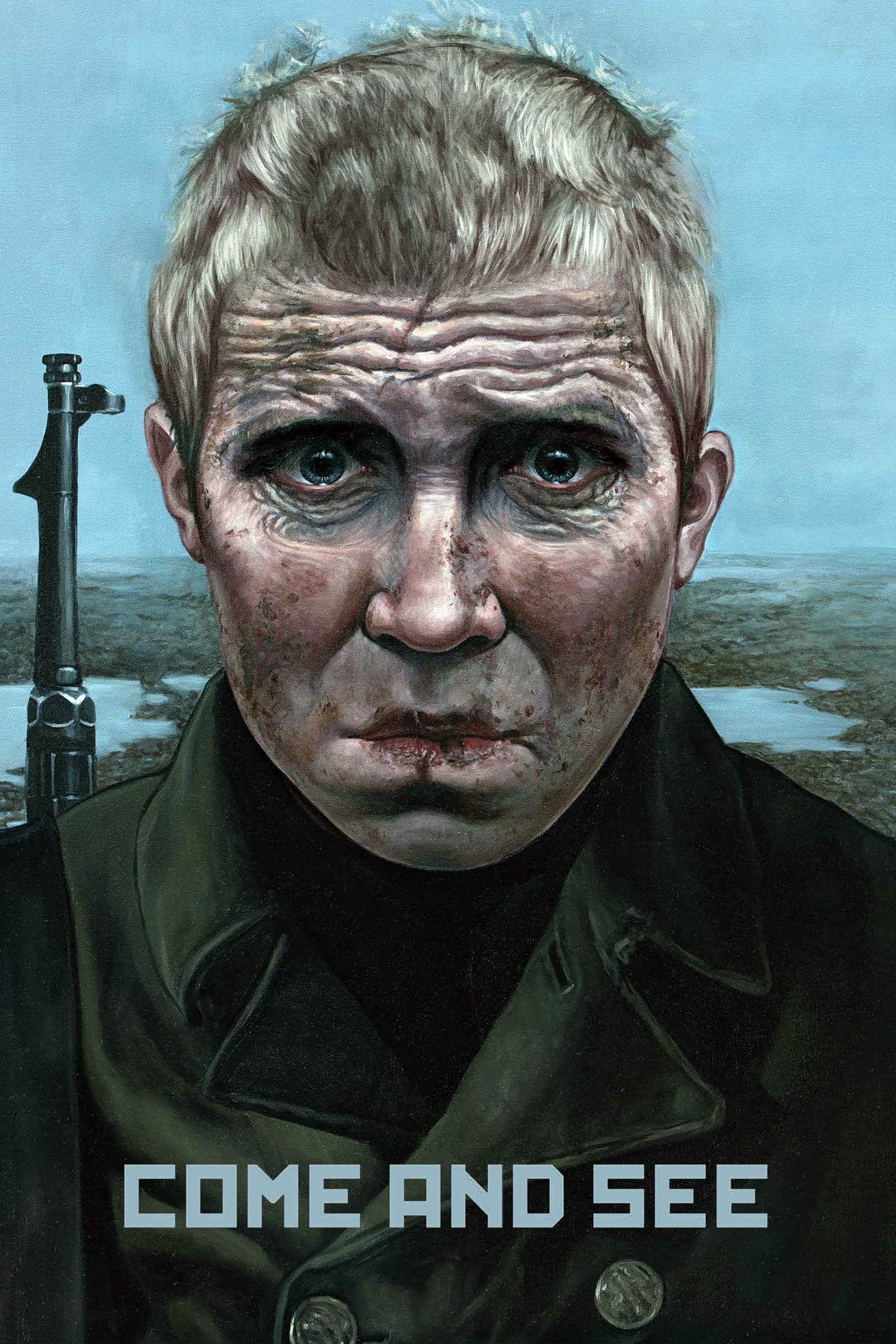
The review hails the film as horrifyingly relentless yet beatific in its artistry, capturing the psychological toll of war through dissociative sound and image manipulation. It singles out the demand for the viewer to witness and remember the cataclysmic intrusion of war.
The critic praises the film's searing portrayal of WWII horrors as an expressionist nightmare and coming-of-age tale about confronting evil. It stands out for its poetic, surreal depiction of war from a boy's perspective, blending documentary realism with unforgettable visual poetry.
Cox calls Come and See a devastating, genuine anti-war film that stands out for its close-quarters depiction of violence and its effects. He singles out the sound design in a bombing raid sequence, where the protagonist's ruptured eardrums create a high-pitched screaming noise on the soundtrack.
Nathan deems it one of the most powerful and disturbing war movies ever made, an extraordinary piece of filmmaking and a relentless masterpiece. He singles out the physical representation of war through raptured precision cinematography and the unforgettable close-ups of the lead child's face mapping terror and madness.
The critic hails the film as a disturbing, mesmerizing epic with few rivals in depicting the horrors of war, ranking it alongside other apocalyptic visions. He singles out the lead performance by Aleksei Kravchenko for its emotional transparency and the innovative sound and visual techniques that draw viewers into the protagonist's harrowing experience.
Klimov sustains an epic odyssey through hallucinatory moods and sweeping expressiveness that largely succeeds in making the familiar subject fresh. The film overreaches in its conclusion with overly obvious makeup and a sentimental, false ending that strains credulity.
The film renders powerful material in its central village-burning sequence but relies on heavy-handed intrusions that undermine the impact. The young protagonist mainly serves as a vehicle for the director's display of powers rather than a coherent point of identification.
The critic calls it one of the greatest movies ever made and the greatest war film, an unflinching descent into the horrors of Nazi occupation in Belarus that feels necessary rather than gratuitous. They single out the lead performance and the way the film ages the young protagonist decades in two hours.
The critic ranks it among the most overlooked war films, praising its hallucinatory horror and the mesmerising central performance of a boy joining the partisans in WWII Belarus. They highlight rapturous images amid the ethnic cleansing and biblical hardships.
The film enacts the hellish experience of war and its effects on a generation through the story of a young partisan witnessing atrocities in 1943 Soviet Belorussia. Klimov renders it as a disorienting mix of lyrical poeticism and expressionist nightmare.
The critic calls it a mesmerizing and legendary WWII masterpiece and a towering work in the pantheon of greatest war films. They single out its visceral expression of war’s emotional carnage told from a child’s perspective and its status as an underseen triumph that should be compulsory viewing.
The critic hails it as one of the finest films ever made on the subject of war, an intimate epic in which the promise of adolescence is perverted by war. They single out the repeated close-ups on the boy’s traumatised face and the extraordinary performance by Kravchenko.
Ordered by the weight we give each publication, then by score. Scores are normalised to 100; * means inferred from an unrated review. Summaries are ours, not quotations; follow the links for the reviews themselves. How we rate