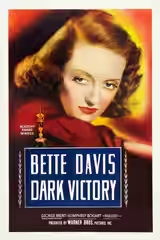
Critics’ reviews

Dark Victory (1939)

10 reviews from 10 publications. Critics’ score 81: 10 positive, 0 mixed, 0 negative.

Back to our review of Dark Victory

81
Positive
10
Mixed
0
Negative
0

The critics are unanimous that this is Bette Davis’s film, and most say it is one of her finest hours. Every review returns to the performance: the socialite who moves from denial and anger through to resignation, the delicacy of the scenes in which her sight fails, and the final close-up, which several single out as the moment the whole picture has been building towards. Edmund Goulding’s direction draws praise too, particularly for shooting in sequence so that Davis could build the decline in order.

The reservations cluster around everything that is not Davis. Radio Times calls the story codswallop and finds Humphrey Bogart miscast as the stable hand; The New Yorker finds the plotting banal and George Brent perfunctory; Empire agrees about Brent and adds Max Steiner’s score to the list of weaker elements. Eye for Film concedes it may look overblown and sentimental to modern eyes. The spread is narrow, from good to excellent, with nobody dissenting from the view that the star carries it.

Film Comment
· James McCourt
90*

The critic hails Bette Davis's performance as Judith Traherne in Dark Victory as her supreme cinematic achievement and one of the four greatest of her career. It praises the way the actress deploys every facet of her range to realize a self-directed, driven character who moves from desperation to resignation, culminating in an exquisite final close-up.

Read the full review →
Slant Magazine
28 June 2005 · Keith Uhlich
90*

The critic calls the film an embarrassment of riches even by Bette Davis melodrama standards, praising its emotional depth, Christian iconography, and Davis's tour-de-force performance as a socialite facing death with dignity.

Read the full review →
The New Yorker
15 April 1939 · John C. Mosher
90*

Davis is ideally cast and assured in portraying a lady about to die; she achieves finesse, delicacy in blindness scenes and plausibility in key moments, giving life to the story despite its banal characteristics and Brent's perfunctory performance.

Read the full review →
The New York Times
21 April 1939
90*

Bette Davis scores new honors and is superb, eloquent, tender and heartbreakingly sincere in a great role as the doomed heiress. The adaptation, direction by Goulding and performances (including Fitzgerald) make it one of the most sensitive and haunting pictures of the season.

Read the full review →
Empire
31 March 2006 · David Parkinson
80*

The critic calls it an out-and-out weepy that found resonance amid the darkening world situation of 1939, noting Davis saw it as a showcase after missing out on Gone With the Wind. Goulding's sequential shooting allowed Davis to build from gregarious socialite to exquisite suffering, with her powerhouse performance (channeling personal turmoil) standing out against weaker elements like George Brent and Max Steiner's score.

Read the full review →
Radio Times
★★★★ · Tony Sloman
80

The critic praises it as possibly the best terminal illness movie before Love Story, highlighting Bette Davis's standout performance as the heiress with a brain tumour. Production values and the memorable death scene are noted positively, though the story is called codswallop and Bogart miscast.

Read the full review →
The AV Club
18 June 2015 · Gwen Ihnat
80*

The critic notes that the film originated the trope of the young heiress facing a brain tumor and highlights Davis's mesmerizing performance as she confronts her fate with strength and spirit, making it a tearjerker standard.

Read the full review →
Time Out
15 March 2012
70*

Bette Davis plays a brave woman hiding her terminal illness while Humphrey Bogart appears in a small role as an Irish stable hand. The final scene is singled out as a particular highlight.

Read the full review →
Variety
31 December 1938 · Variety Staff
70*

The film is an intense drama with an undercurrent of tragedy, nicely produced and featuring Bette Davis in a powerful role. It notes the story of a heiress with a brain tumor and praises the production and Davis's performance.

Read the full review →
Eye for Film
26 January 2008 · Jennie Kermode
70*

The film may seem overblown and sentimental to some, but Bette Davis' angry and confused portrayal of a young woman facing terminal illness feels honest and humane. It remains surprisingly powerful and worth watching despite its old-fashioned style.

Read the full review →

Ordered by the weight we give each publication, then by score. Scores are normalised to 100; * means inferred from an unrated review. Summaries are ours, not quotations; follow the links for the reviews themselves. How we rate