Film review

Dark Victory

1939 · Directed by Edmund Goulding · 1h 44m · MPA NR

In a sentenceBette Davis gets the worst news imaginable and responds by going to more parties

DramaRomance

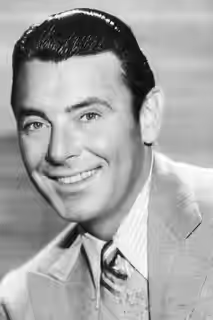
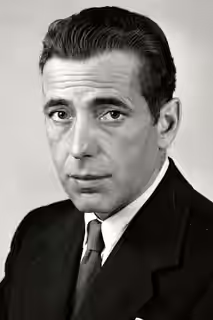
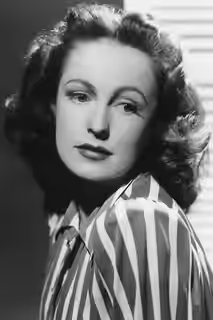
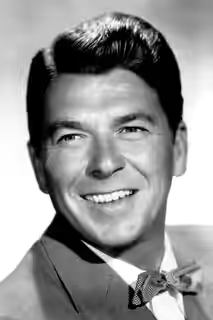
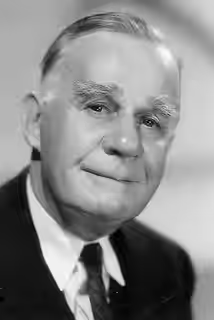
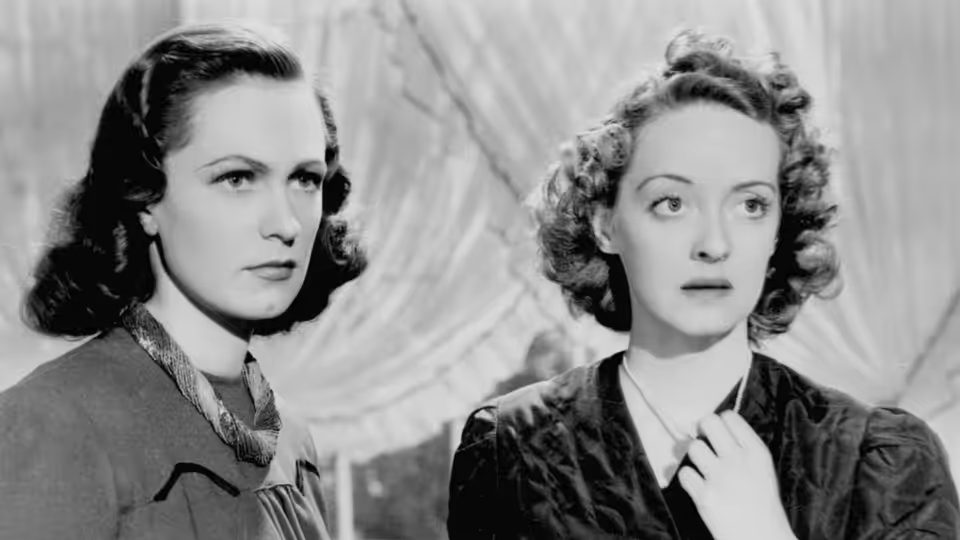
Judith Traherne (Bette Davis) is a young Long Island heiress who rides to hounds, gives parties and drinks her way through them. Lately she has headaches, sees double on the stairs and takes a fall from her horse that she cannot explain. Her friend and secretary Ann King (Geraldine Fitzgerald) and the family doctor, Dr Parsons (Henry Travers), talk her into seeing Dr Frederick Steele (George Brent), a brain specialist who is packing up his New York practice for a research job in Vermont. Judith tries to charm her way out of the examination, then submits to it, and Steele decides to operate. Back at the estate her Irish trainer Michael O’Leary (Humphrey Bogart) works her horse, and her friend Alec (Ronald Reagan) is rarely seen without a glass in his hand.

Fi1m review

A Long Island heiress learns she is ill and Bette Davis refuses to let her be pitiable. The story is nonsense, Bogart is miscast and Steiner’s score never rests, but Davis carries the film, and the last scene is deserved.

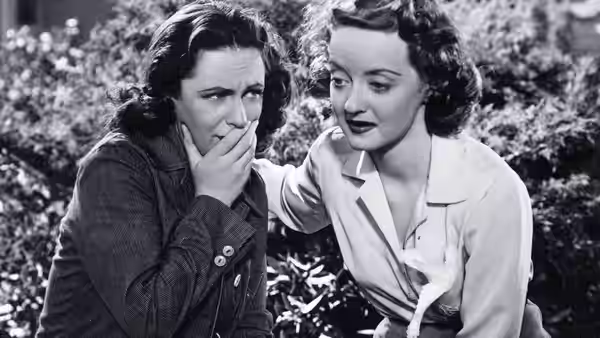
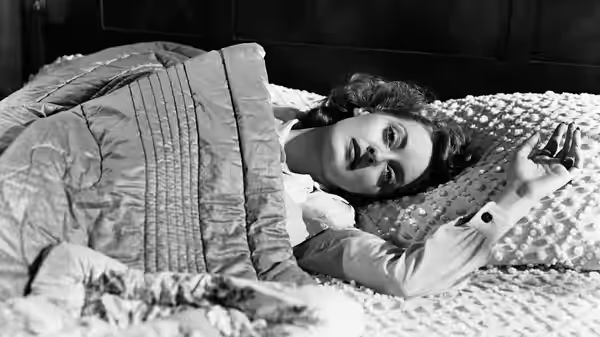
Judith Traherne has everything a 1939 studio could put in a house: horses, servants, a long drive, a wardrobe, and nobody to tell her to slow down. Then the headaches start. Edmund Goulding’s film, from a screenplay by Casey Robinson, is a weepy and does not pretend otherwise, and it is a good one. The medicine is nonsense from the first consultation to the last, and we did not mind for a minute, because Bette Davis is in the middle of it and she has decided that Judith is going to be a person rather than a lesson.

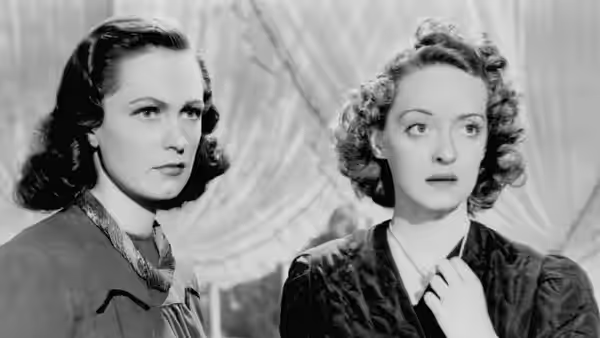
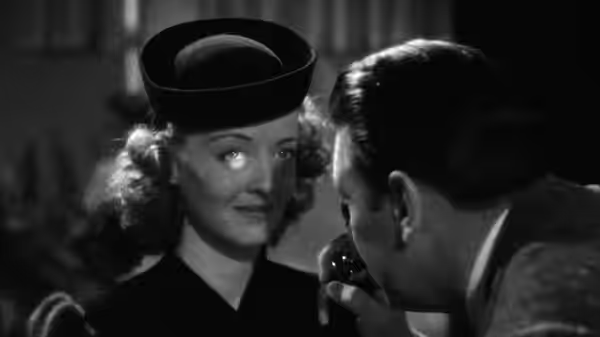
Watch what she does in the first half hour. Judith arrives at Dr Steele’s consulting room determined to be charming, treats the examination as a party she has been dragged to, and fires off lines while he waits. Then he asks her to do a few simple things with her hands and eyes, and she cannot quite do them. Davis plays the fear as irritation, a woman furious with her own body for letting her down in front of a stranger. It was here, not in any of the scenes critics usually name, that the film first got us. We had braced for a great performance and were caught out by a plain one.

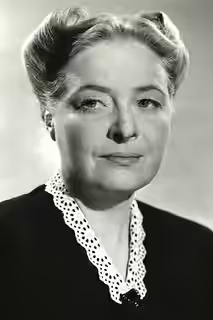
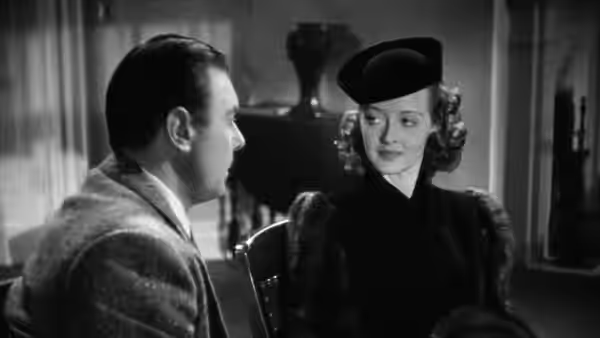
She is the reason to watch, but not the only one. Geraldine Fitzgerald, as Ann, is given the job of knowing more than Judith and saying less, and she does it with her face: standing in a hospital corridor while the doctors talk, she looks like someone rehearsing bad news. George Brent’s Steele is mostly a wall for Davis to throw herself at. He is decent, calm and a little wooden, which is what the part asks for and not much more. When the two of them are meant to be falling in love we believed her and took him on trust.

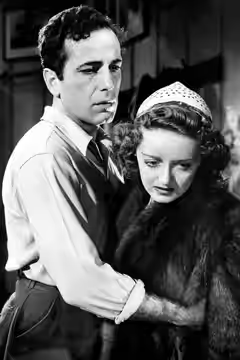
Then there is Humphrey Bogart, playing an Irish horse trainer called Michael O’Leary with a brogue that turns up for some lines and sits out others. He has one good scene in the stables, where O’Leary tells Judith what he thinks of her, and Bogart plays it straight and hungry. Accent aside, he is wrong for the part. Ronald Reagan’s Alec is the drunk friend at every party, glass in hand, and he is more fun than the film needs him to be. Henry Travers, as the family doctor, does his usual kindly business and does it well.

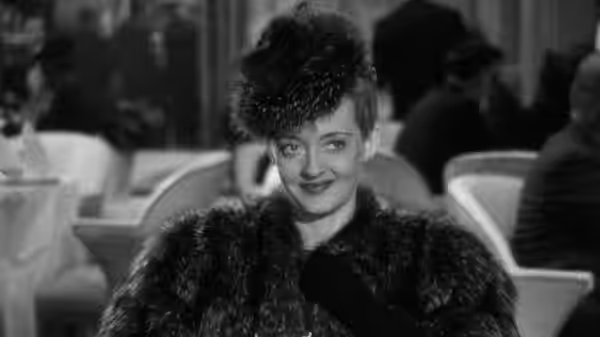
Ernest Haller shoots the estate in high, even light so that everything looks expensive and nothing casts a shadow, then hardens the light in the hospital, where the walls go white and the faces go grey. Orry-Kelly’s costumes chart Judith’s state of mind more honestly than the dialogue does: riding clothes and a slouch hat when she is sure of herself, then gowns that get bigger as the bravado does. William Holmes cuts briskly and the whole thing is done in 104 minutes, which for a 1939 weepy is close to a sprint. Max Steiner’s score is the weak leg. It plays under nearly everything, swells before the actors have finished, and treats every scene as if it needed help. Davis does not.

The second half takes the story somewhere we will not describe, except to say that the film handles it with more tact than the first half led us to expect, and that the last scene, which most critics single out, is earned. We cried. We knew we were being made to, we could hear Steiner doing it, and it made no difference. That is the only test this kind of film has to pass, and it passes.

It is a studio melodrama about a rich woman and a brain tumour, and the diagnosis is a plot device rather than a piece of medicine, so anyone who needs their weepies grounded should look elsewhere. Anyone who wants to see what Davis could do when a script got out of her way has an evening here. Bring a handkerchief. You will feel foolish without one.

Critical consensus AI synthesised

81
Positive
10
Mixed
0
Negative
0

The critics are unanimous that this is Bette Davis’s film, and most say it is one of her finest hours. Every review returns to the performance: the socialite who moves from denial and anger through to resignation, the delicacy of the scenes in which her sight fails, and the final close-up, which several single out as the moment the whole picture has been building towards. Edmund Goulding’s direction draws praise too, particularly for shooting in sequence so that Davis could build the decline in order.

The reservations cluster around everything that is not Davis. Radio Times calls the story codswallop and finds Humphrey Bogart miscast as the stable hand; The New Yorker finds the plotting banal and George Brent perfunctory; Empire agrees about Brent and adds Max Steiner’s score to the list of weaker elements. Eye for Film concedes it may look overblown and sentimental to modern eyes. The spread is narrow, from good to excellent, with nobody dissenting from the view that the star carries it.

Film Comment
· James McCourt
90*

The critic hails Bette Davis's performance as Judith Traherne in Dark Victory as her supreme cinematic achievement and one of the four greatest of her career. It praises the way the actress deploys every facet of her range to realize a self-directed, driven character who moves from desperation to resignation, culminating in an exquisite final close-up.

Read the full review →
Slant Magazine
28 June 2005 · Keith Uhlich
90*

The critic calls the film an embarrassment of riches even by Bette Davis melodrama standards, praising its emotional depth, Christian iconography, and Davis's tour-de-force performance as a socialite facing death with dignity.

Read the full review →
The New Yorker
15 April 1939 · John C. Mosher
90*

Davis is ideally cast and assured in portraying a lady about to die; she achieves finesse, delicacy in blindness scenes and plausibility in key moments, giving life to the story despite its banal characteristics and Brent's perfunctory performance.

Read the full review →
The New York Times
21 April 1939
90*

Bette Davis scores new honors and is superb, eloquent, tender and heartbreakingly sincere in a great role as the doomed heiress. The adaptation, direction by Goulding and performances (including Fitzgerald) make it one of the most sensitive and haunting pictures of the season.

Read the full review →
Empire
31 March 2006 · David Parkinson
80*

The critic calls it an out-and-out weepy that found resonance amid the darkening world situation of 1939, noting Davis saw it as a showcase after missing out on Gone With the Wind. Goulding's sequential shooting allowed Davis to build from gregarious socialite to exquisite suffering, with her powerhouse performance (channeling personal turmoil) standing out against weaker elements like George Brent and Max Steiner's score.

Read the full review →
Radio Times
★★★★ · Tony Sloman
80

The critic praises it as possibly the best terminal illness movie before Love Story, highlighting Bette Davis's standout performance as the heiress with a brain tumour. Production values and the memorable death scene are noted positively, though the story is called codswallop and Bogart miscast.

Read the full review →

Cast

Awards

Academy Awards, 1940

Nominated
Best Actress
Nominated
Best Original Score
Nominated
Best Picture

If you liked this, try…

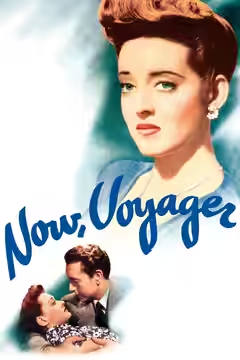
Now, Voyager poster

Now, Voyager

1942 · Davis, Robinson and Steiner again, this time with a makeover instead of a diagnosis.

Ikiru poster92

Ikiru

1952 · Kurosawa’s civil servant gets the same news and takes it far more quietly.

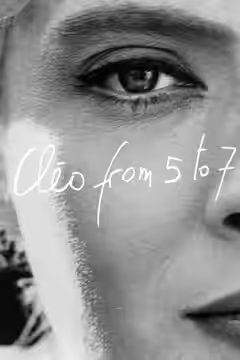
Cléo from 5 to 7 poster

Cléo from 5 to 7

1962 · Two hours in Paris waiting for test results, shot as if nothing else mattered.

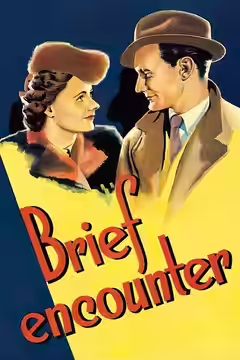
Brief Encounter poster90

Brief Encounter

1945 · British restraint where Dark Victory has American gowns; the tears arrive anyway.

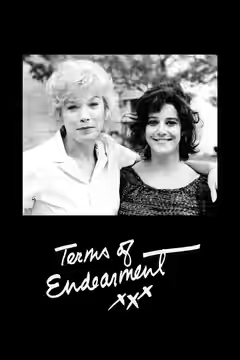
Terms of Endearment poster81

Terms of Endearment

1983 · The illness weepy forty years on, with jokes, and a hospital scene nobody forgets.