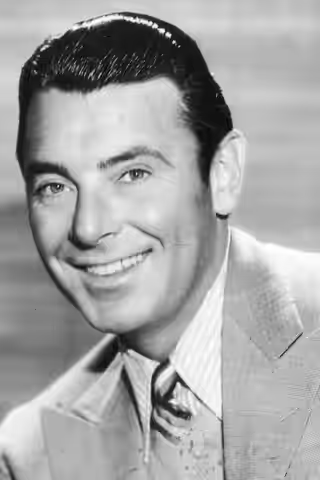
George Brent's job at Warner Bros was to stand next to the biggest female stars on the lot and stay out of their light. He did it eleven times with Bette Davis, did it well, and it is the reason hardly anyone remembers him.
Fi1m perspective
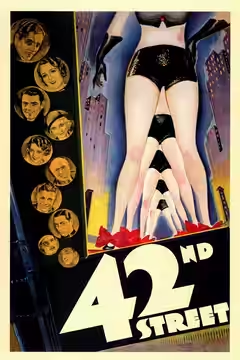
There is a moment in 42nd Street (1933) where Bebe Daniels's Dorothy Brock, who is being kept in bracelets by the show's backer, slips out to see the man she actually likes. That man is Pat Denning, and George Brent plays him with a raincoat, a shrug and the good sense to let Daniels do the deciding. The part is written as somewhere for her to go rather than as a person, and Brent does not fight it. He stands where he is put, looks worth the risk, and gets out of the way. He would go on doing that for the rest of his time at Warners.
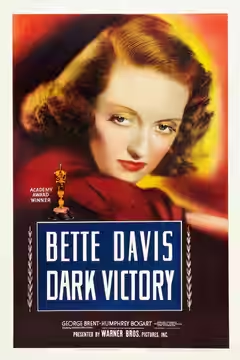
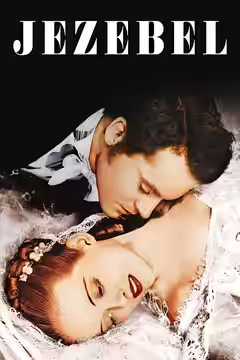
He had come to films in 1930 at Fox, and Warner Bros signed him in 1932. The studio made pictures around its women, and it needed a man the audience would accept as the cause of their trouble without wanting to watch him instead. Brent was that man. He made eleven films with Bette Davis, among them Jezebel (1938), Dark Victory (1939) and The Great Lie (1941); six with Kay Francis; five with Barbara Stanwyck, starting with Baby Face (1933); four with Ruth Chatterton. The word that follows him around is dependable, and it is meant as praise and as a complaint, and both are fair. He is never bad. He is also rarely the reason to watch.
We will admit we enjoyed him in 42nd Street more than the film needs us to. He gives Daniels something to be foolish about, and because he asks for so little the picture never slows down when he is in it, which at that speed is a skill. What he lacks is the thing Davis and Stanwyck had to spare: the flicker that makes you look at a face when nothing is happening on it. Put him beside them and the eye goes to them, every time. The studio knew this, and it was the point. There were departures, The Spiral Staircase (1946) among them, where a script asked him for something other than patience, but they were the exception.
After the war the budgets got smaller, then the roles did, and by the 1950s he was on television, in guest parts and a series, until 1960. There was one more film in 1978. Asked about Davis, he said: "Bette was a professional. She always knew her lines, her blocking, and how to play a scene. It’s a pleasure to work with someone like that." It is the compliment of a man who valued exactly those things in himself, and it is, near enough, the review he gets. Start with 42nd Street, where he is good company for ten minutes. Then watch a Davis picture and time how long it takes you to notice him. That was the job.
Biography
George Brent (born George Brendan Nolan; 15 March 1904 – 26 May 1979) was an Irish-American actor. He was born in Ballinasloe, County Galway, Ireland.
Brent appeared in his first film in 1930 and signed with Warner Bros. in 1932. He is known for roles including Pat Denning in 42nd Street (1933), Buck Cantrell in Jezebel (1938), Dr. Frederick Steele in Dark Victory (1939) and Professor Warren in The Spiral Staircase (1946). He appeared in eleven films with Bette Davis.