Edmund Goulding had no visual signature and never seemed to want one. What he had was a habit of standing back and letting a star, usually a woman, decide who her character was, and in Dark Victory that was enough.
Fi1m perspective
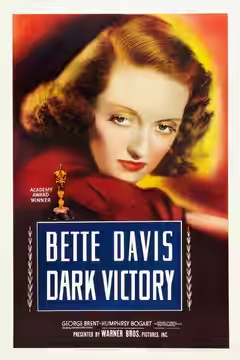
Watch what happens in Dark Victory (1939) when Bette Davis is told the headaches are not headaches. The film does not turn on her and start pleading. Davis fills the space with a woman who has decided she will not be pitied, a person rather than a lesson, and the scene is hers. That is the Goulding habit, and it is close to the whole of what he brought: he put the camera where the actor could do the work, and then he let them.
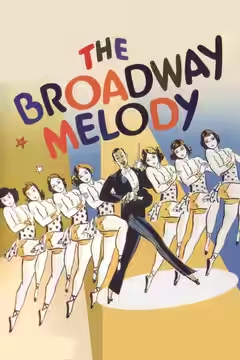
He came from the stage, where he had acted, written and directed in London from boyhood, and he arrived in Hollywood as a writer first. The story for The Broadway Melody (1929) is his, and we thought the film a museum piece with a pulse: the backstage plot that musicals would borrow for the next twenty years, told in slang so thick some lines need a second hearing. He was directing by the mid-1920s, with Love (1927) the first of two films with Garbo, and Grand Hotel (1932), an all-star ensemble melodrama, made his name at MGM. Then Warner Bros and four films with Davis, of which Dark Victory is the one people remember and the one he most prized himself. In 1943 he moved to Fox for a careful literary adaptation in The Razor's Edge (1946) and, less predictably, a dark noir with Tyrone Power in Nightmare Alley (1947), and he kept working into the late 1950s, finishing with Mardi Gras (1958).
What works is the actors. He was called a woman's director, meaning he was good with female stars in weepies, and the label has been used to file him under minor ever since. It was never the whole truth: The Dawn Patrol (1938) is an all-male picture whose aerial sequences are still the thing people mention. He also took on jobs nobody had asked him to, co-writing, composing, advising on costumes and make-up without credit, which suggests a man who cared about everything except being noticed. What does not work is anything the star cannot fix. In Dark Victory the medicine is nonsense from the first consultation, Bogart is miscast and Steiner's score never rests, and Goulding did nothing about any of it. He was not a director who fought for the frame.
We sat down to Dark Victory expecting a lesson in dying beautifully and got a person instead, and the last scene, which we will not describe, moved us because Goulding had spent the previous hour and a half declining to soften Judith Traherne. He gave Davis room and trusted her to use it. Critics looking for a style across his war films, comedies, noirs and adaptations will not find one, and he has been called a studio craftsman as though that were a small thing. Start with Dark Victory, and watch how much a director can get done by getting out of the way.
Biography
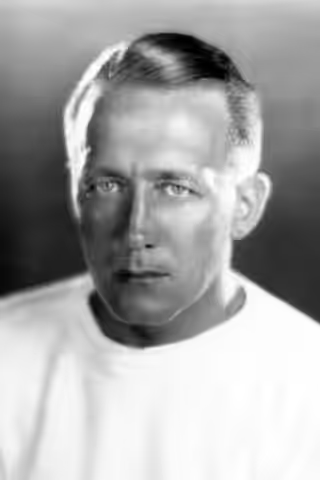
Edmund Goulding (20 March 1891 – 24 December 1959) was a British screenwriter and film director. Born in Feltham, Middlesex, he began his career as a stage actor and playwright in London before serving in the British Army during the First World War. He later moved to Hollywood, where he wrote screenplays for silent films including Tol'able David (1921) and Dante's Inferno (1924).
Goulding directed his first feature, Sun-Up, in 1925. He is known for directing Grand Hotel (1932), Dark Victory (1939), The Great Lie (1941), The Razor's Edge (1946), Nightmare Alley (1947) and The Dawn Patrol (1938). He also wrote the story for the Academy Award-winning The Broadway Melody (1929) and worked as a producer and composer.