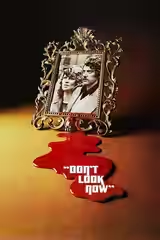
Most critics praise Don’t Look Now as a deeply unsettling supernatural thriller whose scares grow from the couple’s grief. Praise centres on Nicolas Roeg’s fractured editing, the wintry Venice setting and the convincing intimacy between Sutherland and Christie. The love scene draws particular attention for its emotional weight and elliptical cutting. Across the positive reviews, the film’s disorienting images and sound make bereavement and isolation felt rather than merely supplying an eerie backdrop.
The spread is wide, though dissent is limited: the main disagreement concerns whether the technique deepens the emotion or keeps it at a distance. The New Yorker admires the elegance but finds little emotional depth, while The New York Times sees an attractive Venetian travelogue short on suspense. Little White Lies offers a narrower reservation about dated plotting while praising the opening’s staging, performances and editing. Most critics instead find the formal disruption essential to the film’s disturbing effect.
R
Radio Times
★★★★★ · Tom Hutchinson
100
This is director Nicolas Roeg's masterpiece, a supernatural chiller with a fear-drenched mood of alienation sustained to an unforgettable climax. The erotic love-making scene between the leads forms the sensual core of the time-distorted vision of terror set in wintry Venice.
Read the full review →E
Empire
1 January 2000 · Adam Smith
90*
The film is one of the most haunting and enigmatic supernatural thrillers ever made, with a mournful heart provided by Sutherland and Christie's believable grieving couple. It singles out the infamous sex scene and devastating ending for particular praise as brilliantly realised and still shocking.
Read the full review →S
Slant Magazine
9 October 2023 · Chuck Bowen
90*
The review calls Roeg’s film a jumpy, melancholic masterpiece driven by emotional desolation and grief, elevated by its prismatic editing and sound design. It singles out the celebrated, elliptical love scene and the way the fractured structure conveys the couple’s isolation and fragility.
Read the full review →T
Time Out
29 March 2012 · TM
90*
A superbly chilling essay in the supernatural about a couple shattered by the death of their small daughter who go to Venice to forget and are sucked into a terrifying vortex of time. Conceived in Roeg's usual imagistic style, it's hypnotically brilliant.
Read the full review →A
The AV Club
8 June 2018 · A.A. Dowd
85*
The review praises Nicolas Roeg’s film as a singularly haunting work that blends grief drama with supernatural elements through disorienting technique. It singles out the shocking climax and the way the story uses Venice as a labyrinth of the mind to explore mourning and self-fulfilling prophecy.
Read the full review →G
The Guardian
5 July 2019 · Peter Bradshaw
85*
The critic finds Roeg's 1973 film still capable of delivering major scares and jump moments while praising its template-setting influence on horror. He singles out the convincing chemistry of Sutherland and Christie as a married couple and Venice's realistic, non-touristy depiction as standout elements.
Read the full review →Roeg's 1973 film remains one of the most dynamic and radical British films ever made, with its non-linear cutting creating an eerie atmosphere that mirrors the characters' grief and mental disintegration in Venice. It praises the film's groundbreaking style and relevance decades later.
Read the full review →L
Little White Lies
4 July 2019 · 4/4/4 · David Jenkins
80
The critic finds this re-release of the horror classic largely rewarding despite some dated elements in the plot. The opening sequence is singled out as an all-time great for its masterful staging, acting and editing.
Read the full review →E
Evening Standard
10 April 2012
75*
This welcome reissue highlights the strange, doom-laden semi-occult romance in wintry Venice, where bereaved parents seek contact with their drowned child. It remains memorable for the peak-era performances of Christie and Sutherland and the memorable eroticism of their partnership.
Read the full review →N
The New Yorker
17 December 1973 · Pauline Kael
60*
Roeg's splintered, subliminal style creates an elegant but chilly atmosphere of dislocation and premonition in this du Maurier adaptation, making it a masterwork of high-fashion Gothic compared to lesser examples. Kael complains that it is ultimately shallow chic without deeper consciousness or emotional engagement.
Read the full review →N
The New York Times
10 December 1973
40*
The review calls the film a fragile horror soap bubble that fails to elevate its Daphne du Maurier source, turning instead into an elegant but suspense-lacking travelogue of Venice after an early twist.
Read the full review →R
RogerEbert.com
20 December 1973 · Roger Ebert
The critic praises Nicolas Roeg's direction for creating menace through compositions and Venice's wintry atmosphere, highlighting an effective love scene and the film's psychic thriller elements centered on a rational man's denial.
Read the full review →V
Variety
31 December 1972 · Variety Staff
The critic deems it superior suspense with subliminal horror, commending Roeg's visual fillips, strong performances especially from Sutherland and Christie, and the careful editing including a notable love scene.
Read the full review →H
HeyUGuys
23 July 2019 · ★★★★★ · Daniel Goodwin
100
It is an equally striking genre masterpiece and existentialist fable that has lost little of its edge over the decades. Roeg’s rain-sodden Venice, documentary naturalism, jump-cuts, visual distortions and handling of grief through the couple’s experiences are singled out.
Read the full review →E
Eye for Film
9 July 2009 · James Benefield
90*
It is probably the finest of Roeg’s quartet of Seventies masterpieces, a devastating emotional and highly metaphorical horror film that deconstructs film language and transcends genre. Its technical accomplishment, muted colour palette, treatment of grief and two excellent central performances are singled out for praise.
Read the full review →P
Paste
18 November 2023 · Matthew Jackson
90*
The critic calls the film an ecstatic meditation on grief and one of the best thrillers of its era or any other, with a sense of inevitable, claustrophobic terror. They single out the dazzling use of color (especially red), editing, sound design, and symbolism of water for praise in conveying the characters' psychological state.
Read the full review →Ordered by the weight we give each publication, then by score. Scores are normalised to 100; * means inferred from an unrated review. Summaries are ours, not quotations; follow the links for the reviews themselves. How we rate