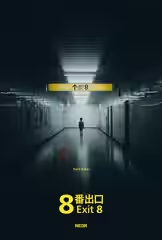
Most critics agree that Exit 8 is a rare video-game adaptation that works, and the spread is narrow: nothing in the reviews so far is hostile, and the reservations are matters of degree. Praise clusters in two places. First, the look of the thing: the white-tiled, endlessly repeating subway corridor, the patient long takes, and a flat brightness several critics call uncanny. Second, Kawamura’s decision to add what the game never had, a protagonist stalling over impending fatherhood, which most reviews find gives the loop a point about drift and indecision. The Wrap goes furthest, placing it near the top of the form.
The reservations cluster in the back half. Several critics say the repetition, effective early, turns numbing at feature length, and that the tension leaks once flashbacks and conversation arrive. /Film is the lowest, finding the looping tedious despite the dread. Time Out and Screen Daily call the theme heavy-handed.
N
The New Yorker
10 April 2026 · Justin Chang
85*
Kawamura's clever adaptation is sleek and precise, subverting the game's minimalism by expanding into multiple characters and a moral argument about apathy and fatherhood. It praises the elegant long takes and the way it turns the loop into a meditation on conformity and possibility.
Kawamura puts an arthouse spin on the popular indie game, transforming the claustrophobic corridors into a site of psychological exploration and national anxieties in a delightful blockbuster provocation. The critic praises how it exploits the frustrations of the looping premise and elevates the material with resonant themes of impending fatherhood.
The review praises the film as one of the better video-game-to-cinema translations, replicating the spot-the-difference mechanics and building effective psychological horror and dread. The third act loses some momentum when characters linger and talk.
The review calls it a disquieting mystery that turns the subway's liminal space into a true nightmare with hidden details, jump scares and deep existential dread. It ranks among the best video-game adaptations.
The critic finds the film a taut, unnerving psychological mystery and a rare successful video-game adaptation that stays close to its source. They single out its evocation of modern 'non-places' and the protagonist's entrapment in an endless corridor as creating an elegant, chilly dream of despair.
The film is an intellectual and exciting existential puzzle about wrong choices and right actions in a looping white-tiled limbo. It singles out the simple yet uncanny rules and the liminal space as a metaphor for autopilot lives.
19 September 2025 · festival review · Jessica Kiang
80*
Kawamura's inventive reimagining is an enjoyable, elegantly spare puzzle that adds psychological depth and moral allegory while staying true to the game's spartan concept. It praises the hyperreal eeriness of the flat bright images and the judicious minimalism of backstory.
Exit 8 is an actually good video-game adaptation guided as much by pressures around declining birth rates and impending parenthood as by its looping subway hallway premise. The critic praises its gratifying artfulness in inventing a complementary narrative and its ability to deliver genuine creepouts amid the claustrophobic setting.
The film channels the game's simple looping rules into an effective early dreamscape of anomalies and repetition but loses steam as a feature-length adaptation. It praises the striking visuals and symbolic expansion beyond the protagonist but notes the sterility becomes numbing.
The adaptation is both beautiful and banal, living up to its source by turning mundane liminal spaces into places for reflection and frustration, though the experience of watching endless hallway loops is tedious. The critic singles out its engrossing aesthetic and smart use of tedium to create something contemplative and uncanny.
The movie aims to replicate the game's puzzle experience but falls short as pure experimentation or horror, though it earns liminal fascination by fusing viewer perspective to the protagonist. It praises the patient Steadicam shots and ambition to be both purgatory and formal advance.
The critic describes it as an unsettling anxiety dream and effective metaphor for life's inescapable loops, with strong claustrophobic production design. It prioritises unease over full nightmare intensity and feels somewhat heavy-handed.
The review presents the film as a bracingly weird Japanese horror that riffs on the nightmare of commuting via a video-game adaptation set in a repeating Tokyo subway corridor. It highlights the survival rules around spotting anomalies and the encounters with other characters in the looping space.
The critic hails the ingenious, twisting chiller that captures the game's feel with tricky rules and repetition, evoking purgatory and personal conscience. It should achieve cult status, though the theme is handled with some mawkishness.
The critic finds the film a creepy, claustrophobic time-loop horror that effectively adapts the game's endless repetition and anomalies to terrifying effect. Tension dissipates later as it shifts to flashbacks and a more conventional emotional resolution.
The film is a creepy if redundant video game adaptation that blends J-Horror tropes into a surreal single-location thriller about a man trapped in a looping Tokyo subway tunnel. The critic notes it sustains a tone of surreal dread but complains that it lacks interesting characters or much story beyond the source game.
The critic calls the film potentially the best video game adaptation yet, praising its brisk, absorbing take on the game's looping corridor premise as a scary, personal horror story about one man's inability to face change and move forward in life. They highlight the effective cinematography that draws viewers into spotting anomalies alongside the protagonist.
The critic praises Kawamura for nailing the adaptation by retaining the game's feel and adding themes of responsibility; singles out the strong thematic depth and fidelity to the source as praise, while noting it might be too simple for hardcore horror fans.
The critic lauds the film for successfully translating the video game's iterative gameplay into cinema through its doom loop structure, praising the empathetic storytelling and self-examination themes.
The critic finds the liminal horror effective at creating dread but criticizes the repetitive nature that becomes tedious, singling out the monotonous looping as the main complaint despite strong creepy vibes.
8 September 2025 · festival review · Therese Lacson
The critic praises the film for capturing the game's puzzle-like frustration and anxiety through repetitive loops and shifting perspectives, turning the simple premise into a compelling narrative about the protagonist's indecision over impending fatherhood and personal growth in a purgatorial setting.
The critic calls it an effective and ambitious horror adaptation that expands the game's eerie corridor into a rich metaphor for the protagonist's emotional uncertainties, indecision about fatherhood, and broader cycles of masculinity and life decisions.
Ordered by the weight we give each publication, then by score. Scores are normalised to 100; * means inferred from an unrated review. Summaries are ours, not quotations; follow the links for the reviews themselves. How we rate