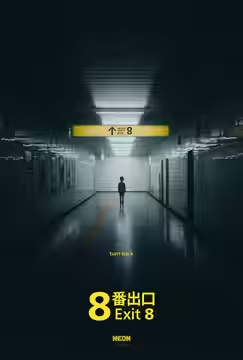
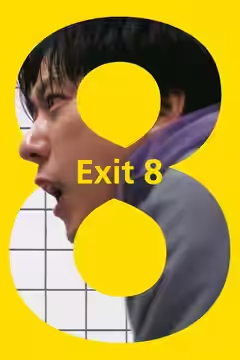
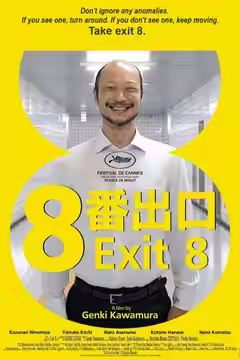
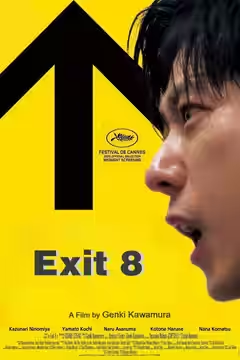
Exit 8 poster

Exit 8

2025 · Directed by Genki Kawamura
1h 35mHorrorMysteryThriller15
72
Fi1m score
76
Critics · 16
Audience · not yet

Where to watch in the UK

Checked 10 September at 22:28. Prices and availability change; the service’s page is the last word.

Plays from YouTube when you press play; nothing loads from them until then.

Synopsis

A man (Kazunari Ninomiya), credited only as Lost Man, is riding a crowded Tokyo train when his partner (Nana Komatsu) rings to tell him she is pregnant and to ask what he wants to do. He does not know. Further down the carriage a passenger is shouting at a mother with a crying child, and nobody looks up. He leaves the train, walks down into the station underpass, and finds that the corridor does not end. A sign gives him the rules: if you see anything wrong, turn back; if you see nothing, keep going; reach Exit 8. A man in a suit (Yamato Kochi) walks towards him, every time. Genki Kawamura directs and co-writes this adaptation of the video game.

Fi1m review

In a sentenceEvery commuter’s nightmare: the underpass goes on, the posters change, and the same man in a suit keeps walking towards you

Genki Kawamura turns a spot-the-difference video game into a white-tiled nightmare about a man who cannot decide anything, and for an hour it is quietly frightening. Then it sits down to explain itself, and the corridor loses its grip.

Exit 8 is adapted from a video game in which you walk down a subway corridor, look for something wrong, and turn back if you find it. That is the whole game, and Genki Kawamura, directing and writing with Kentaro Hirase, has had the sense to keep it as the whole film for as long as he can. A man (Kazunari Ninomiya, billed only as Lost Man) is on a crowded Tokyo train, earbuds in, when his partner (Nana Komatsu) rings: she is pregnant, and what does he think. He does not know what he thinks. At the far end of the carriage a man is screaming at a mother whose child will not stop crying, and nobody, our man included, looks up.

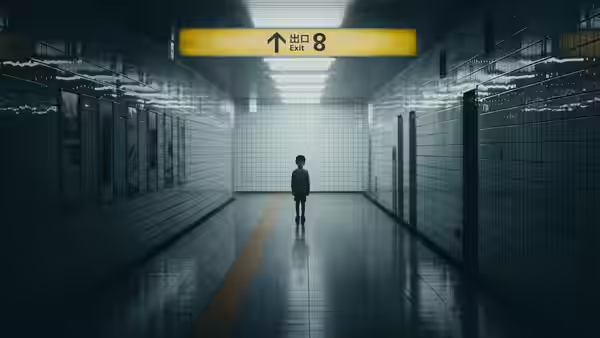
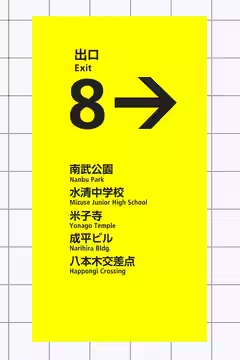
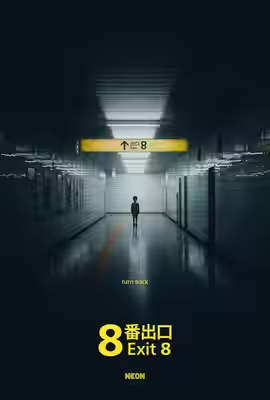
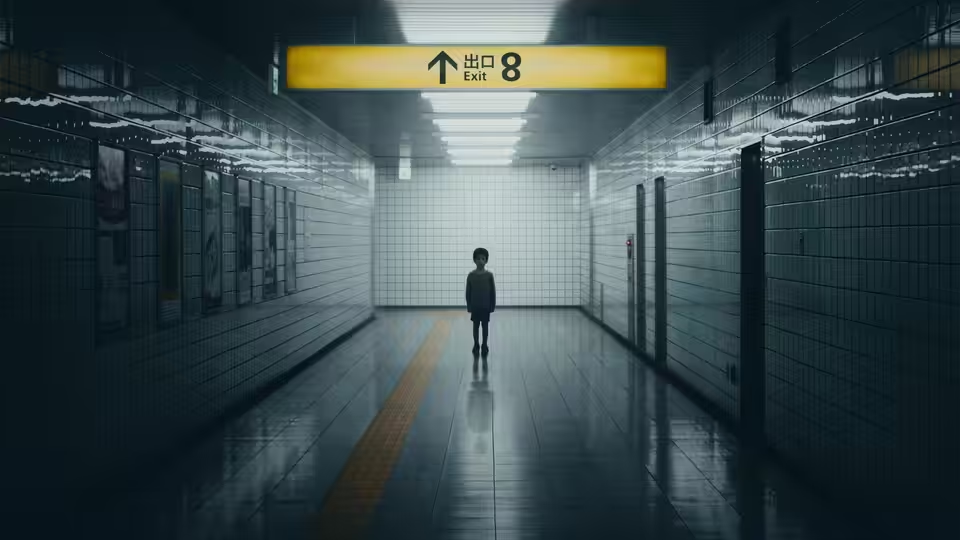
He gets off, goes down into the underpass, and the underpass keeps going. White tiles, a yellow line on the floor, a right turn, a sign that says Exit 8 is ahead. A notice gives him the rules: if you see an anomaly, turn back; if you see none, carry on; find Exit 8. For an hour this is as good a piece of quiet horror as we have sat through in a while. Then the film stops walking and starts talking, and it is a lesser thing for it. Good, and worth your evening if you like being made uneasy.

Keisuke Imamura shoots most of it from just behind Ninomiya’s shoulder, in long takes, and lights it flat and bright so there are no shadows for anything to hide in. That turns out to be worse than dark. Ryo Sugimoto’s corridor is so exactly like every station underpass you have ever hurried through, down to the scuffed skirting and the grille in the ceiling, that when a poster changes or a door stands an inch open the eye catches it before the brain does. We scanned the frame like a proof-reader, and we were not proud of how badly we wanted to spot it first.

The man in the suit is the film’s best idea. Yamato Kochi, billed as Walking Man, comes towards the camera on every loop, eyes front, briefcase in hand, at the same pace. For twenty minutes he is the only other person in the world and he is precisely the same each time. So when he is at last fractionally not the same, we felt the back of our neck go cold, and we had not felt that in a horror film for some time.

Ninomiya’s job is harder and he does it well. The Lost Man does not decide things, and Ninomiya plays the panic small: a swallow, a glance back, a hand that goes to his phone and finds no signal. Sakura Seya cuts each reset hard, with nothing under it, so the return to the start becomes its own small jolt. Yasutaka Nakata and Shouhei Amimori keep the score out of the way for most of the running time, a low hum under the strip lights, and when it finally arrives it counts.

Then the film widens, in ways we will not describe, and the Lost Man’s trouble with the baby is spelt out in full. Kawamura and Hirase plainly believe the corridor is about a man who lets a stranger scream at a mother and then cannot say yes to his own child, and the corridor had already told us so without a word. For the last twenty minutes we were aware of how long was left, and cross about it, because the film had earned our attention and then spent it on a lesson.

Most video-game adaptations fail by adding too much. This one adds a little, late, and gets away with more than most because it started so spare. At 95 minutes it is the right length for the idea and about a quarter of an hour too long for the film. You will notice, next time you are in an underpass, that you are counting the turns.

Critical consensus AI synthesised

76
Positive
13
Mixed
3
Negative
0

Most critics agree that Exit 8 is a rare video-game adaptation that works, and the spread is narrow: nothing in the reviews so far is hostile, and the reservations are matters of degree. Praise clusters in two places. First, the look of the thing: the white-tiled, endlessly repeating subway corridor, the patient long takes, and a flat brightness several critics call uncanny. Second, Kawamura’s decision to add what the game never had, a protagonist stalling over impending fatherhood, which most reviews find gives the loop a point about drift and indecision. The Wrap goes furthest, placing it near the top of the form. The reservations cluster in the back half. Several critics say the repetition, effective early, turns numbing at feature length, and that the tension leaks once flashbacks and conversation arrive. /Film is the lowest, finding the looping tedious despite the dread. Time Out and Screen Daily call the theme heavy-handed.

The New Yorker
10 April 2026 · Justin Chang
85*

Kawamura's clever adaptation is sleek and precise, subverting the game's minimalism by expanding into multiple characters and a moral argument about apathy and fatherhood. It praises the elegant long takes and the way it turns the loop into a meditation on conformity and possibility.

Read the full review →
IndieWire
23 May 2025 · B+ · Blake Simons
83

Kawamura puts an arthouse spin on the popular indie game, transforming the claustrophobic corridors into a site of psychological exploration and national anxieties in a delightful blockbuster provocation. The critic praises how it exploits the frustrations of the looping premise and elevates the material with resonant themes of impending fatherhood.

Read the full review →
Little White Lies
23 April 2026 · 3/4/3 · Josh Slater-Williams
80

The review praises the film as one of the better video-game-to-cinema translations, replicating the spot-the-difference mechanics and building effective psychological horror and dread. The third act loses some momentum when characters linger and talk.

Read the full review →
Radio Times
★★★★ · Matt Glasby
80

The review calls it a disquieting mystery that turns the subway's liminal space into a true nightmare with hidden details, jump scares and deep existential dread. It ranks among the best video-game adaptations.

Read the full review →
The Guardian
22 April 2026
80*

The critic finds the film a taut, unnerving psychological mystery and a rare successful video-game adaptation that stays close to its source. They single out its evocation of modern 'non-places' and the protagonist's entrapment in an endless corridor as creating an elegant, chilly dream of despair.

Read the full review →
The New York Times
9 April 2026 · Manohla Dargis
80*

The film is an intellectual and exciting existential puzzle about wrong choices and right actions in a looping white-tiled limbo. It singles out the simple yet uncanny rules and the liminal space as a metaphor for autopilot lives.

Read the full review →

Cast

Yamato Kochi
Walking Man
Kotone Hanase
High School Student
Nana Komatsu
Lost Man's Partner
Hirota Otsuka
Screaming Man on Train
Tara Nakashima
Mother on Train

Stills

If you liked this, try…

Cure poster

Cure

1997 · Kiyoshi Kurosawa’s detective story, where the frightening thing is how calmly people do harm.

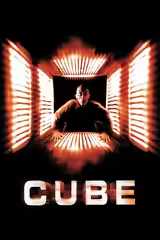
Cube poster

Cube

1997 · Strangers wake in a box of rooms with rules they must work out fast.

Triangle poster

Triangle

2009 · A loop aboard an empty liner, and the slow horror of recognising the pattern.

The Exterminating Angel poster

The Exterminating Angel

1962 · Buñuel’s dinner guests find they cannot leave the party, and nobody can say why.

Skinamarink poster

Skinamarink

2022 · Two children, one dark house, and a camera that stares at corners until they move.