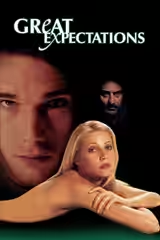
Critics’ reviews

Great Expectations (1998)

9 reviews from 9 publications. Critics’ score 58: 5 positive, 0 mixed, 4 negative.

Back to our review of Great Expectations

58
Positive
5
Mixed
0
Negative
4

The reviews split almost down the middle, with nothing in between: five critics like Cuarón’s modern-dress Dickens and four do not. What they agree on is the look. Nearly every review, warm or cold, praises the voluptuous visual style and finds the move to 1970s Florida and 1980s New York convincingly done. De Niro’s Magwitch figure earns praise from admirers and detractors alike, as does Anne Bancroft.

The reservations cluster around what the update leaves behind. The detractors say the film narrows the story to the romance and the stars and loses the novel’s lessons about loyalty and growing up, so that it ends up stranded between its two periods. Variety finds it a talented curiosity short on dramatic tension; Empire thinks Hawke’s lead is weak; The New Yorker prefers David Lean’s 1946 film. Notably, the warmest notices come from critics revisiting the film years on, while the reviews from its release run cooler.

The AV Club
10 May 2013 · Sam Adams
80*

The critic highlights Cuarón’s boldly sensual, contemporary reimagining of Dickens, which is bright, sunny, and openly erotic in ways that diverge sharply from Anglo-Saxon traditions and prior adaptations. They single out the film’s consistent creation and subversion of expectations, along with strong performances such as Robert De Niro’s complex Magwitch figure.

Read the full review →
The Telegraph
3 April 2023
80*

The critic calls the Cuarón film a bold, sexy and vibrant modern take on Dickens that stands out as one of the most thrilling screen versions, with a witty, poignant script, superb cast and a fascinating central romance between Hawke and Paltrow.

Read the full review →
Time Out
10 September 2012 · GA
80*

The critic finds Cuarón's modernized adaptation stylish, sexy, involving and great fun. They single out the effective transposition of the story to 1970s Florida and 1980s New York for evoking the themes of innocence and experience.

Read the full review →
RogerEbert.com
30 January 1998 · Roger Ebert
70*

The film begins as a great movie but ends as only a good one, limited by its focus on the romantic line rather than broader coming-of-age elements. It is visually enchanted thanks to the cinematography, with strong performances and a successful modern translation of the source material.

Read the full review →
The New York Times
30 January 1998 · Janet Maslin
70*

The pop overhaul of the Dickens story is bold and vulgar but often works due to the director's voluptuous visual style, creating wonder even when wilder ideas misfire. It makes up in visual exoticism what it loses in character and context.

Read the full review →
Empire
1 January 2000 · Angie Errigo
40*

The film is a well-meaning but unsuccessful reworking of Dickens that fails to capture the story's point despite strong visual style and supporting turns from De Niro and Bancroft. Hawke's lead performance is weak and the narrative lacks emotional engagement.

Read the full review →
The New Yorker
9 February 1998
40*

The piece contrasts the film's novelization with Dickens' original, noting how the modern Florida update jettisons the novel's ready-made iconography in favor of disco rhythms and contemporary details. It highlights the accuracy and intensity of David Lean's 1946 adaptation as superior.

Read the full review →
Los Angeles Times
30 January 1998 · Kenneth Turan
30*

The update convincingly moves the story to Florida and New York with lush visuals, but suffers from being neither here nor there, losing the spark of the original by overemphasizing romance and stars at the expense of loyalty, maturity and life lessons.

Read the full review →
Variety
17 January 1998 · Todd McCarthy
30*

This fanciful modern adaptation lacks the emotional depth and dramatic tension needed to command attention beyond a talented curiosity, despite memorable images and vividly realized scenes. The pared-down narrative and opaque effect make it strangely lacking in resonance.

Read the full review →

Ordered by the weight we give each publication, then by score. Scores are normalised to 100; * means inferred from an unrated review. Summaries are ours, not quotations; follow the links for the reviews themselves. How we rate