Alfonso Cuarón moves Dickens to Florida and Manhattan and paints it green. It is lovely to look at, Anne Bancroft and Robert De Niro give it a pulse, and the romance at its centre never once explains why anyone should want anyone.
Alfonso Cuarón’s Great Expectations takes the Charles Dickens novel out of the marshes, puts it on the Gulf Coast of Florida, sends it on to New York and renames Pip Finnegan Bell. Mitch Glazer’s screenplay keeps the bones: the boy, the convict, the mad rich woman, the cold girl, the mysterious benefactor. It drops nearly everything the bones were holding up. What is left is a film that is a pleasure to look at for 111 minutes and that we could not, in the end, make ourselves care about.
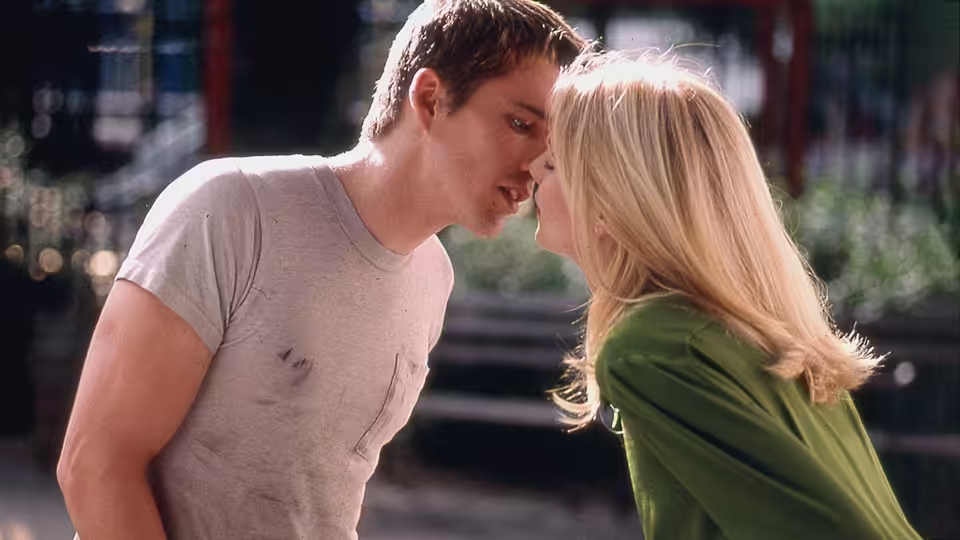
The look first, because it is the reason to see it. Emmanuel Lubezki shoots almost every frame with green in it: the water, Estella’s dresses, the peeling walls of Ms. Dinsmoor’s mansion, the paint on Finn’s hands. Tony Burrough’s Paradiso Perduto is a coastal pile with the garden grown in through the windows and a fountain full of leaves, and the New York apartments are white and bare by contrast, so we know Finn has arrived nowhere in particular. Judianna Makovsky puts Paltrow in fitted green and puts Bancroft in the wardrobe of a woman who has not bought anything new in decades and still dresses for dinner. It is a coherent, deliberate world, and Cuarón moves the camera through it slowly enough to let us live in it.
Bancroft is the film’s great turn. Ms. Dinsmoor smokes, dances alone to old records in her ruined ballroom, and speaks to the ten-year-old Finn (Jeremy James Kissner) as though he were a grown man who had already let her down. She is funny and frightening in the same breath and she never asks for sympathy. De Niro, as the convict Finn finds in the shallows in the first ten minutes, has only a handful of scenes and makes each one count; whenever he is on screen the film has tension, and whenever he is not it has scenery. Chris Cooper plays Joe, the fisherman who raises Finn, with a plain decency the film does not know what to do with.
The problem is the lovers. Hawke’s Finn is a man things happen to. He draws, he wants Estella, he is given money and a gallery, and at no point does he decide anything. Hawke plays it soft-voiced and slightly hurt, and there is nothing behind the hurt. Paltrow’s Estella is asked to be cruel and desirable and nothing else, and she does both, but Glazer never gives her a reason to keep returning to a man she plainly holds in contempt, or him a reason to keep letting her. The kiss at the fountain between the children is the best scene the two characters share, and they are ten.
We wanted to be swept up. The film is built to sweep, all green light and Patrick Doyle’s strings rising every time Estella walks into a room, and around the hour mark we noticed we were admiring the wallpaper while two beautiful people stared at each other. Then we were faintly annoyed, because all the pieces of a real film were there and nobody was assembling them. Doyle’s score works hardest exactly where the writing works least, and you can hear the strain. Steven Weisberg cuts the Florida childhood with a dreamy looseness that suits it and the New York half with the same looseness, which does not; the gallery scenes drift.
Dickens’s Pip learns that he has been ashamed of the wrong people, and Joe is where that lesson lands. Glazer keeps Joe and forgets what he is for. When the fisherman turns up in the city, Finn is embarrassed, and the film is embarrassed with him rather than by him. Without that turn the story is a boy who fancies a girl and gets rich. Hank Azaria’s Walter Plane, the rival for Estella, is given so little to do that he registers as a rumour.
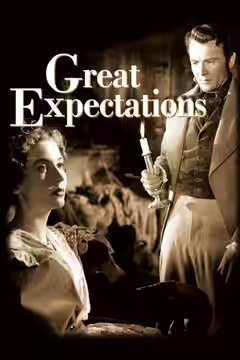
Most critics have split down the middle on this one, and we can see both halves. David Lean’s 1946 film found the marshes frightening; Cuarón finds the Gulf beautiful, and that is the trade he has made. See it for Bancroft, for the colour, and for De Niro coming up out of the water. Watch it at home, where the greens hold and the longing takes up less of the evening. It carries a 15 certificate.