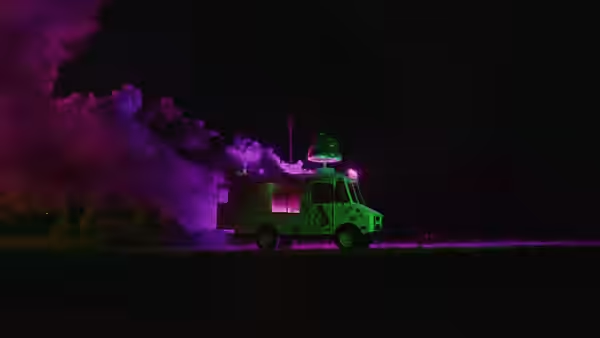
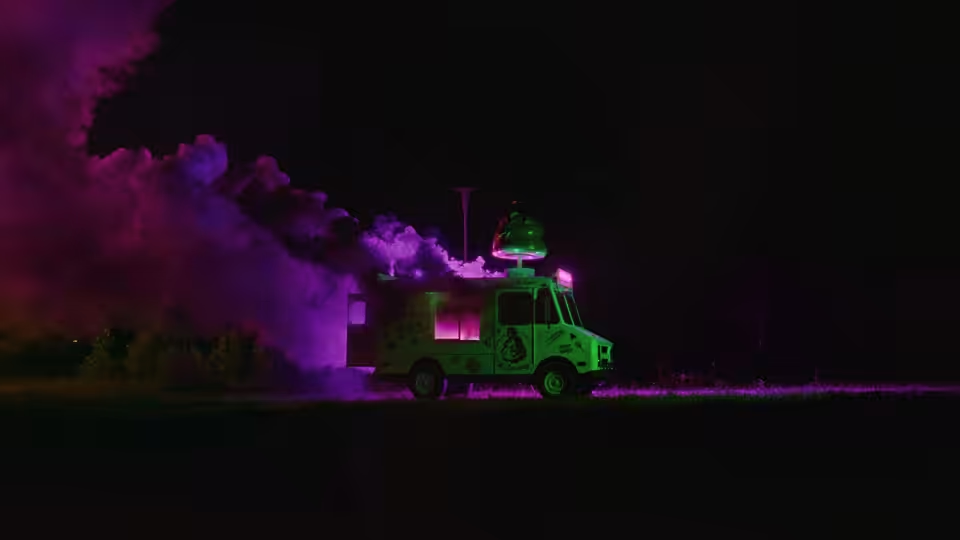
A brightly lit truck sits amid billowing purple smoke at night
Film review

I Saw the TV Glow

2024 · Directed by Jane Schoenbrun · 1h 40m

In a sentenceThe suburbs lit like a screensaver, and the most frightening thing in it is a man insisting he is fine

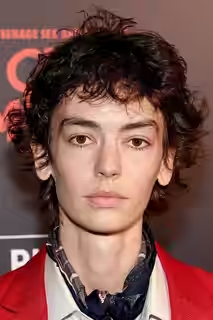
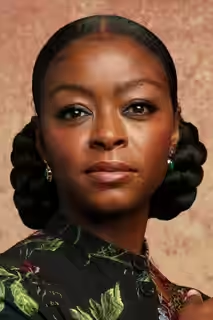
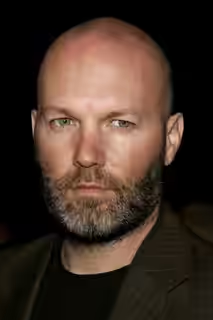
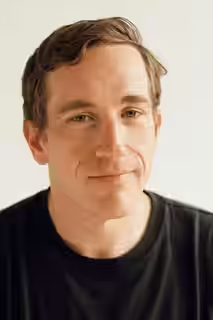
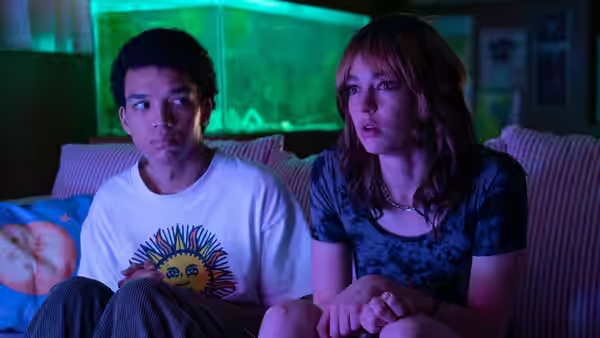
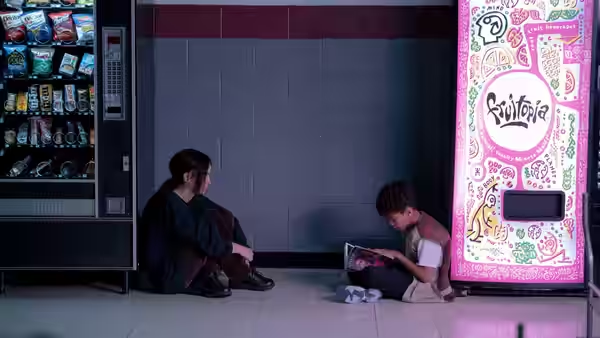
It is 1996, in an American suburb. Owen (Ian Foreman), in seventh grade, wanders into the school hall on election night and finds Maddy (Jack Haven), two years older, reading an episode guide to The Pink Opaque, a Saturday-night show about two girls, Isabel (Helena Howard) and Tara (Lindsey Jordan), who share a psychic link and fight the moon-faced Mr Melancholy (Emma Portner). It airs at half past ten, after Owen’s bedtime, and his father Frank (Fred Durst) thinks it is a show for girls. Maddy tapes it for him, and Owen lies to his mother Brenda (Danielle Deadwyler) about a sleepover and watches it in Maddy’s basement. Justice Smith takes over as Owen gets older, and the show becomes the only thing either of them talks about.

Plays from YouTube when you press play; nothing loads from them until then.

Fi1m review

Jane Schoenbrun’s horror film about a boy, a girl and a cancelled television show is quietly, seriously unsettling for an hour. Then it slows to a crawl and tells us what it means. Worth your evening, if you can sit still for it.

Jane Schoenbrun’s film is set in an American suburb in 1996 and, for its first half, it is about two lonely teenagers and a television programme. Owen is in seventh grade and in bed by ten. Maddy is in ninth, reads an episode guide alone in the school hall on election night, and does not seem to have anyone either. The Pink Opaque goes out at half past ten on Saturdays, so Maddy tapes it for him and labels the cassettes by hand. That is the plot for a long time, and it is enough.

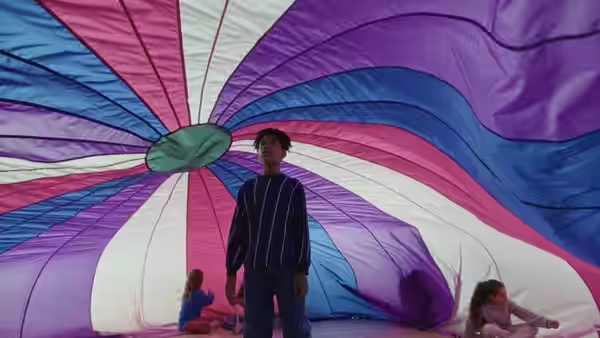
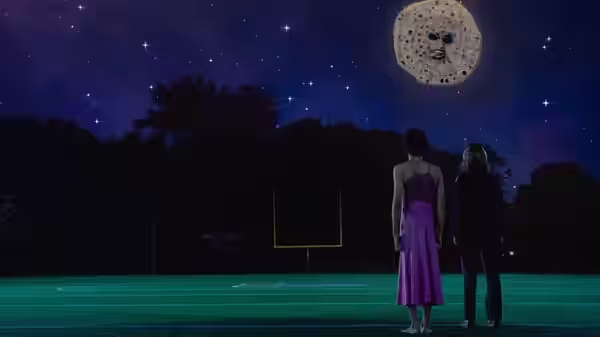
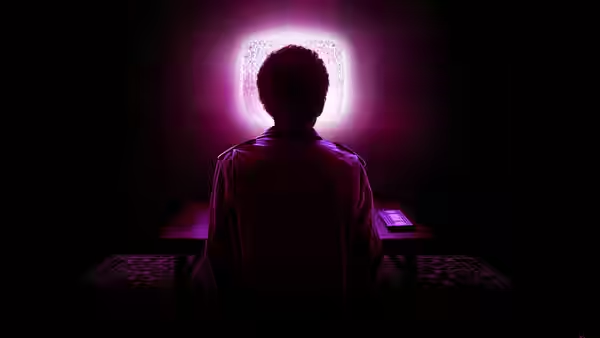
Eric K. Yue lights the town as if every streetlamp had been swapped for a neon tube. Front rooms are pink and violet, school corridors are green, and the television throws a soft white square across children’s faces that is the nearest thing in the film to warmth. Brandon Tonner-Connolly’s production design gets the junk right: a rainbow parachute in a gym, an ice-cream van, the words THERE IS STILL TIME chalked in pink down the middle of a road. The show inside the film is fog, blue gel and Emma Portner’s Mr Melancholy, a moon with a man’s face, and it is as frightening as anything is when you are eleven.

Justice Smith plays Owen from his late teens onwards as someone who has stopped expecting anything. His shoulders sit up round his ears, his voice comes out in a half-whisper, and when he tells us, straight to camera, that he has known since he was small that something was wrong inside him, he says it the way you would read out a phone number. That was the line that got at us. We had been waiting for the horror to come out of the television, and it came instead from a young man being polite about his own disappearance. Jack Haven’s Maddy is the opposite, all edges and long stares, and Haven gets the film’s big speech, on the bleachers of a football field in something close to a single take. We will not say what it is about. It is the best-written scene in the film and the one that most tests your patience.

Schoenbrun is plainly writing about being trans, about years spent knowing and not acting, and the film’s strengths and problems both come from that. Danielle Deadwyler and Fred Durst, as Owen’s parents, are used sparingly and well; Durst, asking whether The Pink Opaque is not a show for girls, makes a sofa and a can of beer menacing. Rachel Dainer-Best keeps Owen in the same slack jumpers across two decades, which tells you most of what you need to know. Alex G’s score hums under all of it and rarely rises above a hum. The songs are another matter.

Twice the film stops for a band to play a full song in a bar called the Double Lunch, and the second time we were doing sums with the runtime. Sofi Marshall cuts the school years quickly and with feeling, then lets the adult years sit, and we understand that the slowness is the subject. Owen’s life is a waiting room. But there is a difference between showing us a man who does nothing and making a film in which nothing happens, and for perhaps twenty minutes in the middle Schoenbrun lands on the wrong side of it. Later the film says aloud what its pictures had already told us, and then says it again.

Schoenbrun’s previous feature, We’re All Going to the World’s Fair, was about a girl and a webcam, and this is the same idea with more people in it. It has better light and two real performances, and it has lost some of that film’s plainness; here every second image is a symbol and you can feel the camera pointing at it. Most critics have been warmer than we are, and we understand why. The people who found it shattering saw themselves in it, and we would not argue with them. We saw an hour that had us completely and forty minutes that had already made their point.

It is a 15 certificate and earns it with dread rather than blood. See it in a cinema if you can, with the sound up, because the glow is the whole point and a laptop will make it look like somebody’s night light. Then go and find the programme you loved at twelve, and see whether you dare watch it again.
Critical consensus AI synthesised

76
Positive
23
Mixed
6
Negative
1
IndieWire
19 January 2024 · A · David Ehrlich
95

Ehrlich praises the film as an astonishing, haunting exploration of trans identity and the power of media. He singles out Brigette Lundy-Paine’s intensely delivered monologue as especially chilling and poignant.

Read the full review →
The AV Club
11 March 2024 · A · Matthew Jackson
95

Jackson calls the film a triumph of beautiful darkness, while noting its unusual approach may not appeal to everyone. He praises its evocative visuals and the hypnotic, emotionally unsettling performances of Justice Smith and Brigette Lundy-Paine.

Read the full review →
Little White Lies
festival review · Esther Rosenfield
92*

Rosenfield finds the film a potent, assured portrait of anxiety, repression and transgender life. She especially praises its vivid, eerie visuals and the way its horror elements gather force.

Read the full review →
Empire
22 July 2024 · Laura Venning
90*

Venning finds the film awe-inspiringly original, visceral, and intensely moving. She especially praises Justice Smith’s revelatory performance and the film’s affecting queer allegory.

Read the full review →
The Hollywood Reporter
21 January 2024 · festival review · Jourdain Searles
90*

The critic finds the film an astonishing, emotionally powerful exploration of identity and self-denial. They single out Justice Smith’s phenomenal performance and praise the film’s dreamlike ’90s atmosphere.

Read the full review →
The Guardian
20 January 2024 · festival review · Benjamin Lee
86*

Lee praises the film as a richly immersive and haunting work, with particular force in its exploration of queer and trans experience. He finds the last act imperfect but says its emotional impact leaves a powerful impression.

Read the full review →

Straight answers AI written, from our review

Is I Saw the TV Glow worth watching?
I Saw the TV Glow is worth watching if you can sit still through a slow second half, and we scored it 74. For an hour Jane Schoenbrun's horror film about two lonely teenagers and a cancelled television show is quietly unsettling, with Justice Smith very good as a young man being polite about his own disappearance. Then it slows to a crawl and tells us what it means, twice.
How long is I Saw the TV Glow, and what is it rated?
I Saw the TV Glow runs 1h 40m. It is a drama and horror film.
Where can I watch I Saw the TV Glow in South Africa?
I Saw the TV Glow is not on any streaming or rental service in South Africa at the moment. It is available in 39 other countries; change your country at the top of the page to see where. Availability is checked daily.
How violent or frightening is I Saw the TV Glow, and is it suitable for children?
I Saw the TV Glow is a UK 15 certificate and earns it with dread rather than blood; there is little violence, but the mood is heavy and sad throughout. The frights come from a moon-faced villain inside a children's show and from a grown man insisting he is fine. It is not for young children, and teenagers should expect a slow, mournful film rather than jump scares.
How does I Saw the TV Glow compare to Videodrome?
I Saw the TV Glow and Videodrome both find horror in a television screen, but Cronenberg's film is about a screen invading the body, while Schoenbrun's is about a boy hiding inside one. Videodrome is the stranger and more physical film and still looks like nothing else; I Saw the TV Glow has the better performances and the gentler, sadder heart. Both are unsettling for an hour, then lose their footing.
What should I watch after I Saw the TV Glow?
After I Saw the TV Glow, try Videodrome (1983, Fi1m 82): Cronenberg’s television gets under the skin, literally; the original screen-as-body horror. Then Perfect Blue (1997, Fi1m 82): Satoshi Kon’s pop idol loses track of which self is real; a fast, nasty cousin; and Donnie Darko (2001, Fi1m 83): Suburban teens, late-night television and dread in the late nineties, with more plot.

Cast

If you liked this, try…

  1. We're All Going to the World's Fair (2021) · not on Fi1m yetSchoenbrun’s earlier film, one girl and a webcam, quieter and stranger still.

  2. Videodrome (1983, Fi1m 82)Cronenberg’s television gets under the skin, literally; the original screen-as-body horror.

  3. Perfect Blue (1997, Fi1m 82)Satoshi Kon’s pop idol loses track of which self is real; a fast, nasty cousin.

  4. Donnie Darko (2001, Fi1m 83)Suburban teens, late-night television and dread in the late nineties, with more plot.

  5. Twin Peaks: Fire Walk with Me (1992) · not on Fi1m yetLynch’s last week of Laura Palmer; the small-town dread Schoenbrun has plainly studied.

I Saw the TV Glow (2024) review: an eerie hour, then it over-explains (South Africa) | Fi1m