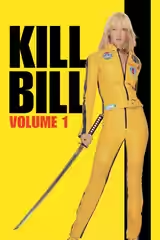
The critics split widely on this one, and the middle ground is thinner than the score suggests. Almost everyone praises Uma Thurman, whose performance is variously called steely, athletic and more emotional than the film around her, and almost everyone admires the fight sequences, the editing and the sheer confidence of the staging. The reservations are just as consistent. Several reviews find the relentless bloodletting numbing rather than provocative, and more than one notes that the film feels like half of something, with an ending that satisfies nobody. Empire and The Independent both miss the dialogue Tarantino is known for. The dissent runs in both directions: Total Film is unreserved in its enthusiasm, while Eye for Film dismisses the film as a self-indulgent barrage of banality and The Independent finds it joyless and adolescent. The majority sit in between, admiring the craft while wondering whether the references add up to a film.
T
Total Film
10 October 2003
90*
The critic hails the film as a brilliant, genre(s) masterpiece and Tarantino masterpiece, praising its pacing, graceful action set pieces, shifts in tone, and how it stands strong as its own film despite the split into volumes. They highlight the cool, stylized violence and fresh tweaks to the director's style.
Read the full review →R
Radio Times
★★★★ · Alan Jones
80
Tarantino marshals a bewildering number of multi-genre references into a hypnotically entertaining whole in this violent martial arts revenge drama, with a searing performance from Uma Thurman.
Read the full review →S
Screen Daily
29 September 2003 · festival review
80*
The first part of the two-parter is an exhilarating ride anchored by a bravura action performance from Uma Thurman, with cartoonish violence and riveting balletic fight sequences.
Read the full review →L
Los Angeles Times
10 October 2003 · Manohla Dargis
70*
Blood splatters in baroque fountains in this private fetish of a movie that is a blood-soaked valentine to movies and the ultimate film-geek freakout, a compendium of 1960s and 1970s cine-references. The critic singles out the quiet exchange with Sonny Chiba's sushi chef and Lucy Liu's performance as elements that elevate it beyond extreme gore and self-adoring virtuosity, while noting it feels like half a movie.
Read the full review →A
The AV Club
6 October 2003 · Scott Tobias
70*
The critic praises the masterful grindhouse theatrics and meticulously orchestrated setpieces in this half of the story but finds the cumulative effect wearying due to unrelieved carnage and an unsatisfying ending. They single out the non-sequential storytelling and eclectic references for effective homage to genre films.
Read the full review →N
The New York Times
10 October 2003 · A. O. Scott
70*
The film is an exercise in style, a densely referential pastiche of B-movie attitudes and situations that immerses viewers in an artificial world reflecting the director's cinematic obsessions. Its appeal depends on sharing those obsessions, with the critic highlighting the passion behind the spectacle and the central connection between Tarantino and star Uma Thurman.
Read the full review →E
Empire
17 October 2003 · Colin Kennedy
65*
The review admires the film's confident action set pieces, Uma Thurman's steely performance, and its splattery climax but finds the rest a curate's egg lacking Tarantino's usual dialogue and quotable flair. It concludes it is a worthy addition to his canon that just about stands alone ahead of Volume 2.
Read the full review →T
Time Out
25 September 2014 · TCh
50*
The critic finds the film self-indulgent, tasteless and ultimately numbing as pure fanboy escapism stitched from set pieces, but praises the bravura filmmaking from a prodigious talent and Uma Thurman's performance as its potential saving grace.
Read the full review →I
The Independent
11 October 2003 · Jonathan Romney
40*
The critic views the film as a joyless, adolescent tribute to Asian action cinema that prioritizes flashy violence over substance. They praise the virtuoso sound design, editing, and Uma Thurman's athletic performance while complaining about the callous tone, skimpy drama, and absence of Tarantino's signature wit.
Read the full review →F
Film Comment
1 November 2003 · Geoffrey O’Brien
The critic views the film as a return to Tarantino’s video-store-clerk roots, a stylized love letter to grindhouse and martial-arts cinema centered on Uma Thurman’s avenging Bride. He praises its dazzling formalism, color, compositions, and inventive action while noting its cartoonish violence and lack of deeper cultural context.
Read the full review →S
Slant Magazine
9 October 2003 · Ed Gonzalez
The critic views the film as a soulless, vacuous pop-culture mixtape that prioritizes references and gags over originality. They single out the constant bloodletting as desensitizing rather than provocative, while noting Uma Thurman's performance as more emotional than the film itself.
Read the full review →G
The Guardian
10 October 2003 · Peter Bradshaw
The critic finds the film an exhilarating adrenaline rush delivered with Tarantino's signature efficiency, though not his best work overall. The stylish, allusive martial-arts revenge tale set in a comic-book universe stands out for its cartoonish violence and genre homages.
Read the full review →T
The Telegraph
3 October 2003 · Sam Leith
The critic sees the film as a triumph of pure style over substance, a shallow but visually energetic cinephile exercise about movies themselves with no real dramatic tension. Its relentless, gory rampage of revenge and genre pastiche are singled out as its core appeal and limitation.
Read the full review →E
Eye for Film
16 October 2003 · ★½ · Angus Wolfe Murray
30
The critic calls the film the most self-indulgent, gratuitous, blood-soaked barrage of banality in B-picture pastiche. They single out the excessive, repulsive violence and lack of memorable dialogue or coherent story as major flaws.
Read the full review →Ordered by the weight we give each publication, then by score. Scores are normalised to 100; * means inferred from an unrated review. Summaries are ours, not quotations; follow the links for the reviews themselves. How we rate