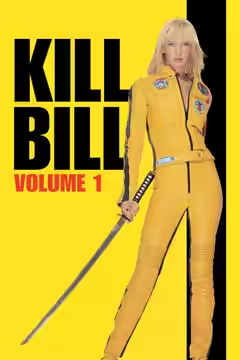
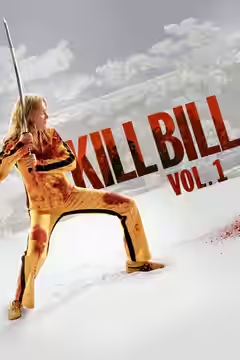
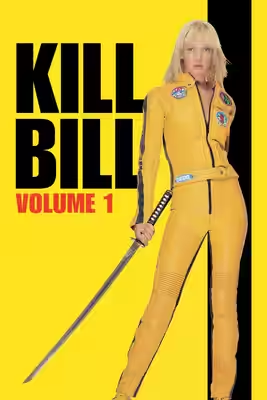
Kill Bill: Vol. 1 poster

Kill Bill: Vol. 1

2003 · Directed by Quentin Tarantino
1h 51mActionCrime18
72
Fi1m score
66
Critics · 10
Audience · not yet

Where to watch in the UK

Checked 10 September at 22:29. Prices and availability change; the service’s page is the last word.

Synopsis

The Bride (Uma Thurman) wakes from a four-year coma. The last thing she remembers is her wedding, the killing of everyone in the chapel by the assassination squad she used to belong to, and its leader, Bill (David Carradine), putting a bullet in her head. She writes down five names. The first is Vernita Green (Vivica A. Fox), now a housewife in Pasadena. The biggest is O-Ren Ishii (Lucy Liu), who runs the Tokyo underworld from a nightclub called the House of Blue Leaves. Before Tokyo she needs a sword, and Hattori Hanzo (Sonny Chiba), who keeps a sushi bar in Okinawa, no longer makes them. Daryl Hannah is Elle Driver, the one with the eyepatch.

Fi1m review

In a sentenceA woman in a yellow tracksuit slices through a nightclub and the best scene is two people talking about sushi

Tarantino’s revenge film is the most purely made thing he has done and the least written. The fights are extraordinary and Uma Thurman carries them on nerve alone, but it is half a film and knows it.

Six years after Jackie Brown, Quentin Tarantino comes back with a revenge film so long it has been cut in two, and this first half is the most purely made thing he has done and the least written. A woman is shot in the head at her own wedding, wakes up four years later, writes five names on a pad and starts working through them. That is the whole plot. Tarantino tells it out of order, in numbered chapters with title cards, and each chapter is a set piece. The set pieces are as good as anything he has staged. The talk in between them is where the trouble is.

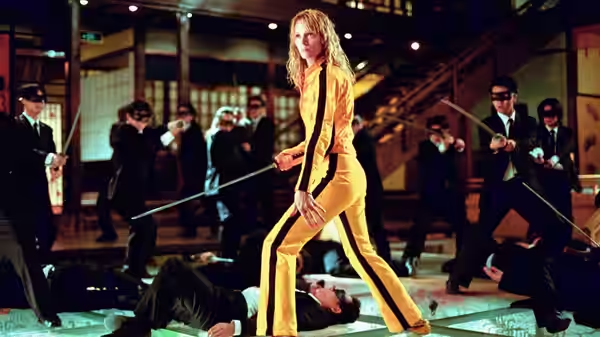
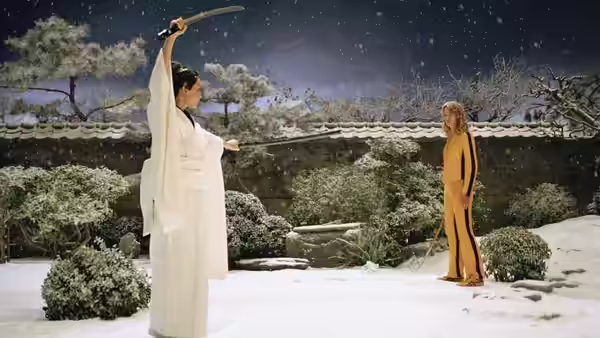
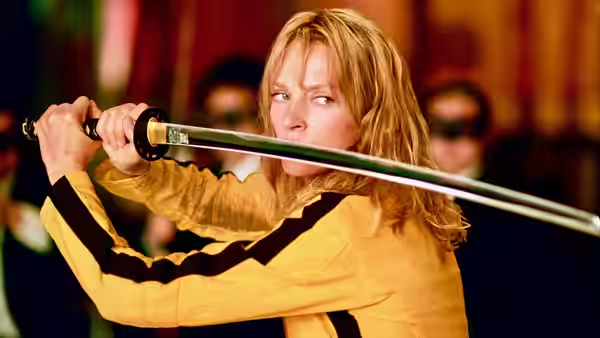
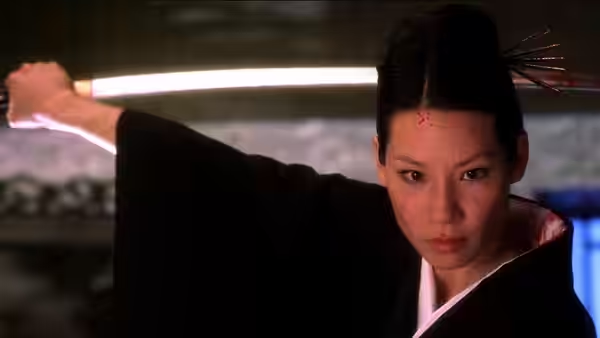
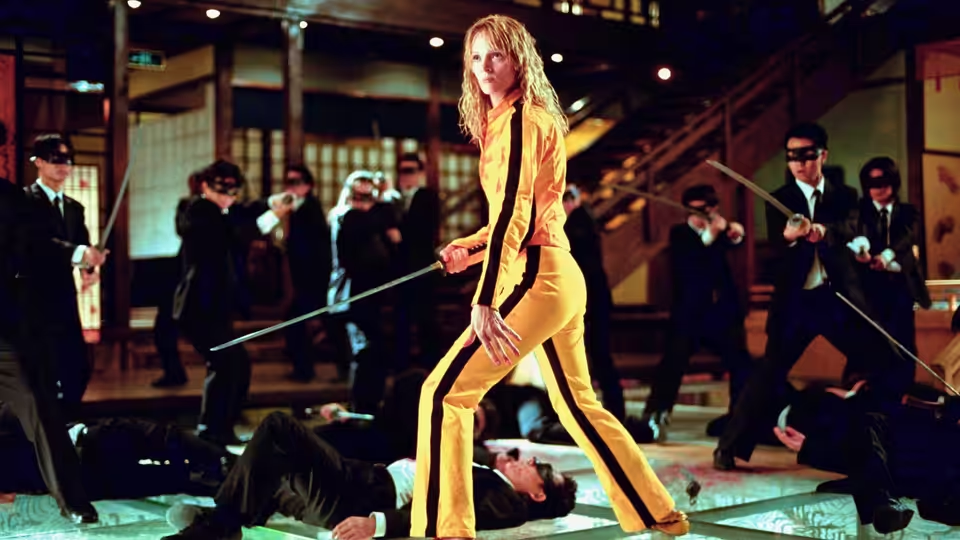
Yohei Taneda and David Wasco build the House of Blue Leaves, the Tokyo club where the film ends up, as two storeys of dark wood around a dance floor lit from below, with a snow garden out the back. Robert Richardson lights it hard and clean, so the yellow of Thurman’s tracksuit and the white of Lucy Liu’s kimono read from the back row and the blood comes out a poster red. Earlier, in the hospital, he splits the screen down the middle: Daryl Hannah’s Elle Driver in a nurse’s uniform and an eyepatch, walking a corridor and whistling, on one side; the Bride asleep on the other. It is the tensest minute in the film and nobody draws a weapon.

Sally Menke cuts the fights so that you always know where the Bride is and how many are still standing. When the Blue Leaves fight reaches a pitch of gore no certificate would allow, the film drops into black and white and carries on, and we laughed out loud at the nerve of it. Then the lights go and the fight continues as silhouettes against blue, and the laugh turned into admiration. RZA’s beats and Tomoyasu Hotei’s strutting guitar riff, which arrives with O-Ren’s entourage in slow motion, are cut to the footsteps. Chiaki Kuriyama’s Gogo, a schoolgirl in uniform swinging a spiked ball on a chain, gets the best short fight.

Thurman holds it together with almost nothing written for her. The Bride is given no jokes and no speeches; Thurman plays her as pure effort, a woman whose body keeps having to be argued into working. The hospital chapter horrified us, and not because of anything with a blade. Michael Bowen’s orderly Buck has been selling the comatose Bride to men, and the film says so with a grin and a novelty truck and moves on. We wanted it to be as sickened as we were. Then it sits still while she stares at her feet and wills her big toe to move, and Thurman does more with that minute than with any sword.

Liu gets the one stretch of writing that sounds like the man who wrote Pulp Fiction, a speech to the Tokyo crime bosses that switches from Japanese to English for the threat, and she delivers it with relish. Sonny Chiba’s Hattori Hanzo, a swordsmith running a sushi bar in Okinawa, has the only quiet scene and the best: two people at a counter, one pretending not to understand the other, then an attic full of swords. David Carradine’s Bill is a voice on a phone and a pair of hands. Vivica A. Fox gets one fight in a suburban kitchen and makes Vernita Green a person in about four minutes.

The rest of the cast is not so lucky, because Tarantino has given most of his dialogue to other films this time. The chapter that tells O-Ren’s childhood is drawn as anime and is the nastiest thing here, a child watching what is done to her parents, and from there the killing stops costing anyone anything, including us. What follows is an expensive tribute reel. If you do not know the films being quoted, a good deal of the second hour is men in black suits falling over.

Reservoir Dogs (1992) and Jackie Brown (1997) were about people who talked, and the violence interrupted them. This time he has kept the violence and left most of the talk at home. It is also, plainly, half of something: it stops rather than ends, on a last line we will not repeat that changes the shape of what you have just watched.

See it for the Blue Leaves, for Chiba, for Thurman’s toe, and for the moment the colour drains out of the frame. Do not expect to feel much for anyone but her. It runs 111 minutes and carries an 18, and it earns the certificate.
Critical consensus AI synthesised

66
Positive
6
Mixed
2
Negative
2

The critics split widely on this one, and the middle ground is thinner than the score suggests. Almost everyone praises Uma Thurman, whose performance is variously called steely, athletic and more emotional than the film around her, and almost everyone admires the fight sequences, the editing and the sheer confidence of the staging. The reservations are just as consistent. Several reviews find the relentless bloodletting numbing rather than provocative, and more than one notes that the film feels like half of something, with an ending that satisfies nobody. Empire and The Independent both miss the dialogue Tarantino is known for. The dissent runs in both directions: Total Film is unreserved in its enthusiasm, while Eye for Film dismisses the film as a self-indulgent barrage of banality and The Independent finds it joyless and adolescent. The majority sit in between, admiring the craft while wondering whether the references add up to a film.

Total Film
10 October 2003
90*

The critic hails the film as a brilliant, genre(s) masterpiece and Tarantino masterpiece, praising its pacing, graceful action set pieces, shifts in tone, and how it stands strong as its own film despite the split into volumes. They highlight the cool, stylized violence and fresh tweaks to the director's style.

Read the full review →
Radio Times
★★★★ · Alan Jones
80

Tarantino marshals a bewildering number of multi-genre references into a hypnotically entertaining whole in this violent martial arts revenge drama, with a searing performance from Uma Thurman.

Read the full review →
Screen Daily
29 September 2003 · festival review
80*

The first part of the two-parter is an exhilarating ride anchored by a bravura action performance from Uma Thurman, with cartoonish violence and riveting balletic fight sequences.

Read the full review →
Los Angeles Times
10 October 2003 · Manohla Dargis
70*

Blood splatters in baroque fountains in this private fetish of a movie that is a blood-soaked valentine to movies and the ultimate film-geek freakout, a compendium of 1960s and 1970s cine-references. The critic singles out the quiet exchange with Sonny Chiba's sushi chef and Lucy Liu's performance as elements that elevate it beyond extreme gore and self-adoring virtuosity, while noting it feels like half a movie.

Read the full review →
The AV Club
6 October 2003 · Scott Tobias
70*

The critic praises the masterful grindhouse theatrics and meticulously orchestrated setpieces in this half of the story but finds the cumulative effect wearying due to unrelieved carnage and an unsatisfying ending. They single out the non-sequential storytelling and eclectic references for effective homage to genre films.

Read the full review →
The New York Times
10 October 2003 · A. O. Scott
70*

The film is an exercise in style, a densely referential pastiche of B-movie attitudes and situations that immerses viewers in an artificial world reflecting the director's cinematic obsessions. Its appeal depends on sharing those obsessions, with the critic highlighting the passion behind the spectacle and the central connection between Tarantino and star Uma Thurman.

Read the full review →

Cast

Uma Thurman
The Bride
Lucy Liu
O-Ren Ishii
Vivica A. Fox
Vernita Green
Daryl Hannah
Elle Driver
Julie Dreyfus
Sofie Fatale
Chiaki Kuriyama
Gogo Yubari

Stills

Awards

International Cinephile Society Award for Best Actress, 2004

Won
International Cinephile Society Award for Best Actress

MTV Movie Award for Best Villain, 2004

Won
MTV Movie Award for Best Villain

European Film Award for Best Non-European Film, 2003

Nominated
European Film Award for Best Non-European Film

If you liked this, try…

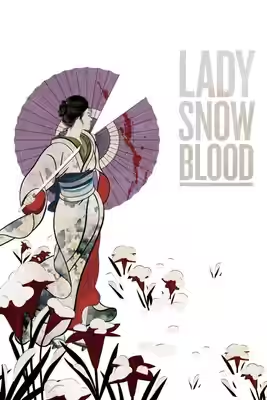
Lady Snowblood poster

Lady Snowblood

1973 · The snow-garden duel comes from here, and the original has a colder heart.

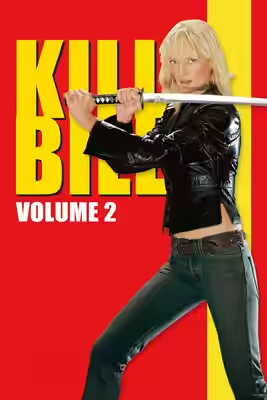
Kill Bill: Vol. 2 poster77

Kill Bill: Vol. 2

2004 · The other half, with the talk this one is missing and a better Bill.

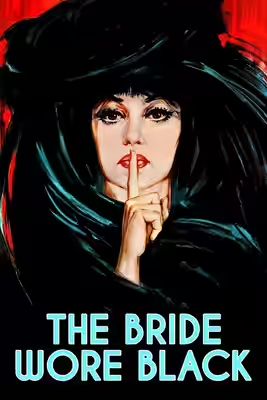
The Bride Wore Black poster

The Bride Wore Black

1968 · Truffaut’s widow works down her own list of five, without a drop of splatter.

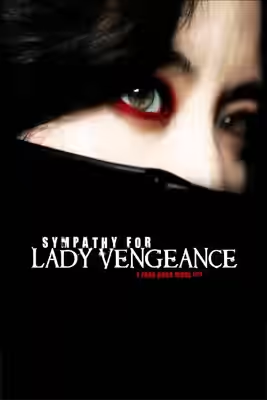
Lady Vengeance poster

Lady Vengeance

2005 · Park Chan-wook’s revenge film asks what the Bride never does: what it costs.

Point Blank poster

Point Blank

1967 · Lee Marvin comes back from the dead to collect, and nobody is quipping.