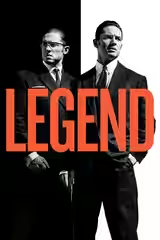
The reviews lean mixed rather than hostile, and almost all of them agree on one thing: Tom Hardy’s performance as both Kray twins is the reason to watch. Critics describe his Reggie and Ronnie as sharply differentiated, intimidating and often funny, and several say he carries a film that would otherwise sag. The effects that let him play both brothers in one frame draw approval too, as does the period look.
Where they part is on everything around him. The most common complaints are a thin script, an underwritten Frances whose narration grates, a tone that swings between comedy and violence without settling, and a romanticised view of the Krays that some find troubling. The spread is wide. British critics are mostly warm, with several four-star notices, while the American trades and the later American reviews are far cooler. The Hollywood Reporter goes furthest, finding the set dressing more engaging than the performances, and Slant is the rare voice unconvinced by Hardy himself.
T
Time Out
2 September 2015 · ★★★★ · Dave Calhoun
80
The review presents the film as a slick, melancholy crime drama. It praises Tom Hardy’s performance as the Kray twins.
The review finds the film flawed but swaggeringly cinematic, and says Tom Hardy excels, especially as Reggie. It praises Hardy’s charismatic, dazzling performance while noting that Frances is frustratingly underwritten.
Jolin gives the film a clearly positive verdict, while noting that Frances’s voiceover can grate. He particularly praises Tom Hardy’s magnetic, sharply differentiated performances as both Kray twins.
O'Sullivan finds the film an ambitious but uneven hotchpotch, with a muddled use of Frances as narrator. She praises Tom Hardy as outstanding and gripping in both roles.
Kermode finds the film cartoonish but entertaining, with its affection for the Krays’ image left intriguingly ambiguous. He singles out Tom Hardy’s committed dual performance as the film’s central strength.
Macnab finds the film lavish and entertaining, though its romanticized treatment of the Krays is troubling. He particularly praises Tom Hardy’s flamboyant, compelling dual performance.
The visible standfirst presents the film as emphasizing substance over style. No fuller critical verdict or specific praise is available in the accessible text.
Lodge finds the biopic compelling but structurally compromised and psychologically thin. He singles out Tom Hardy’s remarkable dual performance as the film’s most dazzling achievement.
The page presents a video review of Brian Helgeland’s gangster biopic but gives no readable verdict. Loughrey raises whether tea can fix everything, though the page text does not reveal her answer or a specific praise or complaint.
Ebiri finds the film unable to match the energy of Tom Hardy’s dual performance. He praises Hardy’s distinct characterizations and singles out the brothers’ tense confrontation at their mother’s house, while faulting the supporting world for feeling underdeveloped.
Fujishima finds the film shallow and unsympathetic, with Hardy unable to bring depth to his twin roles. He particularly faults the script’s thin characterization of Frances and its reliance on recycled gangster-film style.
Felperin pans the film as tonally incoherent, vacuous, and structurally messy. She praises its period visuals and production design, but says the performances are less engaging than the set dressing.
The critic finds Legend particularly absorbing, with Tom Hardy’s dual performance giving the gangster story its tension and magnetism. He praises Hardy’s intimidating, often funny portrayal of the twins, while noting that some digital backgrounds look processed and stagey.
Pape finds the film unfocused and tonally inconsistent, despite its intriguing subject. He praises Tom Hardy’s distinctive dual performance and the seamless effects that let him play both twins together.
The review finds the film morbidly fascinating but uneven, criticizing its romanticized view of the Krays. It praises the tense dialogue and Hardy’s performance as both brothers.
The critic finds the film entertaining and watchable, but says it never develops the deeper meaning its title promises. Hardy’s showy dual performance is a standout, though its oversized portrayal of Ronnie ultimately unbalances the film.
Chitwood finds the film a derivative, overlong slog that fails to make its promising subject compelling. He praises Hardy’s characterization of the twin brothers, especially Ronnie, but says the script gives him too little to work with.
The critic finds the film uneven and ultimately incomplete, despite Hardy’s impressive work. They single out Hardy’s dual performances as its chief strength, while faulting the film’s inconsistent tone and lack of meaningful critique.
The critic finds the film stylish but shallow, with Hardy’s performance doing most of the work. Hardy’s vivid portrayal of both twins is singled out for praise, while the schematic story and polished look draw criticism.
Ordered by the weight we give each publication, then by score. Scores are normalised to 100; * means inferred from an unrated review. Summaries are ours, not quotations; follow the links for the reviews themselves. How we rate