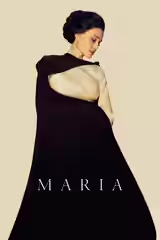
The reviews split widely, from warm four-star notices to outright dismissals, and the argument is nearly always about temperature. Most critics agree that Angelina Jolie is the reason to watch, praising her poise, her diction and the way she keeps Callas’s fragility visible under the grandeur; The Telegraph and Empire go furthest, calling it her best work in many years. Praise also clusters on the look of the film, Ed Lachman’s photography of 1970s Paris, the costumes and production design, and the decision to let Callas’s own recordings carry the music.
The reservations cluster just as tightly. A large minority find the film chilly and bloodless, held at a remove, with Larraín so respectful of Callas’s imperious surface that her fury never gets in. The Los Angeles Times and RogerEbert.com are harshest, the latter finding it stiff and self-important with little to say about opera or its subject. Even admirers concede the pace is stately and the shape familiar from Larraín’s earlier biopics.
L
Little White Lies
9 January 2025 · 3/4/4 · Hannah Strong
80
Jolie has never been better, and Larraín and Knight capture Callas’ flighty nature and vulnerability with sensitivity and grace in an elegant biographical drama that is ultimately a love story.
The critic describes the film as the softer, more restrained conclusion to Larraín’s trilogy of biopics about 20th-century women, focusing on Maria Callas’s final days and her internal struggles rather than external drama. Angelina Jolie’s performance is singled out as career-defining and deeply empathetic, capturing the character’s humanity, fragility, and command.
Jolie gives her finest performance in at least 15 years as Callas in her final week, dazzling with regal glamour while the film focuses on her outliving her career. The biopic doubles down on her star power in a rich biographical role.
Jolie delivers a strong, talk-of-the-town performance in this classy, enjoyable biopic that offers a loving and affectionate portrait of Callas without airbrushing her foibles.
Jolie hits the notes as Callas in Larraín’s latest biopic, which is more than a standard biopic yet not a radical retake; expect acting and craft awards attention for its beautifully lit, costume-driven impersonation and performance.
The biopic is reverential in its portrayal of Callas but Jolie’s regal performance lacks the vibrant personality seen in documentary footage, though the craft, supporting cast and production design are praised.
The film is a bit of a slog even for an opera lover; it shares a cinematic universe with the director’s prior work but fails to fully figure out its subject despite sumptuously staged performances.
Jolie’s ambitious role does not feel like a comeback and comes across as bloodless and removed, with the film itself a snooze despite striking visuals and fantasy sequences. It singles out the beautiful cinematography of 1970s Paris and the use of Callas’s voice and opera excerpts for praise amid the overall detachment.
Larraín respects Callas’s imperious veneer too much, resulting in a chilly, one-note performance from Jolie that lacks the passion and fury of the real singer.
The critic calls Jolie’s portrayal staggeringly good and perhaps her best, highlighting her commanding yet delicate presence, sharp dialogue delivery, and the parallels between the character and the actor’s own career. The film is praised as a muted, autumnal study of fame and performance, with Larraín wisely centering his lead.
Jolie captures Callas’s glamour, intellect and pathos but the film remains emotionally remote in its focus on her last days. It is a stately but conservative biopic that lacks joy and warmth.
Jolie gives a sophisticated, nuanced turn that reminds us of what an accomplished actress she can be in this stirring biopic focused on the final week of Callas’s life.
Larraín flattens the icon into a kitschy, self-serious figure, relegating Jolie to a detached and mannered performance that fails to capture spontaneity or fury. The film is worth seeing mainly for the pleasure of hearing Callas’s voice at its heights, but the director’s approach makes it crack.
Larraín homes in on Callas’s final days with a stiffly dignified Angelina Jolie as the lioness in winter. The film is magnificent and declamatory, winning the critic over despite initial reservations about its self-regarding approach to the cult of the artist.
The film lacks the intimacy of Larraín's prior entries in his women trilogy, presenting Jolie’s Callas at a chilly, distancing remove despite technically precise acting. It praises the sumptuous visuals by Ed Lachman and the power of the opera music while noting the portrait feels glacial and more admiring of the staff than the lead.
The film is a wilfully limp biopic marred by dodgy lip-syncing, focusing on Callas’s final week in a drug haze with slow, half-slurred pronouncements. It lacks any emotionally operatic moments and feels wearily flat.
The critic commends Pablo Larraín's wistful direction and especially Angelina Jolie's transcendent, humanizing performance as the opera singer in her final days, framing it as a fitting close to his trilogy of biopics about famous women.
The critic highlights the film's gorgeous visuals and sound along with Angelina Jolie's strong central performance that anchors the story, while noting some false notes and structural issues but overall finding it accessible and worthwhile.
The review calls the film a restrained, dreamlike fantasia that is exquisitely beautiful and controlled, with Jolie ideal as a luminous wreck of a diva who embraces her own craziness.
The critic argues the film does Maria Callas a disservice by focusing saccharinely on romantic heartbreak and Onassis rather than her talent or craft, with an expository script and stoic performance from Jolie that fails to fully immerse.
The critic praises Angelina Jolie's magnificent, nuanced performance as Maria Callas but finds the biopic otherwise flawed, lacking insight and failing to commit to its narrative ideas around the singer's final days.
The critic finds the biopic tonally unsure of itself, both camp and too po-faced, and ultimately failing to match the legend of its subject despite gorgeous sets. It singles out Angelina Jolie's magnetic performance, including her extraordinary singing, for capturing Callas's fragility, self-mythology and stoicism.
29 August 2024 · festival review · Stephanie Bunbury
55*
The review praises Larraín's masterful command of the medium and Jolie's committed performance as Callas, including her singing, but finds the overall portrait curiously bloodless and distant, lacking the rasping edge of the director's other work.
The critic calls the film a one-note exploration that repeats Larraín's familiar navel-gazing formula on another tragic public figure, with Jolie only coming alive during singing scenes.
The critic finds Angelina Jolie transfixing as Maria Callas and praises the film's blend of surreality and historical context, but notes the screenplay follows Larraín's usual formula without much variation.
Ordered by the weight we give each publication, then by score. Scores are normalised to 100; * means inferred from an unrated review. Summaries are ours, not quotations; follow the links for the reviews themselves. How we rate