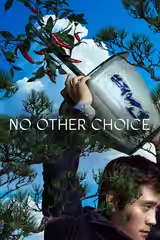
Most critics are won over by Park Chan-wook’s black comedy about a laid-off paper executive who murders his way back into work, and the spread of opinion is narrow: nearly every review lands between warm and delighted, with a single mixed notice. Praise clusters on Park’s direction, with reviewers describing inventive camera angles, elegant framing and set pieces that stage the killings as slapstick, and on Lee Byung-hun, whose sad-sack lead performance is singled out again and again. The satire of the job market, downsizing and AI is widely called timely, and several critics draw comparisons with Parasite.
Reservations are mild. Radio Times finds it broader and less subtle than Park’s earlier work and slightly overlong; The Hollywood Reporter thinks the slapstick short-changes the pathos and thriller stakes; The Playlist and Paste both fault the structure, one for too many plot strands, the other for repetition. The Guardian, otherwise approving, stops short of ranking it with Park’s best.
T
Time Out
28 August 2025 · ★★★★★ · John Bleasdale
100
The critic hails the film as a masterful black comedy and possibly Park Chan-wook’s masterpiece, a successor to Parasite in its take on late capitalism and job-market desperation. They single out the brilliant lead performance by Lee Byung-hun and the beautifully wrought, labyrinthine narrative.
Read the full review →V
Vulture
31 August 2025 · festival review
90*
Park coaxes total audience identification with the protagonist's insane actions through expressionist filmmaking that bends time and space, making the satirical thriller about capitalism and desperation feel deeply emotional and formally inventive.
Read the full review →I
The Independent
22 January 2026
85*
The critic finds the film a brutal and hilarious black comedy about an unemployed man who resorts to murder to secure a job. They praise Park Chan-wook's visual finesse and Lee Byung-hun's comedic performance in depicting the protagonist's desperate moral decline.
Read the full review →F
Financial Times
22 January 2026 · Danny Leigh
80*
A company man tries to save his own neck by targeting rivals in this bloody and beautiful film from virtuoso director Park Chan-wook. Adapting The Ax, it captures the brutal truth of downsizing through a midnight-dark comedy that puts the implicit violence of job cuts front and centre.
Read the full review →S
Screen Daily
29 August 2025 · festival review
80*
The critic calls it a wildly enjoyable economic satire and darkly comic treat with elegant filmmaking that balances psychological tension and hilarious comic set pieces. They single out the mordantly comic tone and its timely relevance to job cuts and AI.
Read the full review →G
The Guardian
29 August 2025 · ★★★★ · Peter Bradshaw
80
The film is a continually surprising black comedy about an unemployed paper worker who hatches a plan to murder his way back into the job market. It morphs from caper into a portrait of family dysfunction, fragile masculinity and the state of the nation, though it may not be Park’s masterpiece.
Read the full review →T
The Telegraph
22 January 2026
80*
In this deviously fun farce the job market in modern-day South Korea is literally murder, as a laid-off executive pursues deadly schemes to regain employment. The tangled bloody plot is vintage Park terrain adapted from an American novel but fitting perfectly into Korean cinema satire.
Read the full review →O
The Observer
24 January 2026 · Wendy Ide
75*
Park Chan-wook orchestrates chaos stylishly in this supremely slick film about a hapless everyman who turns to murder after being fired. The tone is comic but the message is a serious, scathing satire of business culture and AI threats that feels uncomfortably relevant.
Read the full review →R
Radio Times
23 January 2026 · ★★★ · James Mottram
60
The critic describes a broader, less subtle black comedy than Park’s earlier films, still rambunctious and inventive with strong moments of dark humour and surrealism around job loss and automation. They single out the highly watchable Lee Byung-hun performance while noting the film feels slightly overlong.
Read the full review →E
Empire
19 January 2026 · Jake Cunningham
The critic deems it a superb, gripping and ink-black funny effort that is formally ambitious and a sharp critique of the modern workplace. They highlight the inventive violence and visual storytelling as standout elements.
Read the full review →E
Evening Standard
15 October 2025 · festival review · Hannah Pettit
The critic calls it a delirious and elegant black comedy that offers a bitingly relevant satire on corporate life and fragile masculinity. They single out the absurd, amateurish murders and the production design for particular praise.
Read the full review →L
Los Angeles Times
6 January 2026 · Tim Grierson
Park stages the protagonist’s homicide attempts as slapstick set pieces while highlighting foibles and insecurities in a satiric take on the brutal job market. The film blends Park’s early bloody genre flair with recent prestige ambitions but is most cutting in its examination of alienated labor and capitalism’s toll.
Read the full review →H
The Hollywood Reporter
30 August 2025 · festival review · David Rooney
The film is a visual delight with gorgeous crispness, crazy camera angles, appealing leads, amusing jabs at capitalism, and an inventive ending, but it stumbles with jarring tonal shifts where slapstick humor short-changes the pathos and thriller stakes.
Read the full review →N
The New Yorker
23 December 2025 · Justin Chang
Park’s blackly comic adaptation transplants Westlake’s tale to Korea and emphasizes dark comedy and farce over extreme gore. Lee Byung-hun delivers a sad-sack slapstick performance that enhances the psychological acuity of a man driven to murder by unemployment and masculine crisis.
Read the full review →N
The New York Times
25 December 2025 · Manohla Dargis
Park Chan-wook brings comedic flair to the cruel tale of an employee pushed to the brink after being laid off. The film is a brutal story for brutal times, steeped in corrosive humor and delivered with Park’s customary flair.
Read the full review →T
The Times
22 January 2026 · ★★★★☆ · Kevin Maher
This deviously entertaining Korean dramedy explores the moral impact on a family when the father is fired due to AI restructuring and resorts to murdering corporate competition. It is often wickedly good fun with pleasing echoes of Parasite.
Read the full review →C
Collider
11 September 2025 · 9/10 · Ross Bonaime
90
The critic calls it a brilliant dark comedy and one of the year's best films. They single out Park's expert mix of personal tragedy with wild dark comedy and Lee Byung-hun's performance as the desperate lead.
Read the full review →/
/Film
25 September 2025 · 8/10 · Jeremy Mathai
80
The critic highlights the film's expert grasp of tone in blending heartfelt drama, social thriller, and pitch-black satire, along with Lee Byung-hun's incisive lead performance and inventive visuals and editing. It captures the indignities of unemployment and capitalism's absurdities in a darkly humorous, relevant tragicomedy that flies by despite its length.
Read the full review →S
The Skinny
16 January 2026 · ★★★★ · Stefania Sarrubba
80
The critic finds Park Chan-wook's adaptation an accessible, relatable Machiavellian dramedy that sharply takes down capitalism and gender roles. It singles out the elegant framing of the protagonist's moral spiral and the way the resolution is ultimately left to its women.
Read the full review →P
The Playlist
29 August 2025 · B · Marshall Shaffer
77
The critic praises Park Chan-wook's fusion of broad satire, taut thriller elements, and gallows humor grounded in characters' humanity, along with dazzling technical filmmaking in kill sequences and visuals. However, the screenplay struggles with juggling too many characters and plot strands, preventing it from feeling fully cohesive despite strong individual scenes.
Read the full review →P
Paste
13 October 2025 · 7.5 · Casey Epstein-Gross
The critic finds it a viciously funny and beautifully made pulpy corporate satire. They praise the director's virtuoso handling of tone and visual wit but single out the repetitive structure as limiting deeper impact.
Read the full review →Ordered by the weight we give each publication, then by score. Scores are normalised to 100; * means inferred from an unrated review. Summaries are ours, not quotations; follow the links for the reviews themselves. How we rate