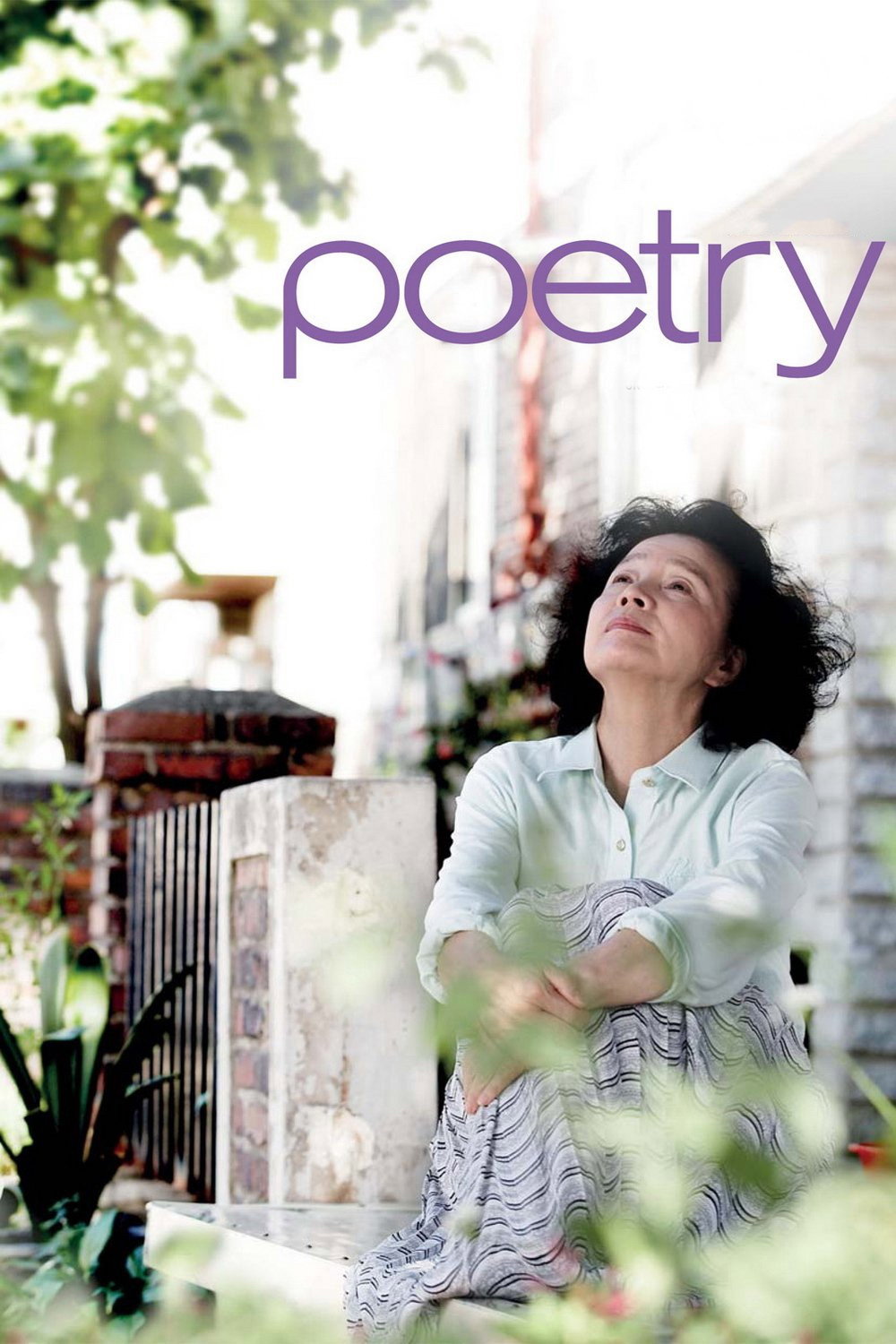
The film uses a grandmother's poetry class and emerging Alzheimer's as a lens for a social critique of patriarchal self-absorption. It builds to a powerful, compassionate conclusion that elevates the story to near-greatness through its lead performance.
The critic praises this mysterious and beautiful film as a remarkable Korean meditation on life, death and memories. They single out the way the protagonist refines her consciousness and makes sense of her life in the shadow of death and Alzheimer's.
The critic praises the film's quietly devastating humanism and its emphasis on truly seeing the world, as embodied in an older woman's poetry class amid personal turmoil. Yun Jung-hee's restrained yet emotionally complex performance anchors the story.
Lee Chang-dong’s Poetry is another sobering philosophical work by the South Korean auteur that contemplates an innocent’s sense of grief and guilt. The film’s beauty derives from the belief that there’s nothing more liberating than learning to speak a language of one’s own creation.
The review highlights the film's daring quietness and subtlety in exploring beauty, truth, and mortality through a grandmother's experiences. Yun Jung-hee's delicate performance and Lee Chang-dong's insightful direction are singled out for praise.
The review praises the film's ability to find solace and meaning through verse amid tragedy. It highlights the director's skill in blending personal awakening with moral complexity.
The film is a gently moving, almost Ozu-like drama about an eccentric old woman who joins a poetry class while grappling with her grandson's involvement in a school scandal and her own Alzheimer's diagnosis. It highlights the superb central performance from Yun Jeong-hie as the quietly plucky Mija.
The film poses questions about creative inspiration and making art amid tragedy through the story of a grandmother dealing with family trauma and illness. Yun Jeong-hie's meticulous central performance anchors the delicately meandering drama.
Lee Chang-dong’s quiet and unhurried film centres on a woman developing Alzheimer’s who joins a poetry class amid her grandson’s implication in a classmate’s suicide and rape scandal. It stands out for its lack of typical Korean cinema ultra-violence, making the social bleakness more impactful.
Lee Chang-dong's quietest and most thematically complete film follows a grandmother writing poetry while facing physical and mental decline and her grandson's actions. The moving lead performance by Yun Jung-hee and intelligent melodrama about a woman in a male-dominated world stand out.
The review describes a delicate film that pulls off a tricky subject with sophistication and solemnity while keeping a sharp eye on characters' foibles. It notes the veneer of politeness over Korean society coming down amid the central events.
The film is described as a deceptively gentle, quietly haunting tale with a tender ache, elevated by Yun Jung-hee's memorable performance and Lee Chang-dong's subtle intelligence. It notes the lack of sentimentality despite heavy themes and some longueurs in the poetry class scenes.
The critic finds the film's muted tone and elliptical style make for difficult viewing, though layers of meaning reward close attention. It explores the ambivalent role of art amid moral vacancy in a society marked by casual depravity.
Lee Chang-dong’s Poetry is a masterclass in weaving weighty themes with insight, compassion and humanity. It builds to a heartrending climax that is truthful and unexpected, with an achingly devastating badminton scene.
Despite dark themes of rape, suicide and Alzheimer’s, the film uses poetry as a metaphor for fully appreciating life and the present moment. The critic singles out the subtle, anchoring lead performance by Jeong-hee Yoon and the considerable emotional impact of the film’s enigmatic ending.
The film is a serene and haunting piece that drifts at the pace of its central character Mija. It contemplates the role of poetry and art in a modern society while highlighting a damning generational loss of morals.
Ordered by the weight we give each publication, then by score. Scores are normalised to 100; * means inferred from an unrated review. Summaries are ours, not quotations; follow the links for the reviews themselves. How we rate