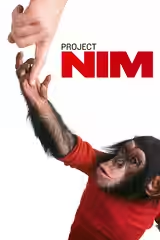
Most critics find Project Nim engrossing and upsetting, with praise clustering around James Marsh’s assembly of archival footage and candid interviews. The reviews repeatedly single out Nim’s relationships with his human carers as the source of the documentary’s emotional force. Many also value its account of human self-interest and responsibility, while several admire Marsh’s restraint in handling people whose decisions invite uncomfortable scrutiny.
The reservations concern how far that scrutiny goes. IndieWire finds the film moving but wants deeper psychological analysis of Nim’s behaviour; Slant Magazine offers the clearest dissent, arguing that sentiment and human-chimpanzee equivalence replace an examination of the experiment’s central questions. Re-enactments divide opinion too, with the Los Angeles Times finding some unsatisfactory despite praising the documentary more broadly. The spread runs from strong enthusiasm to qualified approval and one markedly cooler assessment, rather than a split over whether Nim’s story holds attention.
A
The AV Club
7 July 2011 · A- · Scott Tobias
90
Tobias finds the documentary endlessly fascinating and moving, exploring the blurred boundary between humans and animals. He praises its use of interviews, archival footage, and recreations to tell Nim’s story.
Read the full review →E
Empire
1 August 2011 · Dan Jolin
88*
The critic finds the documentary fascinating, sobering and deeply upsetting, and condemns the experiment’s treatment of Nim. He praises its compelling portrayal of the relationships Nim formed with the humans around him.
Read the full review →H
The Hollywood Reporter
21 January 2011 · festival review · David Rooney
85*
Rooney finds the documentary unsettling yet enthralling, praising Marsh’s craftsmanship and even-handed perspective. He singles out its candid interviews and skillful assembly of archival material for giving the story emotional and psychological depth.
Read the full review →I
IndieWire
21 January 2011 · B+ · Eric Kohn
83
Kohn finds the documentary moving but says it avoids deeper psychological analysis of Nim’s behavior. He praises the scenes showing Nim’s bond with Bob Ingersoll, where Nim is treated on his own terms.
Read the full review →L
Little White Lies
12 August 2011 · 4/4/4 · Martyn Conterio
80
Conterio considers it one of the year’s best documentaries, while noting that it feels too short. He praises Marsh’s deft handling of complex issues and the film’s detached, non-judgmental approach.
Read the full review →L
Los Angeles Times
15 July 2011 · Kenneth Turan
80*
Turan finds the documentary engrossing and eye-opening, showing how Nim’s story exposed human self-interest as much as it explored chimpanzee communication. He praises Marsh’s candid interviews and effective use of archival footage, while noting occasional unsatisfactory re-enactments.
Read the full review →V
Variety
21 January 2011 · festival review · Peter Debruge
80*
Debruge finds the documentary provocative, surprisingly emotional, and compelling as human drama. He praises Marsh’s sensitive, revealing account of Nim’s changing human guardians and the questions their experiment raises.
Read the full review →G
The Guardian
11 August 2011 · Peter Bradshaw
70*
Bradshaw calls the documentary gripping, while arguing it exposes the human participants’ failings. He praises the chimp’s presence but wishes the film explored the experiment’s collapse more fully.
Read the full review →F
Film Comment
· Chris Norris
64*
The available page identifies Chris Norris’s piece on Project Nim but does not reveal the critic’s verdict. It also provides no information about what the critic praises or complains about.
Read the full review →S
Screen Daily
21 January 2011 · Anthony Kaufman
64*
The accessible page identifies this as a review, but its critical verdict is hidden behind the access prompt. No praise or complaint is visible in the provided text.
Read the full review →N
The New York Times
8 July 2011
64*
The page could not be accessed, so the critic's verdict is unavailable. No specific element can be identified as praised or criticized.
Read the full review →S
Slant Magazine
3 July 2011 · ★★/4 · Andrew Schenker
50
Schenker argues that the documentary trades complex analysis for easy sentiment. He criticizes its reliance on human-chimpanzee equivalence to stir outrage rather than probing the experiment’s central questions.
Read the full review →C
Collider
8 July 2011 · A · Matt Goldberg
95
Goldberg calls the documentary captivating and one of the year’s best, while raising difficult questions about humanity and animal experimentation. He especially praises James Marsh’s exploration of Nim’s unpredictable duality through reenactments, interviews, and archival footage.
Read the full review →P
Paste
11 July 2011 · Michael Dunaway
85*
Dunaway finds the documentary fascinating, technically accomplished, and ultimately a powerful cautionary tale about human responsibility. He praises its use of archival footage, recreations, visual motifs, and score to tell Nim’s heartbreaking story.
Read the full review →/
/Film
21 January 2011 · festival review · David Chen
75*
Chen finds Project Nim a heartbreaking, compelling film, though it does not reach the heights of Man on Wire. He praises the wealth of archival material and singles out Nim’s interactions with people as moments of magic.
Read the full review →N
NME
11 August 2011 · Owen Nicholls
75*
The critic calls the documentary riveting and says Nim’s story is touching, while cautioning against wanting to take him home. The film is especially effective in exposing the human personalities and anthropomorphic assumptions surrounding Nim.
Read the full review →The critic finds the documentary fascinating and profoundly sad, while praising how deftly it brings Nim’s story to life. The archival footage and interviews with people who raised and studied him are singled out as particular strengths.
Read the full review →Ordered by the weight we give each publication, then by score. Scores are normalised to 100; * means inferred from an unrated review. Summaries are ours, not quotations; follow the links for the reviews themselves. How we rate