James Marsh makes a compelling, deeply upsetting documentary from archive footage and candid human testimony. It deserves attention for the relationships it records, though its questions about chimpanzee communication receive less care than its account of human responsibility.
James Marsh approaches Project Nim through the people who believed they could learn something from a chimpanzee, and the relationships that belief brought about. It is an absorbing, distressing documentary, worth seeing for its patient attention to how people explain their own conduct. The experiment in chimpanzee communication gives those explanations a purpose: the humans want to establish what the animal can tell them. The archive footage leaves us watching how they behave towards him.
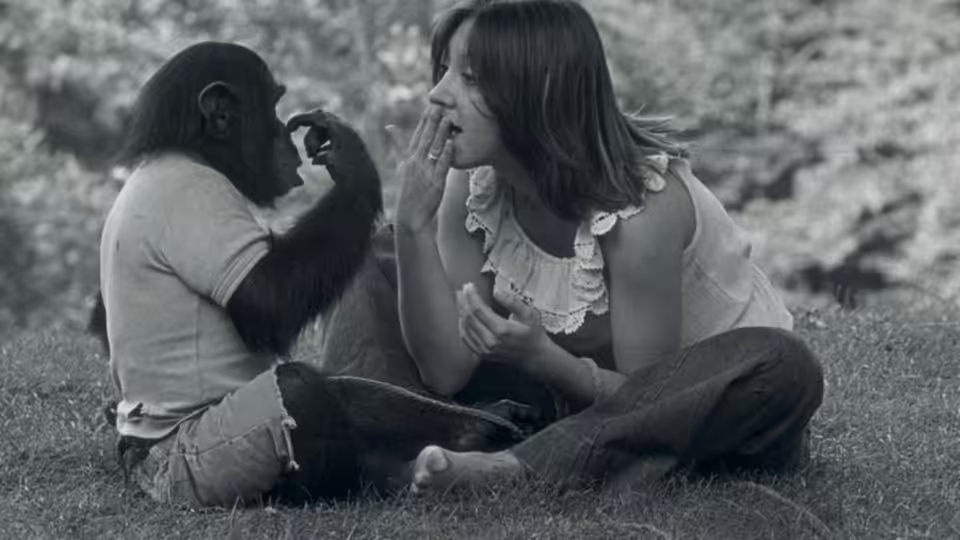
The chief strength is the footage of Nim Chimpsky in contact with humans. These encounters let affection look ordinary, rather than reserving it for a specially prepared emotional moment. We were upset by those interactions, because the apparent trust makes the humans’ responsibilities difficult to evade. Their interview accounts can be candid without settling the question of whether they understood the animal they were dealing with. He holds our attention even when the people have more to say.
Jinx Godfrey’s editing brings the interviews and archive material together so that we can compare what people remember with the behaviour recorded. The film’s 93 minutes pass quickly, with enough room for different accounts to complicate our response. Michael Simmonds’s cinematography is most effective in the interviews, keeping our attention on the people doing the remembering. There is little need to tell us whom to distrust; hearing an explanation and watching the person offer it can do the work.
Not all the reconstruction earns its place. Markus Kirschner’s production design gives the recreations convincing surroundings, but those passages offer less to examine than the archive footage. However carefully an event has been restaged, it cannot let us study an unplanned exchange between a chimpanzee and a person. Dickon Hinchliffe’s music is effective at sustaining unease, though at points its emotional guidance feels unnecessary. The recorded encounters already give us enough to feel.
More frustrating is the limited examination of what the experiment could actually establish. We get a vivid sense of human attachment and self-interest, but less help in thinking through chimpanzee behaviour or the limits of communication. James Marsh is so effective at making us care about his subject that sympathy sometimes seems to settle questions the film has barely examined. The interviews could use more pressure on that point. More time spent considering what the experiment taught its participants would have helped.
This is a familiar difficulty for documentaries built around testimony: the people available to talk can end up determining what gets asked. Here, their candour is valuable, and the film does not need to make them uniformly callous to expose the consequences of their choices. Affection can coexist with poor judgement, and the archive material gives us reason to take both seriously. The participants are allowed to explain themselves at length, which often makes their accounts more troubling.
See it for the archive footage and the uncomfortable candour of the interviews, with the caveat that this is no thorough account of animal language. Its occasional insistence on making us sad is worth tolerating for the encounters it preserves. We would leave some time afterwards before attempting anything cheerful.