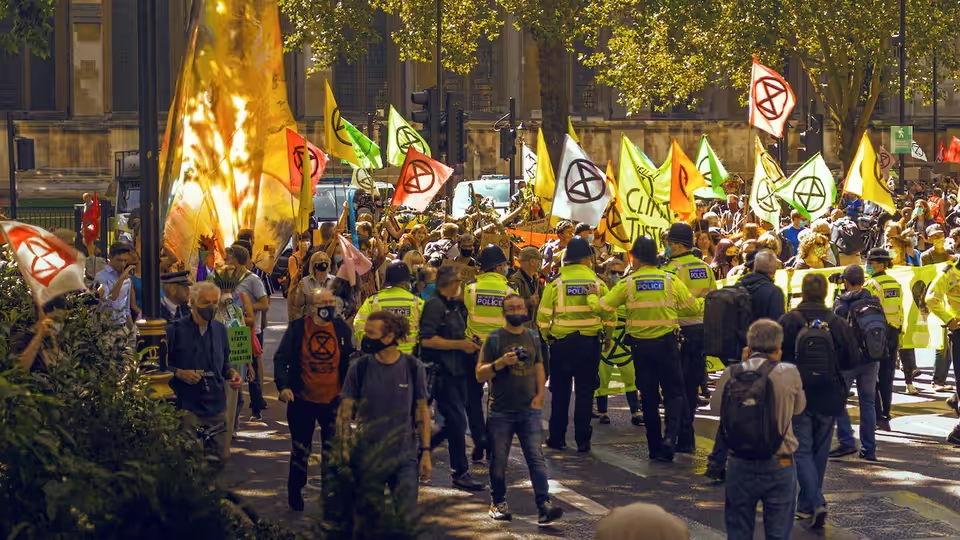
Police officers face a crowd of protesters carrying flags and banners along a city street
Film review

Rebellion

2023 · Directed by Maia Kenworthy, Elena Sánchez Bellot · 1h 32m

In a sentenceA shared concern for the climate does not seem to make the arguments any shorter

Climate activists in the UK pursue change through direct action, while disputes within their own movement complicate the work. Rebellion follows individual campaigners through their personal stories and their disagreements with one another. The people involved share a cause, but the business of acting together brings friction of its own. Directors Maia Kenworthy and Elena Sánchez Bellot, working with producer Kat Mansoor, keep close to the activists, placing their experiences alongside the public campaigning. The documentary follows the effort to make collective action work through the people taking part in it.

Plays from YouTube when you press play; nothing loads from them until then.

Fi1m review

This absorbing but selective documentary is worth seeing for its personal stories and the friction between UK climate activists. Maia Kenworthy and Elena Sánchez Bellot are less persuasive when those encounters have to explain the movement.

Rebellion is an engaging, frustrating documentary, worth an evening for anyone interested in the practical difficulties of climate activism. Directors Maia Kenworthy and Elena Sánchez Bellot get close to UK campaigners and find plenty of friction within a shared cause. They make the individuals interesting enough to sustain our attention across 92 minutes. The difficulty is knowing how much of the movement we are seeing, and how much depends on the people the film has chosen to follow.

Direct action gives the film something visible to follow, a useful starting point for a subject that can easily become a sequence of opinions. The personal accounts give us a reason to stay with it. Maia Kenworthy and Elena Sánchez Bellot resist the temptation to make agreement with the activists a condition of finding them interesting. The close footage allows their disagreements to become part of our understanding of them. We get a sense of how demanding it is to keep acting alongside other people.

We found the bickering wearing, precisely because the personal stories had already given us reasons to care about these campaigners. Those disputes make the task of working together look exhausting, and the film is right to give them space. A tidier account would be easier company but less useful to anyone wondering what participation actually involves. The difficulty is that an argument can hold our attention without helping us understand much. At times the film relies too heavily on the fact that people are disagreeing.

The directors’ closeness to their subjects is valuable, especially when it prevents the activists from becoming anonymous representatives of a cause. That access also gives the selection of participants particular importance. Significant figures are absent, leaving a partial account that the intimate footage cannot fill out on its own. We need more help understanding how representative these people and their disputes are. Without it, the emphasis on internal friction risks giving the most watchable material more weight than it should carry.

A campaigning documentary does not have to provide an opposing speaker every time an activist makes a point. It can choose its company and concentrate on what that company reveals. Once the disagreements become central, though, the film needs to establish enough of the wider picture for us to judge them. Here the personal material is more persuasive than the account of the movement. The problem lies in how the encounters have been selected and presented, not in the decision to take the campaigners seriously.

There is enough here to reward viewers interested in the people behind direct action, with a clear caveat about its scope. Its willingness to include awkwardness gives the participants more life than a purely approving portrait would. The individual stories survive the frustration of the disputes, and they are the reason we would recommend it to the curious. For a broader understanding of UK climate activism, leave room for another account.
Critical consensus AI synthesised

2 of 6
Positive
1
Mixed
1
Negative
0
Little White Lies
15 March 2022 · 3/4/2 · Adam Solomons
80

The critic finds the documentary disappointing despite its gripping personal stories. They praise its intimate footage but fault it for omitting key figures and shaping a selective narrative.

Read the full review →
Time Out
16 March 2022 · ★★★ · Chris Waywell
60

The review finds the documentary engaging and enraging, with plenty of direct action and bickering. It highlights the disputes among UK climate activists as a central feature.

Read the full review →

Straight answers AI written, from our review

Is Rebellion worth watching?
Rebellion is worth watching for those interested in the practical difficulties of climate activism, and we score it 67 out of 100. We find its personal stories absorbing, but the emphasis on internal disputes grows wearing, and its selective view of the campaigners makes it less useful as a broader account of the movement.
How long is Rebellion, and what is it rated?
Rebellion runs 1h 32m. It is a documentary film.
Where can I watch Rebellion in Finland?
Rebellion is not on any streaming or rental service in Finland at the moment. It is available in 6 other countries; change your country at the top of the page to see where. Availability is checked daily.
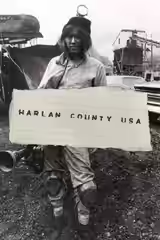
How does Rebellion compare to Harlan County U.S.A.?
Rebellion is the more useful choice for watching campaigners disagree, but we recommend Harlan County U.S.A. more strongly for its account of collective struggle’s daily cost. The miners and their families give the earlier film a concrete focus; its limitation is its reluctance to question its own side, while Rebellion shows friction without sufficiently explaining how representative it is.

If you liked this, try…

  1. Harlan County U.S.A. (1976, Fi1m 88)Striking miners and their families give collective struggle a concrete daily cost.

  2. The Take (2004) · not reviewed yetArgentine workers make collective action feel difficult, necessary and rooted in daily life.

  3. How to Change the World (2015) · not reviewed yetEnvironmental campaigning seen through personalities, tactical disputes and the difficulty of staying together.

  4. 120 BPM (Beats per Minute) (2017) · not reviewed yetFrench activists argue over tactics while the reasons for acting remain painfully immediate.

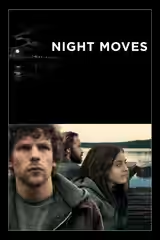
  5. Night Moves (2013) · not reviewed yetA quieter fictional treatment of environmental direct action, uneasy about certainty and commitment.