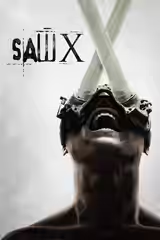
Most critics treat Saw X as the franchise’s best outing in years, and nearly all of them credit the same thing: Tobin Bell, given the lead for the first time, playing John Kramer as a grounded control freak with a dry sense of humour. The reviews also welcome the stripped-back structure, a single linear story with a smaller cast and traps aimed at people the film has taken care to make hateful. Reservations gather around length and the third act, which several find drawn out or contrived, and around the loss of the puzzle-box surprises of the early entries. The spread is wide. Den of Geek argues that making Kramer the hero inverts the series’ moral compass and asks the audience to enjoy the suffering. Slant finds the promised deeper study of Amanda never arrives, though it rates Shawnee Smith. Empire and The Guardian simply find it tired, a relic dressed up as a comeback.
L
Little White Lies
28 September 2023 · 3/4/3 · Hannah Strong
80
The critic praises Tobin Bell's return and the gutsy gore with some good gags, calling it a bloody fun time overall. It notes the film fizzles in the third act and feels indulgent due to its long runtime.
The film corrects many franchise issues by limiting scope and centering Tobin Bell and Shawnee Smith, who deliver their best performances. It features more fitting punishments and returns John Kramer to his core mission of teaching lessons about life.
The critic praises Tobin Bell’s commanding performance and the film’s healthy sense of humor as reasons for fans to return. It positions the linear story and more personal traps as making this the most satisfying Saw installment since the early entries.
The movie sheds excess from the tired series and returns to gory glory with Tobin Bell's compelling performance. It has fun subverting expectations before delivering better-than-passable traps and vengeance.
The critic finds Saw X a welcome return to form that treats John Kramer as an anti-hero protagonist and restores playful mischief missing from recent entries. Bell's grounded, control-freak performance is singled out as the main reason the approach succeeds.
Saw X delivers the series' signature disgusting traps and self-serious yet knowingly absurd plot, making it appealing trash for fans. Director Kevin Greutert builds out the betrayal arc for John Kramer with more coherence and less frenetic editing than prior entries.
Saw X comes closer to being a real movie with a unified plot and Tobin Bell dominating as John Kramer in a full-scale performance. The increased focus on talking and moral hand-wringing over pure torturing is a mixed development for the franchise.
The review praises the stripped-back basics and inventive torment in this revenge thriller taken to extremes, while noting the gruesome effects may put viewers off certain foods.
The review notes that the film delivers the expected gore but feels tired and unoriginal apart from giving Tobin Bell's Jigsaw centre stage. It criticises the way the story increasingly portrays the character as a righteous hero.
The critic finds the film drawn out with no sense of mystery or surprise, despite solid gore and Tobin Bell's performance as John Kramer. It feels like fan service without the puzzle-box pleasures of earlier entries.
The critic concludes that Bell's return is not enough to revive the series and that the film retreats to familiar basement territory. Elaborate traps are staged with ghoulish skill but the surrounding scenes are criticised as talky, dreary and overly sentimental.
The critic finds the film unable to deliver on its promise of deeper character study or meaningful expansion for Amanda, though it offers some pathos in Jigsaw’s revenge and strong work from Shawnee Smith. It notes the highlight is Amanda’s embodied desperation amid otherwise thin material.
The critic describes the film as a plodding yet suspenseful and gleefully perverse sequel in which Tobin Bell commits fully to the role of Jigsaw. The review highlights the director’s third entry in the series as agonizing but notes its personal touch in the traps and story.
The critic finds little of worth in this return to the franchise, noting it is somewhat better than the lowest points but ultimately a relic with poorly acted silliness and no justification for revisiting the series.
The critic calls the tenth instalment ever so fun, noting it has not run out of steam with black humour and inventive traps despite the familiar formula.
The critic calls it the strongest and most effective Saw sequel, praising the throwback to lo-fi traps, the focus on John Kramer and Amanda's relationship, and fresh blood injected into the franchise while noting some issues with pacing and the twist.
The critic praises the film as an uncomplicated return to basics that works well despite some reliance on the past. It singles out the simplicity and focus on Jigsaw, death traps, and a sense of purpose for delivering the series' core appeal.
The critic praises the film's straightforward, linear narrative and Tobin Bell's strong central performance as Jigsaw but notes it lacks the wild, chaotic energy of earlier entries.
The critic calls it one of the franchise's best entries and a major success for dedicated fans, crediting the decision to center Tobin Bell's John Kramer as the lead for the first time.
The critic notes that Saw X delivers the expected intense, viscous and violent horror with inventive traps and strong iconography, including Billy the Puppet and Tobin Bell's performance, but is nothing revolutionary.
The critic finds Saw X a surprising highlight of the franchise that is more engaging, funny, and entertaining than expected, with strong character focus and twists, though it wavers in the final third with some contrivances.
The critic argues that centering John Kramer as the hero inverts the franchise's moral compass by making the victims clearly deserving of punishment, which invites the audience to enjoy the suffering and aligns viewers with the torturers.
The review hails the film as potentially the franchise's best, singling out its inventive and bloody traps along with a fun revenge-flick tone while critiquing some forced emotional moments.
Ordered by the weight we give each publication, then by score. Scores are normalised to 100; * means inferred from an unrated review. Summaries are ours, not quotations; follow the links for the reviews themselves. How we rate